
Laleham Gap School
Safeguarding Procedures for Managing Allegations Against Staff withing Schools and Education Services (including Low-Level Concerns) - LGS06
Date: November 2026
Review Date: September 2028 (or as local procedures are updated)
This policy is aligned to Keeping Children Safe in Education (KCSIE) and Working Together to Safeguard Children (WTSC)
Safeguarding Procedures
Managing Allegations Against Staff
Laleham Gap – A Unicef Rights Respecting School
Laleham Gap is a Unicef Rights Respecting School. We learn, teach and live the United Nations Convention on the Rights of the Child (UNCRC).
We believe the following articles underpin our school ethos and support decisions surrounding managing allegations against staff:
- Article 3: The best interests of the child must be a top priority in all decisions and actions that affect children.
- Article 19: Government must do all they can to ensure that children are protected from all forms of violence, abuse, neglect and bad treatment by their parents or anyone else who looks after them.
- Article 39: Governments must protect children from all forms of abuse and sexual exploitation.
Laleham Gap also observes other key legislation and international agreements, including The Human Rights Act 1998, The Equality Act 2010 and The Public Sector Equality Duty (PSED) highlighted in KCSIE.
1. Introduction
This document includes Laleham Gap School’s adaptation of the KCC guidance ‘Safeguarding Procedures for Managing Allegations Against Staff in Schools and Education Services’. The school has retained the local guidance as its basis and made amendments to reflect changes in local arrangements and information published through KCC’s online resources.
The school will review this document at least every two years, or sooner when KCC publishes an updated version of the local guidance.
In Kent, the statutory Local Authority Designated Officer (LADO) function is provided by the LADO Education Safeguarding Advisory Service (LESAS). Information about LESAS, its mission statement and how to access the service is available through the following local resources:
LADO Education Safeguarding Advisory Service (LESAS) - KELSI
Local Authority Designated Officer (LADO) - Kent Safeguarding Children Multi-Agency Partnership
1.1
This policy is informed by Keeping Children Safe in Education 2026, Working Together to Safeguard Children 2026 and current Kent safeguarding procedures. It is read alongside the school’s Child Protection Policy, Staff Code of Conduct, whistleblowing arrangements, disciplinary procedure and the staff acceptable use policy.
The Education Act 2002 (Section 175) and Section 11 of the Children Act (2004) also place a statutory responsibility on local authorities and governing bodies to ensure that schools/services have procedures in place for safeguarding and promoting the welfare of children. This Procedure has been agreed by representatives of Kent Safeguarding Children Multi-Agency Partnership (KSCMP).
The local resources informing this policy include ‘Kelsi – Managing Staff Allegations’, ‘KSCMP Practice Guidance: Managing Allegations Against Members of Staff, Children’s Workforce’, the ‘Kent and Medway Safeguarding Children Partnership Procedures Manual’.
This policy retains the structure and wording of the local managing-allegations practice guidance, which KELSI identifies as currently being updated. References in the operational sections to children’s social care identify the investigating service, rather than the wider Children, Young People and Education (CYPE) directorate. Current LESAS referral arrangements and current statutory guidance must be followed where older wording differs.
1.2
Employees should also be aware of legislation under the Sexual Offences Act 2003 that makes it an offence for those in a position of trust to have a sexual relationship with a young person under the age of 18 years who is currently being cared for or educated by the individual.
Legislation issued under section 13 of the Education Act 2011 also introduced an anonymity clause for teachers who are subject of an allegation. It is now an offence for anyone to put sensitive information regarding an allegation against a teacher into the public domain prior to any charge or subsequent court appearance. Headteachers and Governing Bodies need to pay particular attention to this legislation when dealing with enquiries from parents or the media.
In relation to Disqualification, an individual may be disqualified from working in a provision for something they have done themselves, however, schools and settings are no longer required to establish whether a member of staff providing, or employed to work in, childcare is disqualified by association, unless working in a residential setting. (Disqualification under the childcare Act 2006 [2018 update]).
2. KSCMP Procedures
2.1
A copy of the KSCMP Procedures is available to any member of staff, on request, from the Headteacher or the Designated Safeguarding Lead. Headteachers and managers should ensure that all staff are aware of this and can access a copy.
This Procedure outlines the principles of child protection, definitions of abuse, powers of statutory agencies and roles and responsibilities of multi-agency staff within the children's workforce.
The KSCMP procedures can be accessed at: https://www.kscmp.org.uk/procedures/local-authority-designated-officer-lado
2.2
Employees working in Laleham Gap School have a responsibility to report all allegations of child abuse and to alert others where appropriate if they suspect that child abuse may have occurred. The specific arrangements for reporting such concerns are set out in detail in this procedure. An appropriate request for support to Kent’s Front Door Service will ensure that the statutory agencies can fulfil their child protection responsibilities.
2.3
If an allegation of abuse is made against a member of staff, a referral is to be made to the LADO function within LESAS within 24 hours, using the Kent Integrated Children’s Services Portal. This referral and or contact with the LADO service must take place prior to any form of investigation being undertaken by the school or service and before the member of staff is made aware of the allegation. Any allegation against an employee should lead to careful consideration of the possibility of abuse and of a referral being made of any concerns to the statutory agencies if it is considered that the harm threshold has been reached and a person who works with children has:
- behaved in a way that has harmed, or may have harmed a child
- possibly committed a criminal offence against or related to a child; or
- behaved towards a child or children in a way that indicates they may pose a risk of harm to children; or
- behaved or may have behaved in a way that indicates they may not be suitable to work with children.
Staff also need to be aware that if their own child/children come to the attention of the statutory agencies for child protection, then issues of transference of risk will need to be considered by the employer (as outlined in the KSCMP Guidelines). Transferable risk is not limited to staff working within the Early Years Foundation Stage (EYFS). The separate requirements relating to disqualification under the Childcare Act 2006 must also be considered where applicable.
For more information visit: https://www.kelsi.org.uk/child-protection-andsafeguarding/managing-staff-allegations
2.4
It is the responsibility of the Governing Body and the Headteacher to ensure that all employees are aware of their responsibility to report any allegation or possible concern of a child protection nature. Failure to report may (a) put a child at risk and (b) imply a breach of the employee’s contractual duty. Staff must be aware of this procedure, understand their responsibilities and know how they can access a copy of this procedure.
2.5
A child who reports that he/she may have been abused by an employee of the school, must be carefully listened to in all circumstances so that their voice is clearly recorded. Staff should only use open questions in seeking clarity and write down the child’s words, explanations and questions raised accurately. Staff should not interpret what the child is saying as this could compromise any investigation. Staff should remember to use TED (Tell, Explain, Describe) questions as outlined in LGS Child Protection Policy to help ensure these remain open questions.
2.6
Staff cannot promise confidentiality to pupils who disclose allegations. Staff should make this clear to children who approach them, whilst also offering reassurance that they have a right to be heard and that their allegation will be taken seriously.
2.7
All Laleham Gap School employees have a duty to assist the statutory child protection investigation agencies by ensuring any possible allegation or concern is reported to an appropriate person and by co-operating with any investigative process, if/when required.
2.8
Employees must be aware of the need to avoid impeding an investigation, e.g., by publicising the allegation or providing the opportunity for evidence to be obscured or destroyed. In cases where the Police or the Crown Prosecution Service have decided against a criminal prosecution, staff employed in Laleham Gap School must continue to co‑operate fully with any internal disciplinary investigation that may follow.
2.9
All risk assessments and responses to concerns undertaken as part of this procedure will be conducted in a reasonable, proportional and transparent manner. The procedure will be applied fairly and transparently in line with KCC’s Equality of Opportunity Policy and Disability Discrimination Legislation.
3. Role of the Respective Agencies in an Investigation
3.1
There are three possible types of investigation:
- By Integrated Children’s Services and the Police under Section 47 of the Children Act 1989
- By the Police under criminal law, and:
- By the school/LA in line with staff disciplinary procedures.
3.2
Any disciplinary process should be clearly separated from the child protection or criminal investigations. The disciplinary process may be informed by these other investigations and in some circumstances the child protection agencies might decide to make a recommendation about suspension or other protective action as a result of a strategy discussion. The child protection or criminal investigation has different objectives from the disciplinary procedure and the two processes should not be confused.
3.3 The Role of Integrated Children’s Services
Kent County Council’s children’s social care service has a duty to investigate cases where there is reasonable cause to believe that a child has suffered, or is likely to suffer, significant harm. On receiving a request for support relating to an allegation against a member of staff which reaches the support level guidance level 3-4, the Front Door Service (or the allocated children’s social care team where the child is already an open case) will call an initial strategy discussion meeting in line with KSCMP procedures. This meeting will define whether a joint investigation is necessary under section 47 of the Children Act 1989.
At any point during a subsequent investigation, children’s social care and the Police may agree that the investigation be terminated. This will either be because enquiries lead them to a conclusion that the child has not suffered the alleged harm or they are satisfied, where harm has occurred, that there is no likelihood of it recurring.
Such decision will be ratified at an outcome strategy meeting with recommendations for further action by the employer as appropriate. (ie conducting an internal disciplinary investigation). It is important to recognise that the purpose of the child protection investigation is to determine, on the balance of probability whether a child has suffered significant harm (abuse) and, if so, to eliminate the likelihood of further abuse.
The staff undertaking child protection investigations on behalf of Kent’s children’s social care service are trained and experienced in doing so. They will handle cases sensitively and professionally, so that a thorough, independent investigation can be undertaken.
3.4 The Role of the Police
The Vulnerable Investigation Teams (VIT) within Kent Police comprises a team of officers specialising in safeguarding children. The officers are specially selected and trained for working with vulnerable children and they will undertake most interviews with children in line with Achieving Best Evidence procedures.
In the event of an allegation being made against a member of staff, it is possible that they will be invited for interview at a police station or arrested by Kent Police. In these circumstances the member of staff should be able to access free legal advice. Normally the interview and/or arrest will not take place on school premises.
The Police are responsible for investigating allegations which indicate that a crime has been committed. The Crown Prosecution Service will then take any decision on whether to formally prosecute based on the strength of evidence and the public interest test.
3.5 The Role of the Local Authority Designated Officer
The LADO Education Safeguarding Advisory Service (LESAS) undertakes Kent’s statutory LADO function and is responsible for the oversight and management of allegations. Any allegation against a member of staff that may meet the harm threshold must be reported within 24 hours to the LADO function within LESAS through the Kent Integrated Children’s Services Portal. This referral will determine whether the allegation reaches the harm threshold to justify involvement from a LADO in the management of the allegation.
A staff conduct or safeguarding concern does not prevent schools from supporting children with safeguarding approaches. If there are concerns about the welfare of an individual child, the school/setting must make a separate request for support to the Front Door Service in accordance with local safeguarding procedures. A LADO referral does not replace this child-welfare referral. LESAS does not make decisions about child protection referrals.
The school will use the current LESAS referral and enquiry arrangements to agree the appropriate response to an allegation or concern about a member of staff, whether at the school or elsewhere in the children’s workforce.
The LADO will attend any strategy meetings that are convened and liaise closely with the school/setting to ensure that the Headteacher or representative is represented in the meetings and decision-making process. The LADO will also ensure that other key Local Authority officers are informed according to the circumstances of the case and this may include the Press Office in certain circumstances that are likely to attract media interest.
The LADO will consider separately with the school whether a referral to the Front Door Service is required for the child in their own right. Where the LADO advises that the matter can be managed internally or that a Request for Support is not required, the LADO will advise on further action that may be taken by the school/setting in investigating the matter internally in line with the staff disciplinary procedures. This will again require close liaison with the personnel provider.
For more information visit: For more information:
https://www.kscmp.org.uk/procedures/local-authority designated-officer-lado
3.6 The Role of the School
The school has a duty to co-operate fully with an investigation undertaken by the Police and children’s social care under section 47 of the Children Act 1989 and a LADO will provide support throughout this process. School staff have a key role in reassuring and supporting the child who is the alleged victim. Employers also have a duty of care to the member of staff who is the subject of the allegation and support will be facilitated in line with the staff disciplinary process.
The task of investigating the allegation under disciplinary procedures is set out below and is separate from the investigations conducted by children’s social care and the Police.
Under no circumstances should the school initiate an internal management investigation into an allegation against a member of staff until contact has taken place with the County LADO Service. Internal management investigations should only be pursued once the Police and or children’s social care have concluded their involvement.
In exceptional circumstances it may be possible for a criminal investigation and an internal investigation to run concurrently but this should only be in the most severe of cases after discussion with the Police to ensure that primary evidence is not compromised. This matter is more straightforward when the member of staff has pleaded guilty to an offence.
The school or setting has a statutory duty to comply with Child Protection Procedures and this will include ensuring that all staff are familiar with the process and understand their responsibilities to report a safeguarding concern.
4. Reporting an Allegation or a Concern
4.1
When an allegation of abuse is made against an employee on behalf of a child there should be immediate consideration of whether a child or children is/are at risk of significant harm and in need of protection.
4.2
Any employee who becomes aware of a possible allegation, breach of position of trust and or professional conduct issue must take immediate steps to ensure the matter is reported to the Headteacher. If the Headteacher is unavailable, the matter should be reported immediately to the Lead DSL or Chair of Governors; Individuals with concerns must be encouraged to report this as quickly as possible and to the most senior person available at the time. An investigation may be impeded if a concern is reported late and/or is communicated through several individuals before Headteacher, and it is important that the school establishes at this stage who the lead contact will be for liaison purposes.
4.3
Should the allegation or concern involve the Headteacher then the matter must be reported to the Chair of Governors. The LADO Education Safeguarding Advisory Service (LESAS) can also provide advice and support to Chairs of Governors when an allegation has been made against the Headteacher.
4.4
In all cases, the Headteacher (or Chair of Governors where the concern relates to the Headteacher) must refer to the LADO within 24 hours about the allegation or concern, who will advise on further action in accordance with this procedure as appropriate.
This is not the beginning of an investigation, but part of the basic information gathering process. This advice will include who should be made aware that an allegation or concern has been raised.
If there is doubt about whether a LADO referral is required, advice must be sought promptly through the LESAS enquiry service.
4.5
The reporting member of staff e.g. the Headteacher or Lead DSL must also seek the advice of their Personnel Services Provider regarding issues of process, responsibilities and communication.
4.6
It is important that the member of staff reporting the concern acts quickly. Establishing whether an allegation warrants further investigation or consultation is not the same as forming a view on whether the allegation is to be believed. The Headteacher or any other employee or governor to whom an allegation has been reported, is not expected to investigate the allegation, or interview pupils, but to assess, after consultation with the LADO how the matter will proceed. Confidentiality must be maintained throughout this stage in order that any subsequent investigation is not prejudiced and that the interests of all parties are protected.
4.7
Where the allegation relates to the use of physical intervention to restrain a pupil (Section 93 of the Education and Inspections Act 2006 enables school staff to use such force as is reasonable to keep a situation safe), the Headteacher/Head of Service should refer to the County LADO Service as in all other cases and a subsequent discussion will be held about whether this may be appropriately managed within the school.
5. Considering Whether Suspension is Appropriate
5.1
The suspension of an employee, particularly in situations of potential child protection allegations will have a significant impact on the individual and therefore it is essential that the facts of the case, as they are known, and alternative courses of action are carefully considered in deciding whether to suspend. The specific arrangements for the suspension of staff are set out in the school’s LGS58 Discipline and Conduct Policy, but it should be recognised that suspension is a neutral act to protect the interests of both parties and not an assumption of guilt. It is also essential that the Disciplinary Procedures are followed in terms of providing appropriate support to the individual throughout the period of suspension.
5.2
The decision to suspend is taken by the Headteacher and/or the Governing Body and not by the Police, children’s social care or LADO. However, Social Care, in collaboration with other agencies, may advise the Directorate and the school of any action recommended to ensure the protection of children, protection of employees and safeguarding of information.
5.3
In the event of the suspended member of staff living in school accommodation on site, then alternative arrangements will need to be negotiated in the best interests of the children, the school and the member of staff concerned. Settings need to consider whether their tenancy agreements would allow a requirement for a member of staff to seek new accommodation while an allegation is being investigated.
5.4
Being suspended or asked to refrain from work can give rise to great anxiety for the individual subject to the allegations. They may fear that colleagues and others within the school/community will have interpreted the very act of suspension as an indicator of presumed guilt from an early stage and may feel particularly isolated and vulnerable.
5.5
Any member of staff subject to an allegation should be encouraged to seek advice and support at the earliest opportunity from their professional association or trade union. It must also be acknowledged that the whole school/community may be affected by a staff member’s suspension, and consideration should be given to necessary support strategies to address this.
5.6
The need for support is equally applicable when considering a staff member’s return to work. Suspension should be retained for as short a length of time as possible and if it is agreed a staff member is to return to school, careful planning needs to take place as to how this situation can be managed as sensitively as possible.
5.7 Initial considerations
It may not be immediately obvious that suspension should be considered, and this course of action sometimes only becomes clear after information is shared with, and discussion had, with other agencies.
In some cases, early or immediate suspension may impede a Police investigation, and therefore the decision whether to suspend may have to be delayed until sufficient evidence has been gathered. Suspension should be avoided in such cases wherever possible and should not be seen as an automatic response to an allegation. This applies to the possible suspension of Headteachers as well as other staff. Suspension should only follow discussion with the LADO. The decision to suspend remains the responsibility of the Headteacher or Governing Body.
When considering suspension, it is important to have regard to the following factors:
- The nature of the allegation
- Assessment of the presenting risk
- The context in which the allegation occurred
- The individual’s contact with children
- Any other relevant information
- The power to suspend
- Alternatives to suspension
Suspension should only be applied if one or more of the following grounds apply:
- A child or children would be at risk
- The allegation is so serious that summary dismissal for gross misconduct is possible
- It is necessary to allow any investigation to continue unimpeded
5.8 Alternatives to suspension
While weighing the factors as to whether suspension is necessary, available alternatives to suspension should be considered. This may be achieved by:
- Leave of absence
- Undertaking different duties which do not involve direct contact with the individual child or other children
- Providing a classroom assistant or other colleague to be present throughout contact time.
If the member of staff is not based in a school, then an alternative may be to:
- Undertake office duty
- Undertake non-contact tasks only
5.9 Action Plan
The Children Act 1989 established the principle that the interests of the child are paramount. This, however, must be considered alongside the duty of care to staff. Any individual subject to allegations should, regardless of the decision to suspend or otherwise, be offered welfare support. Where possible, a means of monitoring the take up and effectiveness of welfare support without compromising confidentiality or trust should be sought. Where suspension is being considered, the duty of care requires the Headteacher to ensure that appropriate support is available to the member of staff. In the case of an allegation against the Headteacher, this responsibility lies with the Chair of Governors (or nominated Chair). Agreement must be reached with education personnel (and police where appropriate) as to how information will be shared and contact maintained with the member of staff throughout the investigative process. This should include agreement as to:
- How the member of staff will be kept updated about the progress of the investigation,
- How support and counselling are to be offered: and
- How links will be maintained with the school so that the staff member is kept informed of other matters occurring within the school.
5.10 Confidentiality
The Headteacher, Chair of Governors (or nominated governor) and Local Authority officers have a responsibility to safeguard confidentiality as far as is possible. Sensitive information must only be disclosed on a need to know basis with other professionals involved in the investigative process. Other people may become aware of the allegation and may not feel bound to maintain confidentiality. Therefore, consideration should be given on how best to manage information, particularly in relation to who should be told what, when and how. This is particularly relevant in respect of parents, carers and the media in light of new legislation and the anonymity clause (referenced in 1.4).
5.11 Planning and Recording
It is essential to record the decisions reached and the rationale behind them. Records should also be made of the agreed action and strategies to manage the situation. The plan should clearly indicate the following:
- Any restrictions to normal contact or activity,
- Issues of contact with children,
- Arrangements for monitoring and welfare support in relation to the member of staff.
- Monitoring the support available for the child.
It is important for the LADO to keep a record of the actions taken in the course of the investigation and, where relevant, the process and conclusion of suspension is undertaken as quickly and fairly as possible. If individuals have specific tasks or responsibilities to carry out, this should be noted and followed up. Agreed strategies for managing and sharing information should be included here. In addition, the member of staff should be informed of the decisions taken at the earliest opportunity by the employer.
6. Disciplinary Investigation
6.1
No action under the disciplinary procedure should be taken in circumstances which might interfere with the criminal investigation. Child protection and criminal investigations shall be treated as paramount and any further action under disciplinary procedures may therefore have to await full completion of the child protection and criminal investigations but will be undertaken as soon as possible.
6.2
Once any child protection investigation has been completed and the matter is not proceeding to court, a decision should be taken by the appropriate person in the school/setting, as whether to investigate under the disciplinary procedures. The school/setting will need to consult with its Personnel Provider prior to reaching a decision on this.
6.3
At the request of the Governing Body/Proprietor, a nominated representative may be appointed to conduct the investigation where it is inappropriate for the Headteacher/Head of Service or other member of the school’s leadership group to do so, e.g., where the Headteacher/Head of Service knowledge might prejudice a fair hearing, where he/she is implicated or when the Governing Body believes it is in the best interests of the school.
6.4
Following the internal investigation the employer needs to come to a reasonably held view ‘on the balance of probability’. The disciplinary investigation must gather evidence objectively establishing the facts where possible and follow the principles of fairness, reasonableness and natural justice.
6.5
Where allegations of child abuse are received against an employee at the school, the LADO will take responsibility for ensuring that relevant information, as defined by children’s social care and or Police, resulting from a child protection investigation is made available to the Headteacher/Head of Service, in order to inform a decision about a possible disciplinary investigation.
6.6
Evidence derived from the child protection investigation or criminal investigation (e.g., statements, exhibits, video-recorded interviews with children) can be requested for use in subsequent disciplinary proceedings, particularly where the witnesses are the same, via relevant legal departments. (It should be noted that the Branch Crown Prosecutor will be cautious about releasing any prosecution material until the criminal proceedings have been concluded and will only consider doing so upon a valid request being made in writing.)
6.7
Where no criminal prosecution is pending or intended, advice from the Kent Police Solicitor’s Department on the release of material should be sought through the LADO who has established a protocol with the Kent Police on behalf of the LA to ease this process. Witnesses may include Police Officers and social workers who have interviewed the child/ren. Children’s social care should usually release the minutes of strategy meetings and, where necessary, provide additional reports.
6.8
Whether it is appropriate to call children as witnesses will depend on their age, understanding and capability. However, the attendance of children at any hearing would be in extremely unusual circumstances and will only occur following careful consultation with all interested parties including the parents of the child/ren.
6.9
If a decision is taken to proceed with a disciplinary investigation, the employee should be informed, in writing, as required under the disciplinary procedure. It is advisable to confirm this position in a meeting with the employee and their representative.
6.10
If a decision is taken not to proceed with a disciplinary investigation, the employee should be invited to a meeting with a union representative or workplace colleague, to explain the circumstances of the decision and confirm this in writing.
6.11
Those involved in the investigation of the complaint or the continuing management of the situation at the school cannot hear consequent disciplinary cases, since they may receive information that may prejudice a fair hearing of the complaint. Governors who are to hear disciplinary appeals must not be involved in the investigation of the complaint or the disciplinary hearing.
6.12
The school will need to make appropriate arrangements to notify the parent/guardian of the child/ren of the outcome of the investigation/hearing and will take advice from the Personnel provider and the County LADO Service regarding the nature of information that can be disclosed.
6.13 Timescales
DfE guidance states that “the quick resolution of the allegation should be a clear priority to the benefit of all concerned. Any unnecessary delays should be eradicated.”
- If the nature of the allegation does not require formal disciplinary action, the Headteacher should institute appropriate action within 3 working days.
- If the evidence indicates that a disciplinary hearing may be required, then the process will be completed as quickly as possible and without avoidable delay within the requirements and timescales of the school’s adopted disciplinary procedure. The employee must be kept regularly informed of the progress in this event.
7. Referral to The Disclosure and Barring Service
7.1
The Secretary of State’s powers to bar or restrict a person’s employment are contained in section 142 of the Education Act 2002. The relevant regulations, setting out the procedure to be followed now sit under the Safeguarding Vulnerable Groups Act 2006 (List 99 was replaced by the ISA Barring list which in turn has now been replaced by the Disclosure and Barring Service)
A relevant employer, or agent (eg a teacher supply agency), is required to provide a report to the DBS where they cease to use a person’s services, or a person is dismissed or resigns before a disciplinary process is completed, because they are considered unsuitable to work with children, as a result of misconduct, or because of a medical condition that raises a possibility of risk to the safety or welfare of children. A compromise agreement does not override the statutory duty to report the matter and such an arrangement should not be considered if the concern was of a safeguarding nature.
These reporting arrangements apply to anyone who works in a school, including volunteers, regardless of what they do. They also apply to staff convicted of a criminal offence against children outside the work setting, when notification may be through the police.
Anyone subject to a direction under section 142 of the 2002 Act given on the grounds that they are unsuitable to work with children is also disqualified from working with children. ‘Work’ includes people in unpaid employment, employed under contract, people undertaking work experience and volunteers.
There is an additional requirement that residential special schools report such matters to Ofsted. It is the responsibility of the employing body to make this referral, and to inform the individual of its’ statutory duty to do so.
Current DBS barring and referral requirements, including who has a legal duty to refer and the conditions that must be met, are set out in Making barring referrals to DBS. These requirements must be checked when applying this section; historical references to List 99, ISA and section 142 must not be used as a substitute for the current DBS requirements.
8. Retention of Records
8.1
The Information Commissioner Code of Practice: Employment Records 2002 states that “records of allegations about workers who have been investigated and found to be without substance should not normally be retained once an investigation has been completed. There are some exceptions to this where for its own protection the employer has to keep a limited record that an allegation was received and investigated, for example where the allegation relates to abuse and the worker is employed to work with children or other vulnerable individuals.”
8.2
Records of investigations into alleged offences against children must be maintained, in order to identify patterns of concerns. A factual record of the details of all allegations and a written record of the outcome, will be retained. This information will be held by the County LADO Service in line with the responsibilities of the LADO function.
8.3
The employee and/or his/her representative will be informed that such records exist and will be able to seek disclosure within the parameters of the Data Protection Act by putting their request in writing through the appropriate channels.
8.4
Any records retained in relation to the outcome of the investigation and the member of staffs comments will be retained in line with Guidance provided by the Information Commissioners Office which states ‘Until the person has reached normal retirement age or for a period of 10 years from the date of the allegation if that is longer’. It is important to note DfE Guidance states “cases in which an allegation was proven to be false, unsubstantiated, or malicious should not be included in an employer’s reference.
8.5
Where a pupil has made an allegation, a copy of the statement or the record made of it, should be kept on the section of a pupil’s child protection file, which is not open to disclosure, together with a written record of the outcome of the investigation. If there are related criminal or civil proceedings, records may be subject to disclosure; and, therefore, no assurances can be given on confidentiality. Any allegation made by a child that is deemed to be malicious after external scrutiny should be investigated further to establish what concerns led to such a situation developing. This is in the best interests of the child and the member of staff.
9. Low-Level Concerns
Laleham Gap encourages all staff to act as critical friends, and the Senior Leadership Team expects colleagues to professionally challenge and report practice that does not fit with safeguarding guidance, or our school ethos and approaches.
Laleham Gap adopts the latest low-level concerns guidance outlined in KCSIE as well as the procedures outlined by KSCMP.
Part four of KCSIE states that ‘low-level concerns’ are allegations that do not meet the harm threshold. Part Four, Section Two states:
“Governing bodies and proprietors should have policies and processes to deal with any concerns or allegations which do not meet the harm threshold, referred to in this guidance as ‘low-level’ concerns. It is important that schools and colleges have appropriate policies and processes in place to manage and record any such concerns and take appropriate action to safeguard children.”
Staff and Governors at Laleham Gap School should understand that the term ‘low-level’ does not mean insignificant and refers to any concern that an adult has acted in a way that is inconsistent with the staff code of conduct, including inappropriate conduct outside of work and/or does not meet the allegations threshold.
Examples of such behaviour could include, but are not limited to:
- being over friendly with children
- having favourites
- taking photographs of children on their mobile phone, contrary to school policy
- engaging with a child on a one-to-one basis in a secluded area or behind a closed door, or
- humiliating children.
The recording and monitoring of low-level concerns is important to:
- identify inappropriate, problematic or concerning behaviour early
- minimise the risk of abuse, and
- ensure that adults working in or on behalf of the school are clear about professional boundaries and act within these boundaries, and in accordance with the ethos and values of the institution.
If an allegation is made against a member of staff in an education setting, it should be reported to or discussed with the Local Authority Designated Officer (LADO) as soon as possible. Where clarification is needed on whether a concern requires a LADO referral, schools should use the LESAS enquiry service. Concerns about an individual child’s welfare must be referred separately to the Front Door Service. Guidance and procedures are available via the KSCMP website: https://www.kscmp.org.uk/procedures/local-authority-designated-officer-lado
Low-level concerns at Laleham Gap will be reported to the Headteacher immediately; concerns about the Headteacher must be reported to the Chair of Governors. A written record of these concerns will be kept securely by the Headteacher, with hard copies being kept in a secure folder only accessible by SLT if required. These records must be kept confidential in line with the Data Protection Act 2018 and the UK General Data Protection Regulation (UK GDPR) and will be held until the employee retires or ceases to work at the school in line with recommendations of KCSIE Part Four, Section Two.
KCSIE Part Four, Section Two states that where low-level concerns are initially reported to the DSL (or other nominated members of staff e.g. members of SLT), they must inform the Headteacher in a timely fashion according to the particular nature of each particular low-level concern. Information about low-level concerns may also be shared appropriately with the DSL so that a more collaborative decision-making approach can be made.
Records should be able to be reviewed by relevant staff such as the Headteacher, Chair of Governors and the DSL so that potential patterns of inappropriate, problematic or concerning behaviour can be identified. Where a pattern of such behaviour is identified, the school should decide on a course of action, either through its disciplinary procedures or where a pattern of behaviour moves from a low-level concern to meeting the harm threshold, in which case it should be referred to the LADO. Consideration should also be given to whether there are wider cultural issues within the school or college that enabled the behaviour to occur and where appropriate policies could be revised, or extra training delivered to minimise the risk of it happening again.
KCSIE Part Four, Section Two states: “Low-level concerns which are shared about supply staff and contractors should be notified to their employers, so that any potential patterns of inappropriate behaviour can be identified.”
If there are any doubts that information which has been shared as a low-level concern meets the harm threshold, the LADO should be consulted immediately.
The Laleham Gap Low-Level Concerns form is available in our safeguarding folder and on the staff drive. The Low-Level Concerns Fact Sheet is also available in these locations and is pinned to the safeguarding board in the staffroom.
Further detailed guidance regarding the recording, monitoring and response to low-level concerns is available from KCSIE Part Four, Section Two of KCSIE and will be referred to as necessary. Further examples of low-level concerns and the associated risks of not identifying these can also be found at:
https://www.thesafeguardingcompany.com/resources/blog/low-level-concerns/
10. Good Practice Guidelines
10.1
All schools and settings are required to establish a Code of Practice for all staff, which considers the following areas. The Teacher Standards document (2012) provides a clear outline of expectations.
- Out of school contact with pupils.
- Physical contact with pupils.
- Personal care of pupils.
- Relationships and attitudes.
- Extra curricular activity.
- Reporting of incidents.
- Risk Assessment and lone working
- Use of e-mail and mobile phones
‘Guidance for Safer Working Practice for those working with Children and Young People in Education Settings’ (Feb 2022) (Published by the Safer Recruitment Consortium on behalf of the DfE). This document can help to inform practice and can be accessed via the https://www.saferrecruitmentconsortium.org/.
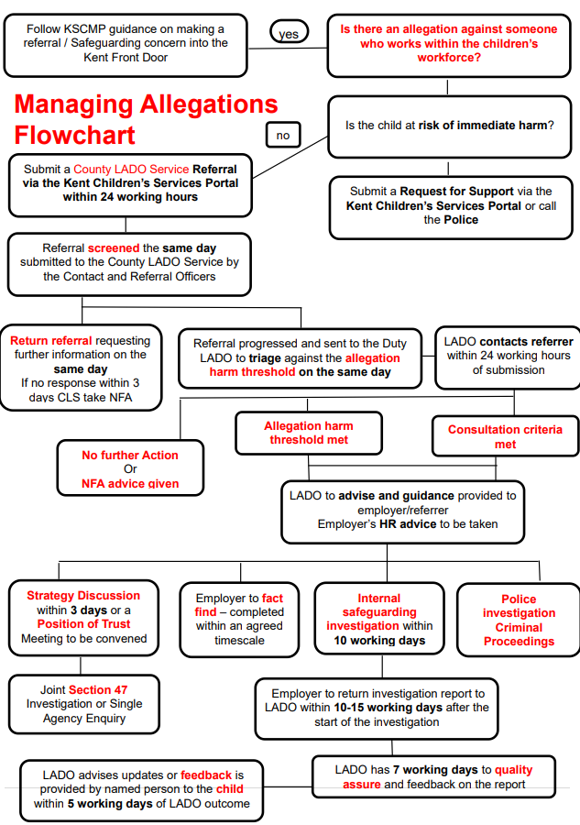
11. Procedures Flow Chart
Child Protection - Allegations Against Staff
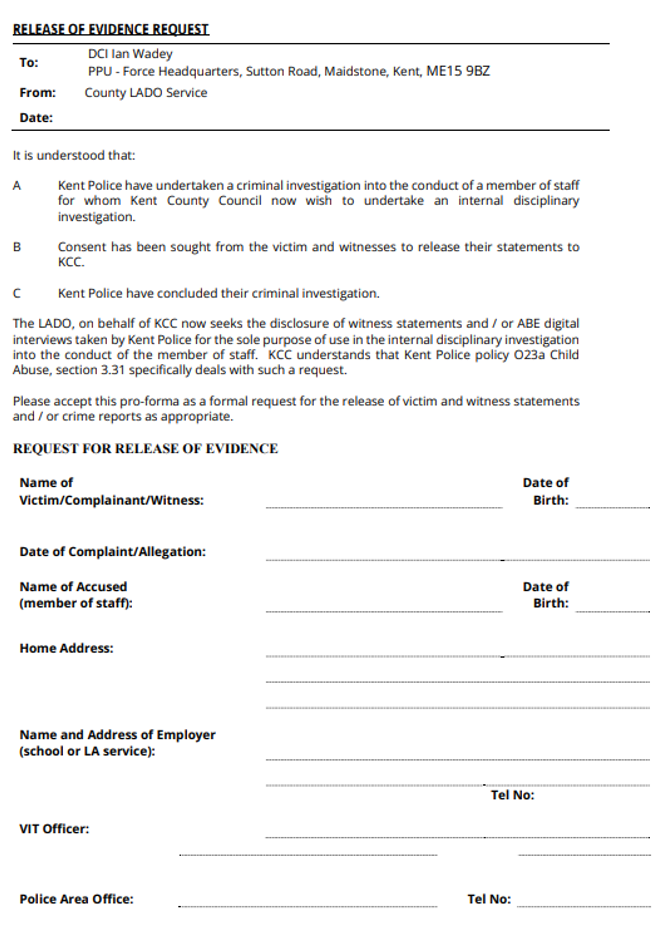
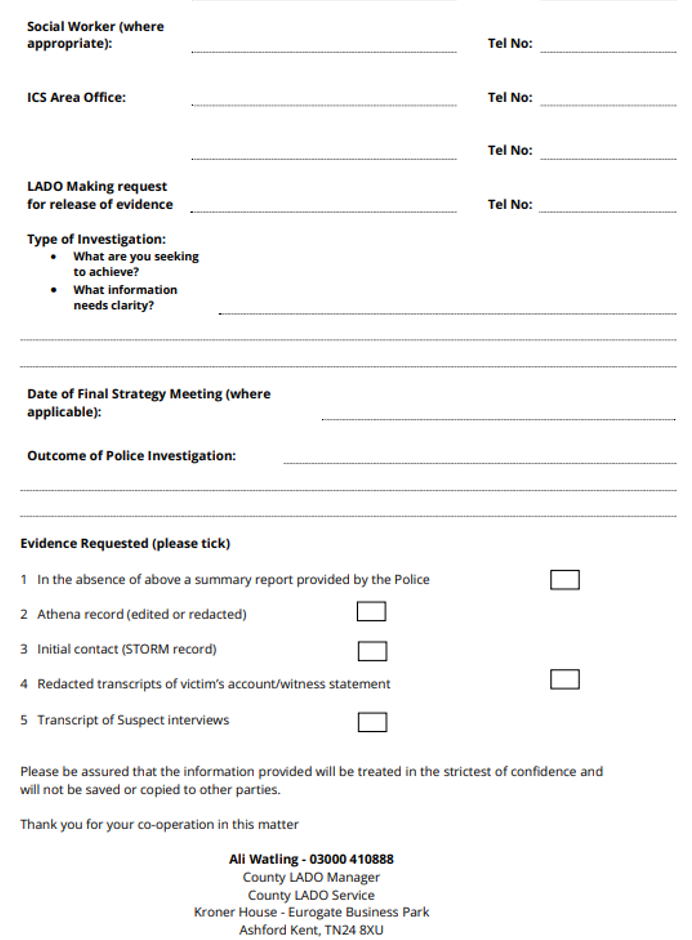
Protocol Agreed with Kent Police for the Release of Evidence
1. In line with the requirements of DfE Guidance: Working Together to Safeguard Children the local authority has agreed a protocol with Kent Police for the release of evidence to inform Internal Disciplinary processes following the conclusion of Police involvement in the case.
2. The release of such evidence is vital to inform disciplinary investigations and to avoid witnesses, particularly children, having to be interviewed again. It states within Keeping Children Safe in Education - ‘Where the police are involved, wherever possible the employer should ask the police to obtain consent from the individuals involved to share their statements and evidence for use in the employer disciplinary process. This should be done as their investigation proceeds and will enable the police to share relevant information without delay at the conclusion of their investigation or any court case’. (paragraph 392). This is agreed across the Children’s Workforce in Kent not just for Education settings.
3. To ensure that a consistent format is applied it has been agreed that all requests for the release of evidence should be channelled through the County LADO Service who provide support and guidance to settings whenever an allegation is made against a member of staff. This will avoid Kent Police being approached by a variety of schools and settings. Chairs of Governing Bodies or Personal Advisers would need to be validated before evidence is released.
4. Once the evidence has been received by the Local Authority Designated Officer (LADO) they will liaise closely with the school or setting to ensure that information is shared appropriately and no additional copies are made and that there is a clear audit line around accountability for keeping documents safe.
5. In cases where statements have been taken from children via digital recording in line with procedures for Achieving Best Evidence, a transcript of the recording prepared for court will be provided. In cases that do not proceed to court, however, it is unlikely that a transcript will have been taken. Under these circumstances it is unlikely that the video evidence will be released, as disclosures may be evident that have no bearing on the disciplinary investigation being undertaken. In such cases Kent Police have agreed to provide a summary of the evidence that is relevant to the disciplinary investigation. It is recognised that this will not constitute primary evidence, but such information from Kent Police should suffice to inform a disciplinary process where the burden of proof is based on “balance of probability”.
Information shared must be treated in the strictest of confidence and should only be made available to those involved in the disciplinary process.
|
Ali Watling County LADO Manager County LADO Service Date: August 2023 |
DCI Ian Wadley Detective Inspector PPU Kent Police Date: August 2023 |
Useful Links and Contacts
This document has been informed by key national and Local Authority legislation. Further guidance and links for managing allegations against staff can be found below.
Keeping Children Safe in Education:
Working together to Safeguard Children:
KSCMP: Practice Guidance - Managing Allegations against Members of Staff:
Safer Recruitment Consortium: Guidance for safer working practice for those working with children and young people in education settings:
KCC Guidance for Investigation:
County LADO Service Escalation Guidance:
Kent LESAS and child-welfare referral routes:
- Allegations against adults working with children: submit a LADO referral through the Kent Integrated Children’s Services Portal, accessed via KELSI – Managing staff allegations.
- Clarification about whether to make a LADO referral, or general education safeguarding advice: use the LESAS enquiry form, accessed via KELSI – LESAS.
- Concerns about an individual child’s welfare: contact the Front Door Service through the Kent Integrated Children’s Services Portal. For urgent safeguarding advice during office hours, call 03000 41 11 11.
- For urgent concerns outside office hours, call 03000 41 91 91. If a child is in immediate danger, call 999.
- https://www.kscmp.org.uk/procedures/local-authority-designated-officer-lado