
Laleham Gap School
Child Protection Policy - LGS15
Date: September 2026
Date agreed and ratified by the Governing Body: 23/09/2026
Date of next review: September 2027
This policy will be reviewed at least annually and/or following any lessons learnt and/or updates to national or local guidance and procedures
This is a core policy that forms part of the induction for all staff. It is a requirement that all members of staff have access to this policy. All staff must attend annual child protection training and understand the procedures laid out in this document.
Key Contacts
| Designation | Name | Contact Information |
| Designated Safeguarding Lead (DSL) | Joshua Payne | |
| Deputy Designated Safeguarding Lead(s) |
Rebecca Minter Stuart Clements Katie Reeves Les Milton |
rebecca.minter@lgs.kent.sch.uk |
| Headteacher | Les Milton | les.milton@lgs.kent.sch.uk |
| Safeguarding Governor | Victoria Acors | |
| Additional Staff with DSL Training |
Ruth Jones Jonathan Deslandes |
|
| Online Safety Advisor/CEOP Ambassador | Melissa Wakefield | |
| School Network Manager (filtering and Monitoring Support) | Jon Shaw |
Laleham Gap – A Unicef Rights Respecting School
Laleham Gap is a Unicef Rights Respecting School. We learn, teach and live the United Nations Convention on the Rights of the Child (UNCRC). The following articles underpin our beliefs about child protection:
- Article 1: Everyone under the age of 18 is a child and has all the rights in the Convention.
- Article 2: The Convention applies to every child without discrimination, whatever their ethnicity, gender, religion, language, abilities or other status, whatever they think or say, whatever their family background.
- Article 3: The best interests of the child must be a top priority in all decisions and actions that affect children.
- Article 6: Every child has the right to life. Governments must do all they can to ensure that children survive and develop to their full potential.
- Article 12: Every child has the right to express their views, feelings and wishes in all matters affecting them, and to have their views considered and taken seriously.
- Article 16: Every child has the right to privacy. The law should protect the child’s private, family and home life, including protecting children from unlawful attacks that harm their reputation.
- Article 19: Governments must do all they can to ensure that children are protected from all forms of violence, abuse, neglect and bad treatment by their parents or anyone else who looks after them.
- Article 20: If a child cannot be looked after by their immediate family, the government must give them special protection and assistance. This includes making sure the child is provided with alternative care that is continuous and respects the child’s culture, language and religion.
- Article 24: Every child has the right to the best possible health. Governments must provide good quality health care, clean water, nutritious food and a clean environment and education on health and wellbeing so that children can stay healthy.
- Article 25: If a child has been placed away from home for the purpose of care or protection (for example, with a foster family or in hospital), they have the right to a regular review of the treatment, the way they are cared for and their wider circumstances.
- Article 32: Governments must protect children from economic exploitation and work that is dangerous or might harm their health, development or education. • Article 33: Governments must protect children from the illegal use of drugs and from being involved in the production and distribution of drugs.
- Article 34: Governments must protect children from all forms of sexual abuse and exploitation.
- Article 36: Governments must protect children from all other forms of exploitation, for example, the exploitation of children for political activities, by the media or for medical research.
What to do if you have a welfare concern in Laleham Gap
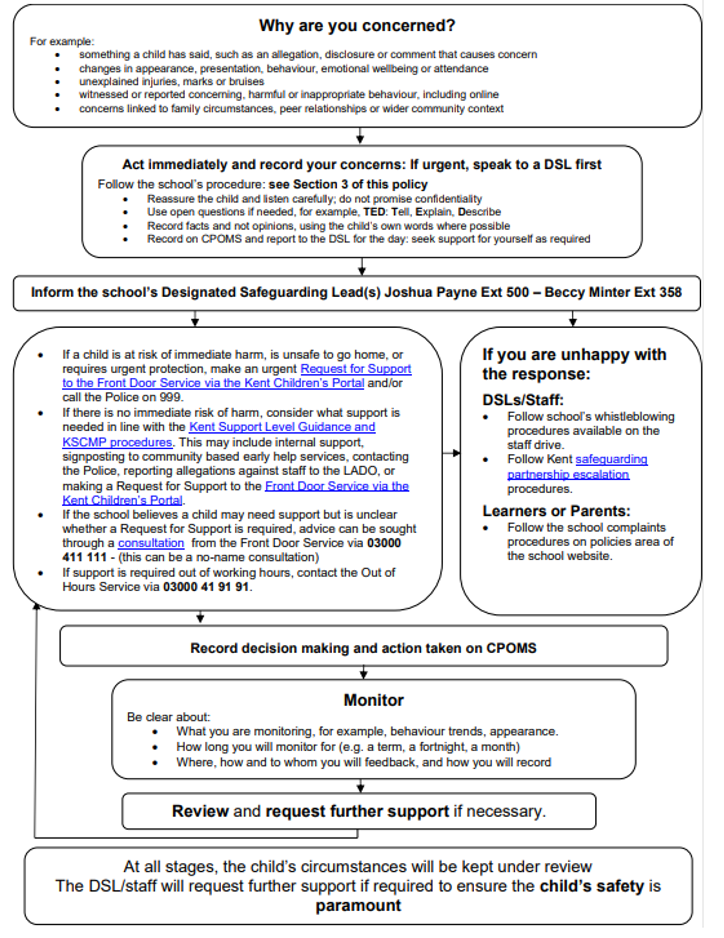
Graphic Links
- Request for Support to the Front Door Service via the Kent Children's Portal
- Kent Support Level Guidance and KSCMP Procedures
- Front Door Service via the Kent Children's Portal
- Consultation (Front Door Service)
- Safeguarding Partnership Escalation
1. Child Focused Approach to Safeguarding
1.1 Introduction
Laleham Gap School recognises its statutory responsibility to safeguard and promote the welfare of all children. Safeguarding is everybody’s responsibility and everyone has a role to play in keeping children safe. This includes staff, volunteers, governors, leaders, parents/carers, wider family networks and learners.
Laleham Gap School believes that the best interests of children always come first (UNCRC Article 3). All children, defined in law and in this policy as anyone under the age of 18 (UNCRC Article 1), have a right to be heard (UNCRC Article 12), protected and supported. This policy applies to all children, including those living with birth parents or extended family, children in kinship care, adopted children, looked after children, previously looked after children and care leavers. Where safeguarding concerns relate to pregnancy, staff will also consider the help, support and protection needs of unborn children.
All children have equal rights to protection (UNCRC Article 2), regardless of age, sex, ability, culture, race, language, religion, belief, sexual orientation or identity. Laleham Gap School is committed to creating and maintaining an inclusive, anti-discriminatory safeguarding culture. Staff are expected to recognise and challenge racism, discrimination and prejudice, and to consider how these experiences may affect children’s safety, welfare and access to support.
Staff at Laleham Gap School will maintain an attitude of ‘it could happen here’ where safeguarding is concerned. When concerned about the welfare of a child, staff will always act in the best interests of the child. If any member of our community has a safeguarding concern about any child or adult, they should act and act immediately.
This policy applies to child protection concerns relating to children who attend Laleham Gap School. It may also apply to other children connected to the school, such as siblings, children on student or work placements, or members of staff who are under the age of 18.
Laleham Gap School recognises the importance of providing an ethos and environment where children are safe and feel safe and help them to reach their potential and to learn, grow and succeed. Children will be respected, listened to and encouraged to talk openly. Their wishes and feelings will be taken into account when deciding what safeguarding action to take and what support to provide (UNCRC Article 3, 12).
Laleham Gap School recognises that children’s behaviour, presentation and experiences should be understood in context. Staff will take a trauma-informed and child-centred approach, considering the possible root causes of behaviour and the impact of abuse, neglect, exploitation, discrimination, adversity and wider contextual or extra-familial harm.
Our core safeguarding principles are:
- Prevention: providing a positive, supportive and safe culture, curriculum and pastoral opportunities for children, alongside safer recruitment procedures.
- Protection: following agreed procedures and ensuring all staff are trained and supported to recognise and respond appropriately and sensitively to safeguarding concerns
- Support: adopting a child-centred approach and providing appropriate support for learners, parents/carers and staff, including specific interventions for those who may be at risk of harm.
- Collaboration: working with parents/carers, where safe and appropriate, and with other agencies to ensure timely, proportionate and effective safeguarding action is taken.
The procedures contained in this policy apply to all staff, including governors, temporary or third-party agency staff and volunteers, and are consistent with those outlined within ‘Keeping Children Safe in Education’ 2026.
1.2 Policy context
This policy is implemented in accordance with our compliance with the current statutory guidance from the Department for Education ‘Keeping Children Safe in Education’ (KCSIE), which requires individual schools and colleges to have an effective child protection policy.
This policy has been developed in accordance with the principles established by the Children Acts 1989 and 2004 and related national and local guidance. This includes but is not limited to:
- Keeping Children Safe in Education (KCSIE) 2026
- Working Together to Safeguard Children (WTSC) 2026 o Early Years and Foundation Stage Framework (EYFS) 2026
- Ofsted: Education Inspection Framework 2026
- Framework for the Assessment of Children in Need and their Families, 2000
- Kent and Medway Safeguarding Children Procedures
- The Education Act 2002
- Education and Inspections Act 2006 o The Human Rights Act 1988
- The Equality Act 2010 (including the Public Sector Equality Duty)
- Data Protection Act 2018, the UK General Data Protection Regulation (UK GDPR), and the Data (Use and Access) Act 2025 – referred to collectively as ‘data protection laws’
Section 175 of the Education Act 2002 requires school governing bodies, local education authorities and further education institutions to make arrangements to safeguard and promote the welfare of all children who are pupils at a school, or who are students under 18 years of age. Such arrangements will have regard to any guidance issued by the Secretary of State.
Laleham Gap School will follow local or national guidance in response to any emergencies. We will amend this policy and our procedures as necessary but regardless of the action required, our safeguarding principles will always remain the same and the welfare of the child is paramount.
Laleham Gap School is a Unicef Rights Respecting School. We recognise the need to ensure that all rights taught and maintained within our school to help keep our children safe. All of the rights are relevant to this child protection policy, those which have particular relevance are the following: o
- Article 3 – Adults must do what’s best for me.
- Article 19 – I have the right to be protected from being hurt or badly treated.
- Article 36 – I have the right to be kept safe from things that could harm my development.
- Article 39 – I have the right to help if I have been hurt, neglected or badly treated.
1.3 Definition of safeguarding
In line with ‘Working Together to Safeguard Children’ and KCSIE, safeguarding and promoting the welfare of children is defined for the purposes of this policy as:
- providing help and support to meet the needs of children as soon as problems emerge
- protecting children from maltreatment, whether that is within or outside the home, including online
- preventing impairment of children’s mental and physical health or development
- ensuring that children grow up in circumstances consistent with the provision of safe and effective care
- promoting the upbringing of children with their birth parents, or otherwise their family network, whenever possible and where this is in the best interests of the child(ren)
- taking action to enable all children to have the best outcomes.
Child protection is part of safeguarding and promoting the welfare of children. It refers to the activity undertaken to protect specific children who are suspected to be suffering, or likely to suffer, significant harm. This includes harm that occurs inside or outside the home, including online.
Laleham Gap School understands that significant harm is the threshold used to determine when statutory child protection intervention may be required. Under the Children Act 1989, “Harm” is the “ill treatment or the impairment of the health or development of the child”. Harm can be determined “significant” by “comparing a child’s health and development with what might be reasonably expected of a similar child”. There are no absolute criteria for determining significant harm. Significant harm may arise from a single serious incident or from a pattern of acute, longstanding, chronic or cumulative concerns which impair a child’s health or development.
Laleham Gap School recognises that safeguarding concerns are rarely isolated. Children may experience multiple and overlapping harms, including abuse, neglect, exploitation, online harms and extra-familial harm. Our safeguarding response will consider the full context of a child’s lived experience, including their relationships, family circumstances, peer groups, community, online activity and wider environment.
Safeguarding includes a wide range of issues including, but not limited to:
- abuse and neglect
- bullying, including cyberbullying, prejudice-based and discriminatory bullying
- child-on-child abuse
- children absent from education, missing from education, home or care
- children with family members in prison or affected by parental offending
- contextual safeguarding and extra-familial harm
- domestic abuse
- drugs and alcohol misuse
- exploitation, including child sexual exploitation and child criminal exploitation, group-based exploitation, county lines, gangs, serious violence, trafficking and modern slavery
- fabricated or induced illness
- gender-based abuse and violence against women and girls
- hate, discrimination and harmful prejudice
- homelessness
- honour or faith-based abuse, including Female Genital Mutilation and forced marriage
- mental health concerns
- online abuse and technology-assisted harm, including making or sharing nudes or semi-nudes o preventing radicalisation and extremism
- private fostering
- sexual violence, sexual harassment, harmful sexual behaviour and relationship abuse
Further information about specific safeguarding issues can be found in Part one and Annex A of Keeping Children Safe in Education.
1.4 Related safeguarding policies
This policy is one of a series in the school integrated safeguarding portfolio and should be read and actioned in conjunction with the policies listed below:
- LGS01 Health & Safety
- LGS02 Management of Personal Information
- LGS03 Safer Recruitment
- LGS04 Complaints Policy
- LGS06 Safeguarding Procedures Managing Allegations Against Staff Including Low-Level Concerns
- LGS08 Acceptable Use Policy
- LGS10 Pastoral Care
- LGS11 Learning for Life (Incorporating Relationships and Sex Education (RSE) and Health Education)
- LGS12 Designated Teacher Responsibility for Looked After Children (CIC)
- LGS13 Anti-Bullying
- LGS14 Online Safety
- LGS18 Whistleblowing
- LGS32-37 Health and Medical Policies
- LGS34 Intimate Care Policy
- LGS39 Offsite Activities and Educational Visits
- LGS43 Searching and Confiscation
- LGS44 Positive Behaviour Policy
- LGS45 Positive Handling, Support and Intervention
- LGS63 Emergency Management & Business Continuity Plan
- LGS69 Staff Code of Conduct
- Allergy Safety and Anaphylaxis Policy: Use of ‘Spare’ Adrenaline Auto-Injectors (AAIs)
- Attendance Policy
Supporting Guidance to be read and followed alongside this document
- Guidance for Safer Working Practice for Adults who Work with Children and Young People in Education Settings - Safer Recruitment Consortium
- What to do if you are worried a child is being abused
- Early Years Foundation Stage (EYFS) Statutory Framework: The Safeguarding and Welfare Requirements
These documents can be found in the staff drive, in the ‘Current Policies’ and ‘Safeguarding Guidance’ folders. Paper copies are available on request from the school office or a DSL. As policies are updated, new versions will be placed in the ‘Safeguarding Policies’ folder in the staffroom.
1.5 Policy compliance, monitoring and review
Laleham Gap School will review this policy at least annually and update it as needed, so that it remains current and reflects safeguarding issues as they emerge and evolve, including lessons learnt. The policy will also be updated following relevant national or local guidance changes, significant safeguarding events or learning, and any changes to school procedures.
All staff, including temporary staff, agency staff and volunteers, will be provided with access to this policy and Part one of the current version of Keeping Children Safe in Education. Staff will be expected to read and understand the relevant information as part of induction and ongoing safeguarding training. These documents will be provided at induction and during annual training. Electronic copies can be found on the staff drive. Paper copies can be accessed in the safeguarding policies folder, or on request from the school office or a DSL.
The governing body, working with the senior leadership team and DSL, will ensure mechanisms are in place to support all staff to understand and discharge their safeguarding roles and responsibilities as set out in Part one of KCSIE.
Parents/carers can obtain a copy of the school Child Protection Policy and other related policies on request. Key policies can also be viewed via the school website: Laleham Gap School - Policies
The policy forms part of our school safeguarding arrangements and will be reviewed annually by the governing body who have responsibility for oversight of safeguarding and child protection systems.
The Designated Safeguarding Lead (DSL) and headteacher will provide regular reports to the governing body on safeguarding activity, systems and themes. Reports will support effective oversight and challenge but will not include details that identify individual learners or families, unless this is required for a specific safeguarding purpose and is lawful and appropriate. The school’s mechanisms for sharing information include termly audits, governor monitoring visits and self-reviews.
2 Key Responsibilities
2.1 Governance and leadership
The governing body and leadership team have strategic responsibility for the school safeguarding arrangements and will ensure they comply with their duties under legislation and Keeping Children Safe in Education.
The governing body will ensure there is a whole-school approach to safeguarding. This means ensuring safeguarding and child protection are at the forefront of, and underpin, all relevant aspects of process and policy development, and that all systems, processes and policies operate with the best interests of the child at their heart.
The governing body and leadership team will ensure appropriate policies and procedures are in place so that timely action is taken to safeguard and promote children’s welfare. The headteacher will ensure that these policies and procedures are understood and followed by all staff.
The governing body will have regard to their obligations under the Human Rights Act 1998, the Equality Act 2010, including the Public Sector Equality Duty, and the local multi-agency safeguarding arrangements set out by the Kent Safeguarding Children Multi-Agency Partnership (KSCMP).
- This includes but is not limited to safeguarding all members of the school community, including staff, learners, parents/carers and other family members, who are identified with protected characteristics within the Equality Act; age, disability, gender reassignment, marriage and civil partnership, pregnancy and maternity, race, religion or belief, sex, sexual orientation.
- For further information about our approaches to equality, diversity, and inclusion, please access our school website.
The governing body and leadership team will promote an inclusive, anti-discriminatory safeguarding culture and ensure staff are supported to identify, understand and challenge racism, discrimination and disproportionality in safeguarding practice.
The governing body will ensure an appropriate senior member of staff, from the school leadership team, is appointed to the role of Designated Safeguarding Lead (DSL). They will ensure the DSL and any deputies have the appropriate status, authority, time, funding, training, resources and support to carry out the role effectively.
The school has a nominated governor for safeguarding. This person will provide appropriate oversight and challenge, including whether safeguarding policies are effective, interlink with other relevant policies, reflect local procedures and are reviewed at least annually and updated when required.
2.2 Designated Safeguarding Lead (DSL)
The school has appointed Joshua Payne, a member of the senior leadership team, to act as our Designated Safeguarding Lead (DSL).
The DSL has overall responsibility for the day-to-day oversight of safeguarding and child protection, including online safety and understanding the filtering and monitoring systems and processes in place.
The school has also appointed Deputy DSLs who are trained to the same standard as the DSL and will have delegated responsibilities to act in the DSL’s absence:
- Mrs R. Minter (Wellbeing Resources Manager)
- Mr S. Clements (KS3 Lead)
- Mrs K. Reeves (Deputy Headteacher)
- Mr L. Milton (Headteacher)
For the purposes of this policy, references to the DSL, includes the DSL and any appropriately trained deputies, however, Laleham Gap School recognises that whilst the activities of the DSL may be delegated to the deputies, the ultimate lead responsibility for safeguarding and child protection remains with the DSL and this responsibility will not be delegated.
The DSL is most likely to have a complete safeguarding picture and is the most appropriate person to advise staff on the response to safeguarding concerns.
The DSL will carry out their role in line with Annex B of KCSIE. This includes, but is not limited to:
- managing referrals to the Front Door Service, the police, the Channel programme, the Disclosure and Barring Service and other agencies as required.
- working with others, including the Headteacher, senior leaders, relevant staff, social workers, early help services, Family Help workers, local authority services and other safeguarding partners.
- acting as a source of support, advice and expertise for all staff.
- maintaining a confidential recording system for safeguarding and child protection concerns.
- coordinating safeguarding action for individual children, including children who need a social worker, children receiving early help, children who are looked after or previously looked after, and children subject to child protection or child in need plans.
- ensuring the school contributes to multi-agency safeguarding arrangements and is appropriately represented at relevant safeguarding meetings.
- ensuring locally established procedures, including Kent Safeguarding Children Multi-Agency Partnership procedures are followed as necessary.
- promoting educational outcomes by sharing relevant welfare, safeguarding and child protection information with teachers and school/college leadership staff, where appropriate.
- taking lead responsibility for online safety, including understanding filtering and monitoring systems and processes.
- ensuring staff access appropriate safeguarding and child protection training, including online safety, and receive regular safeguarding updates.
- keeping the Headteacher informed of safeguarding issues, especially ongoing enquiries under section 47 of the Children Act 1989 and police investigations.
- being aware of the requirement for children to have an Appropriate Adult where there is a need for police detention, treatment or questioning.
- ensuring child protection files are kept up to date, stored securely and transferred appropriately when a child moves setting.
During term time, the DSL will be available during school hours for staff to discuss safeguarding concerns.
Where the DSL is not available, the following arrangements are in place so that safeguarding concerns can be raised, received, monitored and acted on without delay.
If the Lead DSL is not available or is responding to another safeguarding matter, a member of staff must speak with a Deputy DSL immediately.
Where appropriate, the Deputy DSL will respond to the concern and update the DSL when they become available. o If the matter is urgent and requires the Lead DSL, a Deputy DSL must take steps to make the DSL available without delay.
The school will ensure appropriate DSL cover arrangements are in place during any closures, out-of-hours activities and out-of-term activities arranged by the school
- During the school holidays, the DSL@lgs.kent.sch.uk e-mail address should be used for issues to be communicated to the safeguarding team. This is managed on a rota.
- Where school events are taking place outside of school hours, an appropriately trained member of staff such as the DSL or a Deputy DSL should oversee the activity. If they cannot attend the activity themselves, they must be contactable by mobile phone to offer immediate support with any concerns.
The DSLs will undergo appropriate and specific training to provide them with the knowledge and skills required to carry out the role. This training will be updated at least every two years. The DSLs’ knowledge and skills will be refreshed at regular intervals, and at least annually, to keep up with developments relevant to safeguarding and child protection. Deputy DSLs will complete the same standard of bi-annual child protection training as the Lead DSL.
2.3 Members of staff
All staff have an important role in safeguarding and promoting the welfare of children. They are particularly well placed to observe changes in a child’s behaviour, appearance, attendance or wellbeing, identify concerns early, provide help for children and prevent concerns from escalating.
All members of staff have a responsibility to:
- provide a safe environment in which children can learn.
- be aware of the systems within school which support safeguarding, including this child protection policy, the staff handbook, the safeguarding response to children who are absent from education, and the role of the DSL.
- be aware of the indicators of abuse, neglect and exploitation, so they can identify children who may need help or protection.
- be prepared to identify children who may benefit from support before statutory intervention, including universal services, community-based Early Help, targeted early help through Family Help, and/or statutory support from children’s social care, in line with the Kent Support Levels Guidance and local procedures.
- understand the local process for seeking advice and making referrals, including Requests for Support to the Front Door Service, and for statutory assessments under the Children Act 1989, in line with the Kent Support Levels Guidance. This includes where a child may be in need, disabled, or suffering, or likely to suffer, significant harm.
- know what to do if a child tells them they are being abused, neglected or exploited, and understand the impact this can have on a child.
- maintain an attitude of professional curiosity and speak to the DSL if they have any concerns about a child.
- be aware that mental health problems can, in some cases, be an indicator that a child has suffered or is at risk of suffering abuse, neglect or exploitation.
- know how to maintain an appropriate level of confidentiality, while understanding that early sharing of information is vital to keeping children safe.
- reassure children who report concerns that they are being taken seriously and that they will be supported and kept safe.
- undertake safeguarding and child protection training, including online safety, and engage with regular safeguarding updates.
- act in line with the school code of conduct and other relevant safeguarding policies.
- where applicable, act in line with the Teachers’ Standards, which state that teachers, including headteachers, should safeguard children’s wellbeing and maintain public trust in the teaching profession.
Staff at Laleham Gap School recognise that children may not feel ready or know how to tell someone that they are being abused, exploited, or neglected, and/or they may not recognise their experiences as being abusive or harmful. This will not prevent staff from having professional curiosity and speaking to a DSL where they have concerns.
Staff at Laleham Gap School will determine how best to build trusted relationships with children and parents/carers which support appropriate communication and early identification of needs and concerns. This will be achieved in line with relevant school policies, including the staff handbook and relationships policy.
2.4 Children
Children have a right to:
- feel safe, be listened to, and have their wishes and feelings taken into account.
- be taken seriously when they raise concerns about abuse, neglect, exploitation or any other safeguarding issue.
- receive appropriate help and support from safe adults.
- safely express their views, share concerns and give feedback about safeguarding arrangements.
- contribute to the development of school safeguarding policies.
- learn how to keep themselves and others safe, including online.
2.5 Parents and carers
Parents/carers have an important role in safeguarding and promoting the welfare of their children. They are encouraged to work in partnership with the school and to:
- understand and follow relevant school policies and procedures. o talk to their children about safeguarding, including online safety, and support the school in their safeguarding approach.
- identify behaviours or changes which may indicate that their child, or another child, may be at risk of harm, including online.
- speak to the school if they have concerns about their child, or another child’s, welfare or wellbeing.
- seek advice or support from the school or other agencies if they have concerns about their child, or another child’s, safety or wellbeing.
3 Child Protection Procedures
3.1 Recognising indicators of abuse, neglect and exploitation
Staff will maintain an attitude of ‘it could happen here’ where safeguarding is concerned. When concerned about the welfare of a child, staff will always act in the best interests of the child.
All staff are made aware of the definitions and indicators of abuse, neglect and exploitation as identified in ‘Working Together to Safeguard Children’ and ‘Keeping Children Safe in Education’. Staff will also be expected to understand these indicators in line with the Kent Support Levels Guidance.
All members of staff are expected to be aware of and follow the ‘What to do if you are worried a child is being abused’ guidance if they are concerned about a child:
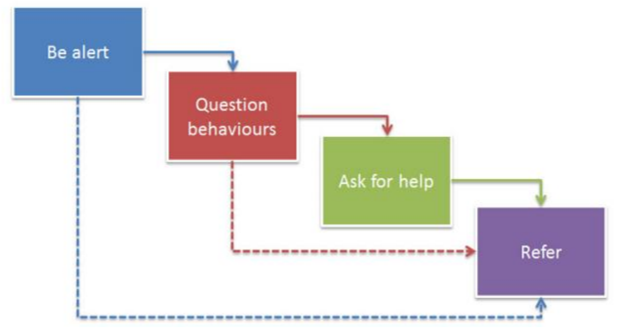
Laleham Gap School recognise that when assessing whether a child may be suffering, be suffering, or is likely to suffer, harm, there are four categories of abuse (further information is included in appendix 1):
- Physical abuse
- Sexual abuse
- Emotional abuse
- Neglect
By understanding the indicators of abuse, neglect and exploitation, we can identify children who may need help or protection, respond as early as possible, and help ensure children and families receive the right support.
Laleham Gap School recognises that concerns may arise in many different contexts and can vary in nature and seriousness. Indicators of abuse, neglect and exploitation do not automatically mean that a child is being harmed; however, all concerns will be taken seriously and explored by the DSL on a case-by-case basis.
Laleham Gap School recognises abuse, neglect, exploitation and other safeguarding issues are rarely standalone events and cannot always be covered by one definition or one label. In many cases, multiple issues will overlap.
All staff will consider whether children may be at risk of abuse, neglect, exploitation or harm in situations outside their families. Laleham Gap School recognises that extra-familial harms can take a variety of forms and that children may be vulnerable to multiple harms, including sexual abuse, sexual harassment and exploitation, domestic abuse within their own intimate relationships, criminal exploitation including financial exploitation, serious youth violence, county lines, online harms and radicalisation. Staff will report any concerns to the DSL in line with this policy, and the DSL will consider the wider context of the child’s experiences when assessing risk and support needs.
Laleham Gap School recognises that any child may benefit from support before statutory intervention is required. This may include support from universal services, community-based Early Help, or the targeted early help level of Family Help. Further information about how Laleham Gap School responds to safeguarding and welfare concerns, including requests for support, is set out in section 3.2 of this policy.
All staff will be alert to the potential need for additional support for children who may be more vulnerable or whose circumstances may indicate emerging, escalating or unmet needs. Staff will be particularly alert to the potential need for additional support for a child who:
- is disabled or has certain health conditions and has specific additional needs
- has special educational needs, whether or not they have a statutory Education, Health and Care plan
- has a mental health need
- is a young carer
- is pregnant and/or is a parent themselves o has exhibited early signs of abusive, violent and/or harmful behaviours
- is showing signs of being drawn into anti-social or criminal behaviour, including gang involvement, association with organised crime groups or county lines
- is frequently missing or goes missing from education, home or care
- electively home educated
- has been repeatedly removed from the classroom, experienced multiple suspensions, is on a part-time timetable, is at risk of permanent exclusion, is attending alternative provision or is attending a Pupil Referral Unit
- is at risk of exploitation, modern slavery or trafficking, including criminal or sexual exploitation
- is at risk of being radicalised into terrorism o has a parent or carer in custody, or is affected by parental offending
- is in a family circumstance presenting challenges for the child, such as drug and alcohol misuse, adult mental health issues or domestic abuse o is misusing alcohol or other drugs themselves
- is at risk of honour or faith-based abuse, such as Female Genital Mutilation or Forced Marriage
- is privately fostered.
Where staff identify that a child may benefit from additional support, they will report their concerns to the DSL in line with this policy.
Staff will be alert to:
- concerns raised by children, including disclosures or comments about themselves, their peers or family members.
- changes in a child’s behaviour, appearance, attendance, presentation or emotional wellbeing.
- indicators of abuse, neglect or exploitation.
- concerning interactions between children and parents/carers.
- parental behaviours which may indicate risk, including concerns linked to substance misuse, mental health, domestic abuse or other family circumstances.
- risks outside the family home, including peer groups, the wider community and online context.
- the needs of children with additional or complex needs, who may require additional support or specialist services
Children may not feel ready or know how to tell someone they are being abused, neglected or exploited. They may also not recognise their experiences as harmful. This should not prevent staff from having professional curiosity and speaking to the DSL if they have concerns.
All reports and concerns raised by children will be taken seriously and responded to in line with this policy. Staff will reassure children that they are being taken seriously, that they will be supported and kept safe, and that they will not be made to feel ashamed or that they are creating a problem by reporting concerns.
Laleham Gap School recognises that technology can be a significant component in many safeguarding and wellbeing issues; children are at risk of abuse or exploitation online from people they know (including other children) and from people they do not know; in many cases, abuse will take place concurrently via online channels and in daily life.
Following a concern about a child’s safety or welfare, any searching, screening or confiscation of items, including electronic devices, will be managed in line with the school ‘Searching and Confiscation Policy’ which is informed by the DfE ‘Searching, screening and confiscation at school’ guidance.
- The DSL will be informed of any search where there were reasonable grounds to suspect a learner was in possession of a prohibited item, or where a search identifies a potential safeguarding risk. The DSL will consider the circumstances and any wider safeguarding concerns.
- At Laleham Gap the Headteacher or the most Senior member of staff on site, must be consulted about all searches, unless imminent danger is suspected.
- Staff will involve the DSL (or deputy) without delay if they believe that a search has revealed a safeguarding risk.
3.2 Responding to child protection concerns
Where safeguarding concerns are identified, the child’s lived experience, voice and views will remain central to our decision-making, assessment and planning.
If staff are concerned about the safety or welfare of a child, they are expected to:
- listen carefully to the child and reflect back the concern.
- use the child’s own language.
- be non-judgmental.
- avoid leading questions, using open questions where necessary to clarify information, for example: who, what, where, when, or TED: Tell, Explain, Describe
- not promise confidentiality, as concerns will have to be shared further, for example, with the DSL and/or other agencies.
- be clear about boundaries and how the concern will be progressed.
- record the concern using the facts as the child presents them, in line with school record keeping procedures.
- inform the DSL or a deputy, as soon as practically possible.
All staff are made aware that early information sharing is vital for the effective identification, assessment, and allocation of appropriate support. This applies when concerns first emerge and where a child is already known to other agencies. Staff will not assume that a colleague or another professional will act or share information that may be critical in keeping a child safe.
Laleham Gap School recognises that children should not be seen or relied upon as protective factors for adults. When considering family circumstances, adult vulnerabilities or parental needs, staff will remain focused on the child’s needs, safety, welfare and lived experience. Staff will not assume that a child’s presence, behaviour, affection, resilience or relationship with a parent/carer reduces risk, prevents harm, or means that an adult’s needs are safely managed.
Laleham Gap School will respond to safeguarding concerns in line with the Kent Safeguarding Children Multi-Agency Partnership (KSCMP) procedures, the Kent Support Levels Guidance which follow the principle of ‘Right Help, Right Time, Right Professional’.
The full KSCMP procedures and additional guidance relating to reporting concerns and specific safeguarding issues can be found on the KSCMP website: www.kscmp.org.uk
All staff will be made aware of the process for identifying, assessing and responding to children’s needs in line with the Kent Support Levels Guidance. This includes understanding the criteria, including the level of need, for when children and families may be supported through
- universal services and community-based Early Help
- the targeted early help level of Family Help, under sections 10 and 11 of the Children Act 2004
- statutory services under section 17 of the Children Act 1989, including children in need and disabled children
- statutory child protection processes under section 47 of the Children Act 1989, where there is reasonable cause to suspect that a child is suffering, or is likely to suffer, significant harm
- care and supervision proceedings under section 31 of the Children Act 1989
- accommodation under section 20 of the Children Act 1989.
Staff are not expected to make threshold decisions alone. If staff are concerned about a child’s welfare or safety or are unsure what level of support may be required, they will speak to the DSL in line with this policy. The DSL will consider the concern in line with the Kent Support Levels Guidance, KSCMP procedures and local referral pathways.
Where safeguarding concerns are identified, options may include:
- managing support for the child internally through school pastoral, welfare and/or safeguarding support processes, where this is appropriate and does not place the child at additional risk.
- considering whether parents/carers should be informed to further support the child’s wellbeing, where it is safe and appropriate to do so.
- accessing universal services and community-based Early Help for children with emerging needs, including support available through Kent Family Hubs, the school and other local universal, voluntary or community services.
- making a Request for Support to the Front Door Service via the Kent Children’s Services Portal where a child’s needs cannot be met by universal or community-based early help support alone and coordinated, multi-disciplinary support may be required, or where there is reasonable cause to suspect that the child is suffering, or is likely to suffer, significant harm.
Community-based Early Help is support for children of all ages that improves a family’s resilience, improves outcomes or reduces the chance of a problem getting worse. It is not a single service, but a system of support delivered by local authorities and their partners, including education providers. The Kent Support Levels Guidance describes this as ‘children with emerging needs (Level 2)’.
- Children at this level are usually best supported by professionals who already work with them, such as health professionals, early years settings, schools or colleges, and/or through community resources such as Family Hubs or voluntary services.
- A Request for Support via Front Door Service is not required for support at this level.
- Where community-based Early Help is appropriate, the DSL will consider what support can be provided within school and/or through local universal, voluntary or community services, including Kent Family Hubs.
- Where the need of a child/family escalate, become persistent, or cannot be met by universal or community-based Early Help alone, the DSL will consider whether a Request for Support to Family Help is required in line with the Kent Support Levels Guidance.
Where children and families have multiple and/or complex needs, or persistent needs, which cannot be met by universal or community-based early help support alone, they may require coordinated, multidisciplinary support to prevent escalation through the targeted early help level of Family Help. The Kent Support Levels Guidance describes this as ‘Family Help – Children with multiple and/or complex needs (Level 3)’. Support at this level may include targeted early help and statutory support under section 17 of the Children Act 1989, where required to safeguard and promote the child’s welfare.
- A Request for Support is required and will be made to the Front Door Service via the Kent Children’s Services Portal.
Where there is reasonable cause to suspect that a child is suffering, or is likely to suffer, significant harm, and needs and risks cannot be safely managed through targeted or Child in Need Family Help support alone, a statutory child protection response is required. The Kent Support Levels Guidance describes this as ‘Family Help – Children in need of protection (Level 4)’.
- Safeguarding activity at this level is led under section 47 of the Children Act 1989.
- A Request for Support is required and will be made to the Front Door Service via the Kent Children’s Services Portal.
- If a child is at immediate risk, the Request for Support will be marked as “urgent”.
- If the child is in immediate danger, emergency services will be contacted using 999
Laleham Gap School will take appropriate safeguarding action in response to concerns but will not investigate child protection concerns as a single agency or attempt to determine whether abuse, neglect or exploitation has occurred. Staff will record and report concerns in line with this policy and KSCMP procedures, and information will be shared with Children’s Front Door and/or the police where appropriate, so that concerns can be considered through the appropriate multi-agency process.
Laleham Gap School recognises that children may be harmed in contexts outside the home, including within peer groups, the wider community and online. When making a Request for Support, the school will provide as much relevant information as possible so that any assessment can consider the full context of the child’s lived experience and take a contextual approach to harm.
If the school believes a child may need support but is unclear whether a Request for Support should be submitted, the DSL may seek advice through a no-name consultation with the Front Door Service before deciding next steps. A consultation will not be used where a child is suffering, or is likely to suffer, significant harm; in these circumstances, a Request for Support will be submitted without delay.
The DSL will usually have responsibility for making Requests for Support and other safeguarding referrals. However, all staff are made aware of the local Kent process for making referrals to the Front Door and for statutory assessments under the Children Act 1989, including the role they may be expected to play in such assessments.
If staff have any concerns about a child’s welfare or safety, they are expected to act on them immediately.
- If staff are unsure whether something is a safeguarding issue, they will speak to a DSL.
- If, in exceptional circumstances, a DSL or deputy DSL is not available, this must not delay appropriate action being taken. In these circumstances, staff should speak to a member of the school senior leadership team, seek a consultation from the Front Door Service, contact the police where urgent action is required, or make a Request for Support themselves. Contact information is available in the safeguarding flowchart on page.
- Any safeguarding action taken by staff must be shared with the DSL as soon as possible.
Parents/carers will usually be spoken to where a Request for Support is being considered, and their agreement to engage will be sought where this is required and safe/appropriate to do so. This will be considered in line with KSCMP procedures and the Kent Support Levels Guidance.
- Parent/carer agreement to engage is not required for ‘Family Help – Children in need of protection (Level 4)’, where there is reasonable cause to suspect that a child is suffering, or is likely to suffer, significant harm. A Request for Support must be made in these circumstances; however, it is good practice for the school to work openly and transparently with parents/carers and inform them of the Request for Support where it is safe to do so.
- Parents/carers will not be informed before a Request for Support is made where this may place a child at increased risk of harm, place an adult at risk of serious harm, prejudice the prevention or detection of serious crime, or undermine a criminal investigation. A parent should never be informed about referrals relating to concerns of Fabricated and Induced Illness as this could exacerbate the issue.
If, after a Request for Support or other external intervention, a child’s situation does not appear to be improving, or there are concerns about a decision or response, staff or the DSL will consider whether to re-refer and/or follow the Kent Safeguarding Children Escalation Procedure to ensure concerns are addressed and, most importantly, that the child’s situation improves.
Any pastoral or welfare support provided by the school to children and families will be recorded and reviewed. The DSL will oversee support where families are requiring additional support, to ensure that school activity does not obscure potential safeguarding concerns from the wider professional network.
3.3 Multi-agency working
Laleham Gap School recognises the pivotal role education settings play in multi-agency safeguarding arrangements. We are committed to working in line with the Kent Safeguarding Children Multi-Agency Partnership procedures, the Kent Support Levels Guidance and the principle of ‘Right Help, Right Time, Right Professional’. Our Lead DSL is an Associate Trainer for KSCMP and attends regular development days with the partnership.
The school leadership team, governing body and DSL(s) will work to establish effective and cooperative relationships with safeguarding partners and other local agencies. This may include Children’s Front Door, social workers, Family Help practitioners, health professionals, mental health services, specialist teachers, educational psychologists, other education settings and the police.
Laleham Gap School will work with partner agencies to provide a coordinated safeguarding response which promotes children’s welfare and protects them from harm. This includes contributing to relevant multi-agency plans and meetings, such as child in need meetings, child protection conferences, core groups, strategy discussions and care planning meetings.
Where a child is supported through community-based Early Help, Family Help, child in need, child protection or care planning processes, the school will work with partner agencies to promote joined-up planning, avoid unnecessary duplication and ensure the child’s educational needs, safety, voice and lived experience are considered.
The school will allow access for Kent Children’s Social Care and, where relevant, a placing local authority, so that they can conduct, or consider whether to conduct, assessments under section 17 or section 47 of the Children Act 1989.
When making a Request for Support or contributing to statutory assessments, the school will provide relevant information about the child’s presentation, attendance, progress, relationships, family circumstances, wider context and any known risks outside the home, including online, peer group or community-based concerns.
The headteacher and DSL are aware of the requirement for children to have an Appropriate Adult where there is a need for police detention, treatment or questioning. The school will respond in line with relevant guidance and local procedures, including the School Searching and Confiscation Policy, where applicable.
3.4 Child Protection Records
All safeguarding concerns, discussions, decisions, and reasons for those decisions, will be recorded in writing using CPOMS. Records will be passed to the DSL verbally and recorded without delay.
- In the event that CPOMS is not working, a concern form can be found in the Staff Handbook and/or in the Safeguarding Policies Folder.
If there is an immediate safeguarding concern, staff will speak to the DSL first. Completing a written record must not delay urgent safeguarding action.
Records will be completed as soon as possible after the incident/event and be signed and dated by the member of staff. They will be accurate, factual and written in a clear and professional manner, using the child’s own words where relevant. Records will not include personal opinions unless these are clearly identified as professional judgement.
Staff will include relevant details such as the date, time, location, people present, the concern or disclosure, any visible injuries, the child’s presentation and any action taken. A body map will be completed where visible injuries to a child have been observed.
If staff are unsure about recording requirements, they will seek advice from the DSL.
Our child protection records will include a clear and comprehensive summary of concerns, details of how concerns have been followed up and resolved, actions taken or not taken, decisions reached, the rationale for those decisions and any outcomes.
Child protection records will be kept confidential and stored securely. Records will be maintained separately from the child’s main school record and retained in line with data protection legislation and school record retention arrangements.
The DSL will have oversight of child protection records and will ensure they are reviewed, shared and transferred appropriately in line with statutory guidance, KSCMP procedures and school record keeping arrangements.
3.5 Transferring and receiving child protection files and safeguarding information
When a child leaves Laleham Gap School, the DSL will ensure that their child protection file is transferred to the DSL at the new setting as soon as possible. This will be within 5 days for an in-year transfer or within the first 5 days of the start of a new term.
Child protection files will be transferred securely, separately from the child’s main file, and in accordance with data protection legislation and statutory safeguarding guidance. Confirmation of receipt will be obtained.
In addition to transferring the child protection file, the DSL will consider whether it is appropriate to share relevant information with the DSL at the new setting in advance of the child leaving. This may include information to support the new setting to undertake an assessment of risk to others, as well as to make arrangements to safeguard the child, promote their welfare or continue appropriate support. Where there are safeguarding concerns, known risks or significant support needs, the DSL will instigate a direct conversation with the new setting to support effective information sharing and transition planning.
Where Laleham Gap School receives a child protection file from another setting, the DSL will review the records and ensure relevant staff are made aware of information they need to know in order to safeguard and support the child. This may include the Deputy DSLs, Key Stage Leads, pastoral staff, relevant teaching staff or other appropriate members of staff.
Where information shared during transition indicates that a child may present a risk to others and/or may be at risk themselves, Laleham Gap School will consider what safeguarding action is required before, or as soon as possible after, the child starts. This may include completing or reviewing a safeguarding risk assessment and putting in place an appropriate safety and support plan.
Where a child joins Laleham Gap School and no child protection file is received, the DSL will proactively contact the previous setting to confirm whether a child protection file exists and, if so, ensure it is transferred securely without delay.
3.6 Confidentiality and information sharing
Laleham Gap School recognises its duty and powers to hold, use and share relevant information with appropriate agencies where this is necessary to safeguard and promote the welfare of children. Information will be shared at the earliest opportunity where this is needed to identify, assess or respond to risk, in line with Keeping Children Safe in Education, Working Together to Safeguard Children, KSCMP procedures and data protection legislation.
Laleham Gap School has an appropriately trained Data Protection Officer (DPO) in line with data protection law requirements. The DPO is Sophie Conroy, Business Manager, sophie.conroy@lgs.kent.sch.uk
All staff are made aware of the need to protect children’s privacy and to handle information in a way that is lawful, proportionate and secure. Staff are also made aware that confidentiality must never prevent appropriate safeguarding action from being taken.
Staff will not promise confidentiality to a child, as safeguarding concerns may need to be shared with the DSL, the Front Door Service, the police and/or other agencies where appropriate.
Staff are expected to be proactive in sharing information as early as possible to help identify, assess and respond to concerns about a child’s safety, welfare or wellbeing. Staff will not assume that a colleague or another professional will share information that may be critical to keeping a child safe.
Data protection laws do not prevent the sharing of information for the purpose of keeping children safe. Fears about sharing information must not be allowed to stand in the way of the need to safeguard and promote the welfare and protect the safety of children. Information sharing decisions will be informed by safeguarding need, risk assessment, proportionality, data protection requirements and the need to promote the welfare and safety of the child and others.
Staff will have due regard to relevant data protection laws and principles, including when information should be shared and when it should be withheld. Staff will receive appropriate information and guidance about confidentiality, information sharing and data protection through the Staff Handbook, GDPR Policy and the school privacy notices.
Where possible and appropriate, staff will be open and transparent with children and families about what information may be shared, with whom and why. However, information may be shared without agreement where this is necessary to safeguard a child, promote a child’s welfare, prevent delay or avoid increasing risk.
The headteacher and DSL will share relevant safeguarding information with staff on a need-to-know basis, so that staff can safeguard and support children appropriately.
Staff can access further information through the school confidentiality policy, data protection policy and/or information governance procedures.
Laleham Gap School recognises that children have a legal right to privacy under Article 16 of the United Nations Convention on the Rights of the Child (UNCRC), which affirms their entitlement to a private family life, personal space, and protection of personal communications.
While safeguarding concerns may necessitate the sharing of information, this must be done proportionately and only when it is in the child’s best interests.
3.7 Complaints
All members of the school community should feel able to raise or report any concerns about children’s safety, safeguarding practice or potential failures in the school safeguarding arrangements.
Laleham Gap School has a complaints procedure available to parents/carers, learners, staff and visitors who wish to raise a concern or complaint. This can be found on the school website: Laleham Gap School - Policies
The leadership team at Laleham Gap School will take all safeguarding concerns, complaints and whistleblowing reports seriously. Concerns will be considered and responded to in line with the relevant school policies and procedures.
Whilst we encourage members of our community to raise concerns directly with the school where appropriate, we recognise this may not always be possible.
- Children, young people or adults who have experienced, witnessed or are concerned about sexual abuse or harassment in education settings can contact the NSPCC Report Abuse in Schools helpline on 0800 136 663.
- Staff who do not feel able to raise concerns about child protection failures internally, or who feel their concerns are not being addressed, can contact the NSPCC Whistleblowing Advice Line on 0800 028 0285
Any concern or complaint that constitutes an allegation against, or concern about, a member of staff, supply teacher, volunteer or contractor will be dealt with in line with section 8 of this policy.
4 Specific Forms of Abuse and Other Safeguarding Issues
Laleham Gap School recognises that children may be vulnerable to a wide range of safeguarding issues, both inside and outside the home, including online. Staff will maintain an attitude of ‘it could happen here’ and will report any concerns to the DSL in line with section 3 of this policy.
Further information about specific safeguarding issues is available in Keeping Children Safe in Education.
Where staff are unsure how to respond to specific safeguarding issues, they should follow the processes as identified in part 3 of this policy and speak with the DSL or a deputy.
4.1 Child-on-child abuse (including harassment and violence)
All members of staff at Laleham Gap School recognise that children can abuse other children; this is known as child-on-child abuse and may take place online, face-to-face, physically, verbally or through a combination of channels.
Staff will maintain an attitude of “it could happen here”. Even if there are no reported cases of child-on-child abuse, staff will remain alert to the possibility that it may be taking place and not being reported.
Laleham Gap School adopts a zero-tolerance approach to child-on-child abuse. We believe that abuse is abuse and it will never be tolerated or dismissed as “just banter”, “just having a laugh”, “part of growing up” or “boys being boys”; this can lead to a culture of unacceptable behaviours, misogyny/misandry, and can create an unsafe environment for children and a culture that normalises abuse, which can prevent children from coming forward to report it.
Laleham Gap School recognises that child-on-child abuse can take many forms, including but not limited to:
- bullying, including cyberbullying, prejudice-based and discriminatory bullying.
- abuse in intimate personal relationships between children, sometimes known as ‘teenage relationship abuse’.
- physical abuse which can include hitting, kicking, shaking, biting, hair pulling, or otherwise causing physical harm, including where there is an online element which facilitates, threatens and/or encourages physical abuse.
- serious physical assault and harm, or the threat of harm with a weapon.
- sexual violence such as rape, assault by penetration and sexual assault, including where there is an online element which facilitates, threatens and/or encourages sexual violence.
- sexual harassment, such as sexual comments, remarks, jokes and online sexual harassment, which may be standalone or part of a broader pattern of abuse.
- causing someone to engage in sexual activity without consent, such as forcing someone to strip, touch themselves sexually, or to engage in sexual activity with a third party.
- Consensual and non-consensual making or sharing of nudes and semi-nudes (previously known as sexting or youth produced sexual imagery), including where generated by Artificial Intelligence (AI)
- Upskirting (which is a criminal offence), which typically involves taking a picture under a person’s clothing without their permission, with the intention of viewing their genitals or buttocks to obtain sexual gratification, or cause the victim humiliation, distress or alarm.
- Initiation/hazing type violence and rituals, which could include activities involving harassment, abuse or humiliation used as a way of initiating a person into a group and may also include an online element.
Laleham Gap School recognises that harmful sexual behaviour exists on a continuum, from developmentally inappropriate or problematic sexual behaviour through to abusive behaviour and sexual violence.
Concerns will be considered in context, taking account of the age and stage of development of the children involved, any power imbalance, coercion, threats, exploitation, the nature of the behaviour, the impact on those affected, and any wider safeguarding risks.
All staff have a role to play in challenging inappropriate, harmful or abusive behaviours between children. Staff will be alert to factors which may increase risk or affect how children experience or report abuse, including age, developmental stage, sex, ability, SEND, culture, ethnicity, sexual orientation, gender identity, power imbalance, peer group dynamics and wider contextual factors. Staff will be aware of the possibility that children may minimise, normalise or not recognise harmful behaviours, and that some behaviours may be facilitated, threatened, encouraged or shared online.
Laleham Gap School recognises that for some (but not all) forms of child-on-child abuse, girls are more likely to be victims and boys are more likely to be perpetrators. However, all child-on-child abuse is unacceptable, will be taken seriously and will be responded to in line with this policy.
Laleham Gap School recognises that the law is in place to protect children rather than unnecessarily criminalise them. Where relevant, this will be explained to learners in an age and developmentally 25 appropriate way which avoids alarming or distressing them, while making clear that harmful, abusive or non-consensual behaviour is unacceptable and will be taken seriously.
Laleham Gap School want children to feel confident to report abuse, knowing that their concerns will be treated seriously and that they will be supported and kept safe. The school will ensure reporting systems are well promoted, easily understood and easily accessible. Children who report child-on-child abuse will be reassured that they are not creating a problem and will not be made to feel ashamed for sharing a concern.
Laleham Gap School recognises that child-on-child abuse is a safeguarding issue for all children involved. We will consider the safety, welfare and support needs of the child who has experienced harm, any other affected children, and the child alleged to have caused harm.
Any concerns or allegations relating to child-on-child abuse, whether on-site, off-site or online, will be recorded and reported to the DSL in line with this policy.
- The DSL will consider the concern in line with relevant school policies and procedures, including behaviour, anti-bullying and child protection procedures.
- The DSL will consider the behaviour in context, including the child’s age and stage of development, any SEND or communication needs, trauma or abuse history, power imbalance, coercion, intent, frequency, escalation and the impact on others.
- Concerns will be responded to, and where appropriate investigated under relevant school procedures, while recognising the need to engage with multi-agency processes where safeguarding or child protection concerns are identified.
- Where concerns involve harmful sexual behaviour, sexual harassment or sexual violence, DSLs will respond in line with Part five of KCSIE.
- Responses will always be child-centred, proportionate and based on the circumstances of the case.
When a concern of child-on-child abuse is reported, a DSL will consider whether an immediate risk and needs assessment is required. This will be considered on a case-by-case basis and may include:
- the wishes and feelings of the child who has been harmed
- the nature of the concern or alleged incident
- whether a crime may have been committed
- whether harmful sexual behaviour may have been displayed
- the ages and developmental stages of the children involved
- any power imbalance, coercion, intimidation or exploitation
- whether the concern appears to be a one-off incident or part of a pattern of behaviour
- any vulnerability, SEND or additional needs affecting the children involved
- any online elements or wider contextual factors
- any ongoing risks to the child who has been harmed, other children, staff or the wider school community
- whether the concern links to other safeguarding issues, such as child sexual exploitation, child criminal exploitation, serious violence or abuse within intimate personal relationships between children.
The risk and needs assessment, where completed, will be recorded and kept under review. Actions will be taken to protect and support all children involved and to address any wider safeguarding risks within the school environment.
The school will take appropriate safeguarding, pastoral and/or behaviour-related action in response to child-on-child abuse. However, where the concern indicates that a child may require Family Help, statutory support or protection, a DSL will make a Request for Support via the Kent Children’s Services Portal, in line with the Kent Support Levels Guidance and KSCMP procedures.
The school will normally inform parents/carers of the children involved in child-on-child abuse, unless doing so would place a child at risk of harm, place another person at risk, prejudice the prevention or detection of crime, or undermine a police or statutory safeguarding response.
- Information shared with parents/carers will be relevant to their own child and shared in line with safeguarding, confidentiality and data protection requirements. The school will not share confidential information about other children, including any safeguarding action, support or sanctions, unless there is a lawful and appropriate basis to do so.
Child-on-child abuse is preventable. Timely, evidence-based support can be key to preventing children from going on to commit abuse or violence. Laleham Gap School will work to minimise the risk of child-on-child abuse by creating a safe culture, promoting respectful relationships, providing appropriate curriculum opportunities, ensuring children know how to report concerns, and responding consistently to harmful behaviour.
Our measures include, but are not limited to:
A robust Anti-Bullying Policy that is regularly reviewed and embedded across the school culture.
- Delivery of an age- and ability-appropriate PSHE and RSE curriculum, designed to educate children on respectful relationships, personal boundaries, and how to keep themselves and others safe.
- Provision of high levels of individual support for learners who may be vulnerable or require additional guidance.
- Partnership working with parents, carers, and external professionals to ensure a coordinated and informed response to concerns. This includes training and events delivered to staff, children and parents by key partners and agencies such as CEOP, KCSMP, Kent Police, Prevent Education Officers and reputable organisations such as the Breck Bednar Foundation.
- A range of accessible opportunities for children to express concerns or worries, including trusted adults, anonymous reporting tools (such as our online safety portal), and regular wellbeing check-ins.
- Embedding a restorative and safe culture that promotes accountability, empathy, and resolution.
- Promotion of the UNCRC, particularly Articles 19 and 29, which affirm every child’s right to be protected from harm and to learn in a safe environment
- High levels of supervision across the school day, including during transitions, break times, and online activities.
- Provision of training and informative materials to parents and carers, delivered via our National College portal, and supported by our Designated Safeguarding Lead (DSL) and CEOP Ambassador.
- Social and emotional interventions to help children understand one-another, build resilience and develop a confident and assertive approach to speaking up.
- Regular school council meetings to share and voice any concerns, including child on child and behaviour incidents, strengthening the voice of all children across the school through peer support.
Children affected by child-on-child abuse will be supported according to their needs.
This may include:
- Additional internal support from school-based pastoral staff and therapists
- Referrals to multi-agency partners
- Targeted support from suitable organisations such as Project Salus
4.2 Making or sharing nudes and/or semi-nudes
Laleham Gap School recognises that all incidents involving the making or sharing of nudes or seminudes, whether consensual or non-consensual, will require a safeguarding response.
For the purpose of this policy, nudes and semi-nudes means nude or semi-nude images, videos or livestreams of children under the age of 18. This includes imagery that is taken/created by a child, taken/created by a child and shared by another person, digitally altered, or generated using artificial intelligence (AI). Nudes and semi-nudes may be shared online, between devices, through social media, messaging apps, gaming platforms, forums, livestreams or other digital routes.
Creating, possessing or sharing nudes and semi-nudes of children under 18, including where this has happened with consent, is illegal and can present complex safeguarding issues. However, Laleham Gap School recognises that the law is in place to protect children rather than unnecessarily criminalise them. Responses will therefore be child-centred, proportionate and focused on safeguarding and supporting the children involved.
All concerns must be reported to and managed by the DSL in line with this policy, the Kent and Medway Responding to Nude and Semi-Nude Image Sharing Guidance, the Kent Support Levels Guidance and the UKCIS Sharing nudes and semi-nudes: advice for education settings working with children and young people’ guidance.
Parents/carers of children involved in making or sharing nudes or semi-nudes, will be informed at an early stage, unless there is good reason to believe that involving them would put a child at risk of harm.
A Request for Support will be made to the Front Door Service via the Kent Children’s Services Portal, and/or the police informed immediately if:
- the incident involves an adult (over 18).
- there is reason to believe that a child has been coerced, blackmailed, groomed or exploited.
- there are concerns about a child’s capacity to consent, including due to age, developmental stage, vulnerability or additional needs
- the imagery involves sexual acts, violence, threats, exploitation or other high-risk features (for example, a child under the age of thirteen, or images depict sexual acts which are unusual for the child’s developmental stage)
- a child is at immediate risk of harm
- there are wider safeguarding concerns, including links to child sexual exploitation, child criminal exploitation, harmful sexual behaviour or abuse within intimate personal relationships between children.
All decisions and action taken regarding nude or semi-nudes will be responded to and recorded in line with our child protection procedures.
The DSL may choose to involve other agencies where there are concerns about nudes or semi-nudes at any time, including if further information is disclosed at a later date or there are additional concerns or incidents.
If the DSL is unsure if a Request for Support is appropriate, advice will be sought from the Front Door Service.
4.3 Exploitation, including child sexual exploitation (CSE), child criminal exploitation (CCE), county lines, serious violence and modern slavery
Laleham Gap School recognises that Child Sexual Exploitation (CSE), Child Criminal Exploitation (CCE), county lines, serious violence and modern slavery are safeguarding issues and may overlap. Children may also experience exploitation alongside other forms of abuse, neglect or harm. The school will therefore need to consider the full context of the child’s lived experience, including risks outside the home, peer groups, community locations, transport routes and online environments.
Laleham Gap School recognises that CSE and CCE are forms of abuse. They occur where an individual or group takes advantage of an imbalance of power to coerce, manipulate or deceive a child into taking part in criminal or sexual activity. This may involve an exchange for something the child needs or wants, and/or be for the financial advantage or increased status of the perpetrator or facilitator, and/or involve violence or the threat of violence.
Laleham Gap School recognises that exploitation may be committed or facilitated by individuals, organised networks or gangs, and the child may identify as being part of the group that is exploiting them. Exploitation can affect children of any age and sex, and it is not possible for a child to consent to being exploited, abused or trafficked.
Children may not recognise that exploitation is happening to them and may be manipulated, groomed or coerced into situations they do not fully understand. Children who are exploited may also be coerced, controlled, threatened or manipulated into activity which appears to be offending behaviour, and the school will consider whether such behaviour may be linked to exploitation before responding.
Laleham Gap School recognises that:
- Child Sexual Exploitation (CSE) is a form of child sexual abuse. CSE can be a one-off occurrence or a series of incidents over time and may range from opportunistic to complex organised abuse. CSE can affect any child who has been coerced into sexual activity, including 16- and 17-year-olds who can legally consent to sexual activity. Some children may believe they are in a genuine romantic relationship and may not recognise that they are being exploited.
- Child Criminal Exploitation (CCE) can include children being forced or manipulated into transporting drugs or money through county lines, working in cannabis factories, shoplifting, pickpocketing, vehicle crime, threatening or committing serious violence, or carrying weapons. Children can become trapped in criminal exploitation through threats, violence, intimidation, debt bondage, grooming or coercion, including threats towards their families. The experience of girls who are criminally exploited can be different from that of boys, and indicators may not be the same. Girls are also at risk of criminal exploitation. Both boys and girls who are criminally exploited may be at higher risk of sexual exploitation.
- County lines is a form of criminal exploitation involving gangs or organised criminal networks using dedicated mobile phone lines or other forms of “deal line” to export illegal drugs. This activity can happen locally as well as across the UK; no specific distance of travel is required. Children may be exploited to move, store or sell drugs or money and may be controlled through coercion, intimidation, violence, threats, debt bondage, online activity or exploitation of their family circumstances.
- Serious violence includes violence and exploitation involving weapons, gangs, criminal networks or serious physical harm. It can involve carrying, threatening with, or using knives or other weapons, or concerns that a child may be exposed to weapons through peers, gangs, criminal networks or community-based harm. The likelihood of involvement in serious violence may be increased by factors such as being male, having been suspended, spent time in alternative provision or been permanently excluded, having experienced child maltreatment, having been involved in offending, having used drugs or alcohol in early adolescence, or having previously been a victim or displayed violence. Serious violence can often peak in the hours just before or after school/college, including when children are travelling to and from the setting, and may be concentrated in particular places.
- Modern slavery includes human trafficking, slavery, servitude and forced or compulsory labour. Exploitation can take many forms, including sexual exploitation, criminal exploitation, forced criminality, forced labour, domestic servitude and the removal of organs.
Staff will be alert to indicators that a child may be at risk of, or experiencing, exploitation, county lines or serious violence. These may include:
- unexplained gifts, money or new possessions
- increased absence from school/college or regularly missing education
- going missing from home or care, or regularly returning home late
- changes in friendship groups or relationships with older individuals or groups
- a significant decline in educational performance
- signs of assault, unexplained injuries, self-harm or changes in wellbeing
- drug or alcohol misuse
- association with others involved in exploitation, gangs or criminal networks
- receiving requests for drugs via a phone line, moving drugs or collecting money
- being found in accommodation with which they have no connection, sometimes referred to as a trap house, cuckooing address or hotel room linked to drug activity
- owing money or a “debt bond” to exploiters
- having their bank account used to facilitate criminal activity
- being vulnerable to grooming, coercion, threats, intimidation or online exploitation.
The school will seek to understand when and where children may feel unsafe, including by listening to children, consulting staff and working with partners to understand the local context and support a coordinated safeguarding response.
Laleham Gap School recognises that children who have been exploited may need additional support to help keep them safe and engaged in education.
If staff are concerned that a child may be at risk of, or experiencing, child sexual exploitation, child criminal exploitation, county lines, serious violence, trafficking or modern slavery, they will report their concerns to the DSL without delay.
The DSL will consider concerns about exploitation in line with this policy and relevant local and national guidance and make referrals or reports as appropriate.
- The DSL will consider use of the Kent and Medway Child Exploitation Identification Tool where there are concerns that a child may be experiencing, or be vulnerable to, exploitation.
- Where broader intelligence is known about potential exploitation or other community safety concerns, the DSL will consider whether information should be shared with Kent Police through the Community Partnership Intelligence Portal.
- Where modern slavery or trafficking is suspected, relevant safeguarding and/or child protection procedures will be followed, and the DSL will consider whether a referral through the National Referral Mechanism is required.
- Any safeguarding concerns for children will be referred to the Front Door Service and/or police as appropriate. If there is a crime in progress or immediate risk, emergency services will be contacted using 999.
When sharing information or making a Request for Support to the Front Door Service or other appropriate agencies, Laleham Gap School will provide as much relevant information as possible to support a contextual safeguarding response. This may include information about the child’s presentation, attendance, peer relationships, online activity, family circumstances, community risks, known locations of concern, transport routes, patterns of absence, and any indicators of exploitation, trafficking, modern slavery or serious violence.
4.4 Domestic abuse
Laleham Gap School is an Operation Encompass School and recognises that domestic abuse can encompass a wide range of behaviours and may be a single incident or a pattern of incidents. Domestic abuse can include, but is not limited to, psychological, physical, sexual, financial/economic or emotional abuse, including coercive and controlling behaviour. Domestic abuse can take place inside or outside the home and within different types of relationships, including intimate partner relationships, ex-partners and family members. Types of domestic abuse can include intimate partner violence, abuse by family members, teenage relationship abuse and child-to-parent or caregiver abuse.
Laleham Gap School recognises that anyone can be a victim of domestic abuse, regardless of sex, age, ethnicity, socio-economic status, sexuality, background or identity.
Laleham Gap School recognises children can be victims of domestic abuse in their own right if they see, hear or experience the effects of abuse. Children may also experience domestic abuse within their own intimate relationships, sometimes referred to as teenage relationship abuse. Where one or both children are under 16, this may not fall within the statutory definition of domestic abuse, but it will still be responded to as a safeguarding concern.
Laleham Gap School recognises that domestic abuse can have a detrimental and long-term impact on children’s health, wellbeing, development and ability to learn.
Laleham Gap School recognises that domestic abuse may occur, continue or escalate following separation. Concerns will not be viewed in isolation, and the school will consider the child’s lived experience, family circumstances and any wider safeguarding risks.
Staff will respond to domestic abuse concerns in a trauma-informed way and will avoid victim-blaming language or assumptions.
If staff are concerned that a child may be seeing, hearing or experiencing the effects of domestic abuse, or experiencing abuse within their own intimate relationship, they will report their concerns to the DSL.
The DSL will consider concerns about domestic abuse in line with this policy, KSCMP procedures, the Kent Support Levels Guidance and any relevant local or national guidance. Where the concern indicates a need for Family Help, statutory support or protection, the DSL will consider whether a Request for Support should be made via the Kent Children’s Services Portal. If a child or adult is in immediate danger, emergency services will be contacted using 999.
Laleham Gap School participates in Operation Encompass. Operation Encompass is an information sharing scheme between the police and education settings which supports schools/colleges to provide timely, informed support to children affected by domestic abuse. Police forces in England have a duty to notify a child’s school where they have attended a domestic abuse incident and have reasonable grounds to believe a child may be a victim of domestic abuse. This includes children connected to the household regardless of whether they were present at the incident.
Operation Encompass notifications will help the school to have up-to-date and relevant information about a child’s circumstances so that appropriate support can be considered according to the child’s needs. Operation Encompass does not replace statutory safeguarding procedures, and where there are concerns about a child’s welfare, the DSL will consider whether a Request for Support is required in line with the Kent Support Levels Guidance.
Operation Encompass notifications will be handled confidentially, stored securely and managed in line with data protection requirements and school child protection recording procedures. The DSL will have oversight of notifications and will ensure that relevant information is shared with staff on a need-to know basis to safeguard and support the child.
Where the school is unsure how to respond to an Operation Encompass notification, advice may be sought from the Front Door Service or from the Operation Encompass advice and helpline service: 0204 513 9990.
4.5 Honour or Faith-Based Abuse (HBA)
Laleham Gap School recognises that honour or faith-based abuse (HBA) encompasses incidents or crimes committed to protect or defend the honour of the family and/or community. This can include female genital mutilation, forced marriage and practices such as breast ironing. Abuse committed in the context of preserving “honour” often involves a wider network of family or community pressure and can include multiple perpetrators. Staff will be alert to this dynamic and the additional risks it may create when deciding what safeguarding action is required.
All forms of HBA are abuse, regardless of the motivation, and will be handled and escalated as such. If staff have any concerns that a child may be at risk of, or has experienced, honour or faith-based abuse, they will speak to the DSL without delay. The DSL will consider concerns in line with this policy, KSCMP procedures, the Kent Support Levels Guidance and any relevant national or local guidance. If there is an immediate threat or danger, the police will be contacted.
Female Genital Mutilation (FGM) comprises all procedures involving partial or total removal of the external female genitalia or other injury to the female genital organs. FGM is illegal in the UK and is a form of child abuse with long-lasting harmful consequences.
- All staff will speak to the DSL if they have any concerns that a child may be at risk of FGM or may have experienced FGM.
- Section 5B of the Female Genital Mutilation Act 2003 (as inserted by section 74 of the Serious Crime Act 2015) places a statutory duty upon teachers, to directly report to the police where they discover that FGM appears to have been carried out on a girl under 18. Those failing to report such cases may face disciplinary sanctions.
- It will be rare to see visual evidence of FGM, and staff must not examine learners. Unless the teacher has good reason not to, they should also discuss the concern with the DSL. The mandatory reporting duty does not apply to suspected or at-risk cases where FGM has not been discovered; in these cases, staff must follow local safeguarding procedures and speak to the DSL.
Forced marriage is a crime.
- A forced marriage is one entered into without the full and free consent of one or both parties, and where violence, threats or another form of coercion is used. Coercion may be physical, emotional or psychological. A lack of full and free consent can also arise where a person cannot consent, for example due to learning disabilities.
- It is also a crime to carry out any conduct whose purpose is to cause a child to marry before their eighteenth birthday, even where violence, threats or another form of coercion are not used. This applies to non-binding, unofficial “marriages” as well as legal marriages.
- Staff will report any concerns about forced marriage to the DSL. Advice can also be sought from the Forced Marriage Unit: 020 7008 0151 or fmu@fcdo.gov.uk
4.6 Preventing radicalisation
Laleham Gap School recognises that children may be susceptible to radicalisation into terrorism. Protecting children from this risk forms part of the school’s wider safeguarding approach.
Laleham Gap School is aware of its duty under section 26 of the Counter-Terrorism and Security Act 2015 to have “due regard to the need to prevent people from becoming terrorists or supporting terrorism”. This is known as the Prevent duty.
For the purposes of this policy:
- extremism is the vocal or active opposition to fundamental British values, including democracy, the rule of law, individual liberty, and mutual respect and tolerance of those with different faiths and beliefs
- radicalisation is the process of a person legitimising support for, or use of, terrorist violence
- terrorism is an action that endangers or causes serious violence to people, causes serious damage to property, or seriously interferes with or disrupts an electronic system, where the use or threat is designed to influence the government or intimidate the public and is made for the purpose of advancing a political, religious or ideological cause.
Laleham Gap School recognises that there is no single way of identifying whether a child is likely to be susceptible to radicalisation into terrorism. As with other safeguarding risks, staff will be alert to changes in behaviour, presentation, language, relationships or online activity which may indicate that they are in need of help or protection.
Staff will use their professional judgement and act proportionately where they have concerns that a child may be susceptible to radicalisation. Any concerns will be reported to the DSL in line with this policy.
The DSL and senior leaders will be familiar with the Prevent duty guidance and local procedures for making a Prevent referral. The school’s approach to Prevent will be considered as part of wider safeguarding arrangements and will include appropriate attention to:
- leadership and partnership
- staff capability, training and awareness
- reducing permissive environments, including online environments, external speakers, visitors, use of premises and access to extremist or terrorist content.
Laleham Gap School will ensure that staff receive appropriate Prevent training which is renewed in line with best practice – for new staff this will be part of the ‘LGS Induction and Foundations Programme’ so they understand the Prevent duty, can recognise concerns, know how to report them internally, and understand the local Prevent referral process.
- The DSL will receive more in-depth training to enable them to support staff on Prevent matters and provide updates on relevant issues.
Where the DSL considers that a Prevent referral may be appropriate, this will be managed in line with local Kent Prevent procedures, the Kent Support Levels Guidance and relevant national guidance. The DSL may seek advice from the Kent and Medway Prevent Team where appropriate. If there is an immediate threat to safety, emergency services will be contacted using 999.
Prevent referrals are assessed by police and may be passed on to a multi-agency Channel panel to consider whether support is required. Channel is a voluntary, confidential support programme which focuses on providing support at an early stage to people who are identified as being susceptible to being drawn into terrorism. A representative from Laleham Gap School may be asked to attend a Channel panel to support assessment and planning.
Where a child is receiving support through Prevent or Channel and moves to a new setting, the DSL will share relevant information with the DSL at the new setting in advance of the child leaving, so that support can continue when the child arrives.
4.7 Cybercrime
Laleham Gap School recognises that cybercrime is criminal activity committed using computers and/or the internet. Cybercrime is broadly categorised as either cyber-enabled or cyber-dependent.
- Cyber-enabled crime refers to crimes that can happen offline but are enabled at scale and speed online, such as fraud, purchasing illegal drugs online, child sexual abuse and exploitation, online harassment or other technology-assisted harm.
- Cyber-dependent crime refers to crimes that can only be committed using a computer, computer network or internet-enabled device. This may include unauthorised access to computers, sometimes referred to as hacking, denial of service attacks or “booting”, and making, supplying or obtaining malware such as viruses, spyware, ransomware, botnets or Remote Access Trojans.
Laleham Gap School recognises that children with particular skills and interests in computing and technology may inadvertently or deliberately become involved in cyber-dependent crime, sometimes without understanding the legal, ethical or safeguarding implications.
If staff are concerned that a child may be at risk of becoming involved in cyber-dependent crime, they will report their concerns to the DSL. The DSL will consider the concern in line with this policy, the Kent Support Levels Guidance and any relevant local or national guidance.
Where appropriate, the DSL may consider accessing local support and/or referring to the Cyber Choices programme.
Cyber Choices is focused on cyber-dependent crime. Concerns about cyber-enabled crime, such as fraud, purchasing illegal drugs online, child sexual abuse and exploitation, online bullying or other online safety concerns, will be responded to in line with this policy and relevant school safeguarding, behaviour, acceptable use and online safety arrangements.
If the concern indicates that a child may require Family Help, statutory support or protection, the DSL will consider whether a Request for Support should be made via the Kent Children’s Services Portal, in line with the Kent Support Levels Guidance and KSCMP procedures. If a child is in immediate danger, emergency services will be contacted using 999.
4.8 Bruising in non-mobile children
Laleham Gap supports children and families with a broad range of needs. Some of our children, or, their family members may include non-mobile children (meaning a child who is unable to move independently through rolling, crawling, cruising, or bottom shuffling).
Bruising in babies, infants or children with complex needs that are not mobile (meaning a child who is unable to move independently through rolling, crawling, cruising, or bottom shuffling) is unusual and should always be explored.
If our school is concerned about actual or suspected bruising on a non-mobile child, we will respond in line with the ‘Kent and Medway Protocol for the Management of Actual or Suspected Bruising in Infants and Children who are not Independently Mobile’ procedures (2.2.8 of the KSCMP procedures). In summary, these procedures state:
- If a child appears seriously ill or injured, emergency treatment should be sought through an emergency department (ED) and the Front Door Service should be notified of the concern and the child’s location.
In all other cases:
- Staff must inform the DSL immediately and describe and document accurately on a body map, the size, shape, colour, and position of the mark/s on the head and/or body.
- Any explanation of the history of the injury or comments by the parents/carers will be documented accurately (verbatim) in the child’s record, along with the body map.
- If there is a concern about parental response to the injury, no explanation, or an explanation that is inadequate, unlikely or does not rule out abuse or neglect, an immediate referral will be made to the Front Door Service, who have responsibility for arranging further multi-agency assessments.
- If there are concerns regarding the immediate safety of the child or staff, the police will be called.
- If the setting is in any doubt as to how to respond to bruising on a non-mobile child, advice may be sought from the Front Door Service.
4.9 Child abduction and community safety incidents
Laleham Gap School recognises that child abduction is the unauthorised removal or retention of a child from a parent or anyone with legal responsibility for the child. Child abduction can be committed by parents or other family members, by people known to the child, or by strangers.
Laleham Gap School also recognises that community safety incidents in the vicinity of the school can raise safeguarding concerns for children, parents/carers and staff.
Staff will report any concerns about child abduction or community safety incidents to the headteacher and/or DSL immediately. Where there is an immediate risk to a child, emergency services will be contacted using 999.
Laleham Gap School will support children to develop age-appropriate personal safety awareness through the curriculum and wider safeguarding education. This will focus on building children’s confidence, judgement and ability to seek help, rather than simply warning them about strangers.
4.10 Children and the court system, including children affected by parental separation, court orders or family disputes
Laleham Gap School recognises that children may be affected by the court system in different ways, including where they are required to give evidence in criminal proceedings or where they are affected by private or public family law proceedings, child arrangements or parental disputes.
Where staff are aware that a child is involved in, or affected by, court proceedings, they will share relevant information with the DSL so that appropriate support can be considered. This may include pastoral support, adjustments within school, liaison with parents/carers where appropriate, and working with partner agencies where this is needed to safeguard and promote the child’s welfare.
Laleham Gap School recognises that parental separation, child arrangements and family court processes can be stressful for children and may contribute to conflict, anxiety or safeguarding concerns. The welfare and best interests of the child will remain central to the school’s decision-making.
Where parents/carers disagree about arrangements, decisions or the exercise of parental responsibility, the school will act in line with statutory guidance, relevant court orders, education law, safeguarding duties and data protection requirements. Where necessary, parents/carers may be advised to seek independent legal advice or resolve disputes through the appropriate legal route.
Laleham Gap School will consider any court orders or legal restrictions that are shared with the setting and relevant to the child’s education, welfare or safety. Parents/carers may be asked to provide the most recent court order where this is appropriate and/or necessary to help the school understand arrangements or restrictions.
Staff will remain alert to any safeguarding concerns arising from parental disputes, child arrangements or court proceedings. Concerns will be reported to the DSL and responded to in line with this policy.
4.11 Homelessness
Laleham Gap School recognises that being homeless, or being at risk of homelessness, can present a real risk to a child’s welfare.
The DSL will be aware of local contact details and referral routes into the Local Housing Authority so that concerns can be raised or progressed at the earliest opportunity. Discussion with, or referral to, the Local Housing Authority does not replace safeguarding action where a child has been harmed or is at risk of harm
In most cases, homelessness concerns will relate to children living with their families. However, Laleham Gap School recognises that some 16- and 17-year-olds may be living independently from their parents or carers, for example due to exclusion from the family home. Where this is the case, the DSL will make appropriate referrals based on the child’s circumstances, including to the Front Door Service where safeguarding or accommodation concerns are identified.
Where Laleham Gap School receives information that a child has been placed in temporary accommodation, the DSL will consider what support may be required to safeguard and promote the child’s welfare. This may include considering the impact on attendance, wellbeing, learning, transport, access to resources and family support needs.
4.12 Children with family members in prison or affected by parental offending
Laleham Gap School recognises that children with family members in prison, or who are otherwise affected by parental offending, may experience additional emotional, practical and safeguarding needs. This may include stigma, isolation, poverty, poor mental health, disrupted family relationships, attendance concerns or changes in behaviour.
Staff will share any concerns with the DSL so that appropriate support can be considered. This may include pastoral support, safe adult support, signposting to specialist services, liaison with parents/carers where appropriate, and consideration of early help or wider multi-agency support.
Laleham Gap School will respond to children affected by parental imprisonment or offending in a sensitive and trauma-informed way, recognising the potential impact on the child’s safety, wellbeing, attendance, learning and relationships.
5.0 Supporting Children Potentially at Greater Risk of Harm
Laleham Gap School recognises that some children may be more vulnerable to abuse, neglect, exploitation or harm, or may face additional barriers to recognising, reporting or being supported with safeguarding concerns. Staff will be alert to the needs and experiences of these children and will ensure concerns are reported to the DSL in line with this policy.
The school will take a child-centred, trauma-informed and contextual approach, considering the child’s voice, lived experience, individual circumstances and any barriers they may face in accessing help or support.
Staff should be aware that by definition, any child in our specialist setting may be inherently more vulnerable.
5.1 Safeguarding children with Special Educational Needs or Disabilities (SEND)
Laleham Gap School recognises that children with special educational needs or disabilities (SEND), can face additional safeguarding challenges both online and offline.
Laleham Gap School recognises that additional barriers can exist when recognising abuse, neglect and exploitation for these children. These may include:
- assumptions that indicators of possible abuse, such as behaviour, mood or injury, relate to the child’s SEND without further exploration.
- children being more prone to peer group isolation or bullying, including prejudice-based bullying
- the potential for children with SEND to be disproportionately impacted by behaviours such as bullying, without outwardly showing any signs.
- communication barriers and difficulties in managing or reporting concerns.
- children not understanding that what is happening to them is abuse, neglect or exploitation.
- the need for intimate or personal care, or children being isolated from others.
- children being more dependent on adults for care and support.
- difficulties with cognitive understanding.
Staff will appropriately explore potential indicators of abuse, neglect and exploitation and will not assume that these are related to a child’s SEND. Concerns will be reported to the DSL in line with this policy.
Laleham Gap School will support children with SEND to communicate, be listened to and have their voice heard and acted upon. Staff will consider whether reasonable adjustments, communication aids, trusted adults or other support may be needed to help children share concerns.
Laleham Gap School will consider whether extra pastoral support, communication support or other adjustments are required to safeguard and promote the welfare of children with SEND.
Laleham Gap School has intimate and/or personal care arrangements which promote children’s health, safety, independence and welfare, while respecting their dignity and privacy. Arrangements for intimate and personal care will be open, transparent and appropriately recorded. The school follows ‘Safer Working Practice Guidance’ and further information can be found in the ‘Intimate Care Policy’ and the ‘Medical Policy’ which ensures that the health, safety, independence, and welfare of children is promoted, and their dignity and privacy are respected.
Arrangements for children requiring regular intimate will be agreed with parents in an open and transparent manner and accompanied by robust recording systems. These procedures will be agreed with the DSL or Deputy DSL. The Head of Therapies will also be consulted depending on the child’s needs.
- Any child requiring regular personal/intimate care to meet their needs in school will have this agreed as part of an individual care plan. Some children may have additional guidance in medical care plans, particularity where there is a physical need or toileting is affected by medicines or supplements such as Movicol.
- Personal/intimate care plans name key staff and outline the procedures specific to the individual to ensure that the health, safety, independence, and welfare of children is promoted, and their dignity and privacy are respected.
5.2 Safeguarding children with medical conditions
Laleham Gap School recognises that children with medical conditions, including allergies, should be properly supported so they can access education safely and fully. Further information can be found in our ‘Medical Policy’ and in the ‘Allergy Safety and Anaphylaxis Emergency Response Policy’
An incident relating to the management of a child’s medical condition, including allergies, will not automatically require safeguarding actions. However, staff will report concerns to the DSL where an incident, pattern of incidents or wider information suggests that a child may be at increased risk of abuse, neglect or exploitation because of their medical condition. This may include, for example, where relevant information about a child’s medical condition is not shared with the school, where a child is repeatedly sent to school without essential medication or equipment, or where agreed healthcare arrangements are not followed in a way that places the child at risk.
The DSL will consider concerns in line with this policy, national and local guidance and relevant school medical or allergy arrangements. Where appropriate, this may include considering whether a Request for Support should be made.
5.3 Children requiring mental health support
Laleham Gap School has an important role to play in supporting the mental health and wellbeing of our learners. We recognise that mental health problems can, in some cases, develop into safeguarding concerns, including where there are concerns about self-harm, eating disorders, suicidal ideation or risk of suicide. Mental health problems can also be an indicator that a child has suffered, or is at risk of suffering, abuse, neglect or exploitation.
Mental Health Support at Laleham Gap
Our named Senior Mental Health Lead is Joshua Payne, who oversees the pastoral work carried out by the Wellbeing Team. Jonathan Deslandes is our Head of Therapies and oversees the coordination of therapists at the school.
- Laleham Gap School trains staff across the school in Mental Health First Aid and Suicide Awareness. During 2025–2026, 30 staff members undertook or renewed Suicide First Aid training, delivered by Grassroots UK.
- To support wellbeing and mental health within our setting, Laleham Gap School employs a range of therapeutic staff and Wellbeing Caseworkers to enhance education and support key children. These staff attend weekly multidisciplinary Wellbeing Meetings and work alongside school staff and NHS professionals to support decision-making, signposting and referral pathways for children who may need additional mental health support, including clinical services.
- The school provides a range of universal, targeted and specialist support and interventions to support learners’ mental health needs, in addition to referral and liaison with external services as required. If members of staff are concerned about a child’s mental health, they should refer them to the school’s weekly Wellbeing Meeting via CPOMS, tag the issue as ‘Wellbeing Referrals and Discussions’, and consult the Pastoral Policy.
- Where staff are concerned about more immediate mental health risks, such as self-harm, suicidal ideation or risk of suicide, a DSL should be alerted immediately.
- The school also supports mental health by providing age- and ability-appropriate education to learners, helping to promote positive mental health, wellbeing and resilience.
Staff at Laleham Gap school understand that only appropriately trained professionals should diagnose a mental health problem. However, Laleham Gap School recognises our staff are well placed to observe children day-to-day and identify those whose behaviour, presentation or circumstances suggest that they may be experiencing a mental health problem or be at risk of developing one.
Staff will be alert to potential warning signs that a child may be struggling with their mental health. These may include significant changes in behaviour, ongoing difficulty sleeping, withdrawing from social situations, not wanting to do things they usually enjoy, physical signs of self-harm, neglecting themselves, suicidal ideation, changes in attendance, engagement, relationships or emotional wellbeing.
Not every child who displays these behaviours will have a mental health concern. However, staff will remain professionally curious and will record and report any concerns so children can receive appropriate support and early intervention.
If staff have a concern about a child’s mental health or wellbeing, they will follow the school processes for recording and reporting concerns. This may include completing a ‘Wellbeing’ referral via CPOMS.
If a mental health concern is also a safeguarding concern, staff will speak to the DSL in line with this policy. The DSL will consider whether the child may benefit from support through universal services or community-based early help, or whether a Request for Support is required.
Where mental health support is needed, parents/carers will be informed to support the child’s wellbeing, unless doing so would place the child at additional risk.
If staff believe that a child is in immediate danger, emergency services will be contacted using 999 or arrangements will be made for the child to be taken to A&E immediately by a parent/carer or other suitable person. If a child needs urgent help for their mental health but it is not an emergency, help will be sought through NHS 111.
Laleham Gap School will consider the range of locally available support to meet children’s mental health and wellbeing needs. This may include internal pastoral support, the senior mental health lead, Mental Health Support Teams, school nursing, early help/Family Help, NHS services such as the EWT or CAMHS, early support hubs, young futures hubs, voluntary sector support and specialist services.
Laleham Gap School will ensure that any mental health support or intervention offered is appropriate to the child’s needs, age and phase of education, and is evidenced as safe and effective.
Laleham Gap School will support children’s mental health and wellbeing by:
- promoting positive mental wellbeing and resilience.
- observing learners and identifying early those who may be experiencing mental health problems or be at risk of developing them.
- ensuring early targeted support is considered and provided where appropriate.
- liaising with and/or referring to specialist services where needed.
Age and ability appropriate education will be provided to learners to help promote positive mental health, wellbeing and resilience.
5.4 Children who are absent from education
In line with the Working Together to Improve School Attendance and Children Missing Education statutory guidance, Laleham Gap School recognises that children being absent from education for prolonged periods and/or on repeat occasions can act as a vital warning sign to a range of safeguarding issues, including abuse and neglect, child sexual exploitation, child criminal exploitation and county lines.
Laleham Gap School recognises that a robust response to absence supports the identification of safeguarding concerns and may help prevent the risk of children becoming missing from education in the future.
Staff will be alert to patterns of absence, persistent absence, severe absence, repeated absence, unexplained absence and children missing from education. Where absence raises a welfare or safeguarding concern, staff will report this to the DSL in line with this policy.
The DSL will consider whether absence may be linked to wider safeguarding risks within the family or community, including abuse, neglect, exploitation, mental health concerns, domestic abuse, forced marriage, FGM, trafficking, serious violence, county lines, online harm or other extra-familial harm.
Where possible, Laleham Gap School will hold more than one emergency contact number for each learner, so there are additional options to contact a responsible adult where a child who is absent from education is also identified as a welfare or safeguarding concern.
- Laleham Gap School will seek to hold emergency contact information for both parents where appropriate, unless doing so would place a child at risk of harm or be contrary to a court order or other legal restriction.
- Where contact with a parent or other adult is restricted or unsafe, this will be clearly recorded in line with school safeguarding and record keeping procedures.
- Laleham Gap School will be proactive in understanding children’s significant relationships and lived experiences, including the role of fathers, non-resident parents and other adults who may be important in the child’s life, where this is appropriate and safe.
Laleham Gap School recognises that a child may be considered missing from education at any stage where their whereabouts, education provision or safety cannot be established.
Where Laleham Gap School has concerns that a child has unexplained, persistent, repeated or prolonged absence, or may be missing from education, action will be taken in line with statutory duties and local procedures. This may include working with parents/carers, Kent PRU and Attendance Service (KPAS), the local authority CME team, the Front Door Service and/or other agencies as appropriate.
Where there are concerns that a child may be missing from education, including where the school becomes aware that a child has moved out of area or their whereabouts are unknown, the school will make a referral to KPAS promptly so that appropriate checks can be undertaken. The school will not delay referral while completing local enquiries where this may prevent timely action by the local authority.
Where there are concerns that a child may be missing from education or where their absence raises welfare or safeguarding concerns, the DSL will make a Request for Support as appropriate.
Laleham Gap School will provide information to the local authority where required when a child is removed from roll, including at standard and non-standard transition points, in line with Children missing education statutory guidance and local procedures.
For children struggling to come into school for mental health reasons, part time timetables and other reasonable adjustments should be considered. In more complex cases where EBSNA is a factor, suitability for the school’s Wave Provision should be explored. This must be agreed with Senior Leaders.
5.5 Children attending alternative provision
Where Laleham Gap School places a learner with an alternative provision provider, the school remains responsible for the safeguarding of that child and will ensure that the placement is appropriate and meets the child’s needs.
Laleham Gap School recognises that children attending alternative provision may have complex needs and may be vulnerable to additional safeguarding risks. Safeguarding arrangements will therefore be considered before, during and throughout the placement.
Before a placement is agreed, Laleham Gap School will obtain written confirmation from the alternative provision provider that appropriate safeguarding checks have been carried out on individuals working at the provision. This includes confirmation that the provider will inform the school of any arrangements that may affect the child’s safety, including relevant staffing changes, so the school can assure itself that appropriate safeguarding checks remain in place.
Laleham Gap School will carry out appropriate due diligence and quality assurance before commissioning alternative provision and will continue to monitor whether the provision remains safe, suitable and able to meet the child’s individual needs.
Laleham Gap School will always know where a child is based during school hours. This includes keeping records of the address of the alternative provision provider and any subcontracted provision or satellite sites the child may attend.
Alternative provision placements will be reviewed regularly, ideally every 2-3 weeks, but at least half-termly, to provide assurance that the child is attending regularly, the placement remains safe, and the provision continues to meet the child’s needs.
Where safeguarding concerns arise, the placement will be reviewed immediately and will be suspended or ended, if necessary, unless and until concerns have been satisfactorily addressed. If the concerns relate to the family or child, not the provision, weekly contact will be required.
The DSL will ensure appropriate safeguarding information is shared with the alternative provision provider, in line with information sharing, confidentiality and data protection requirements, so that the child can be safeguarded and supported effectively.
Laleham Gap School will respond to any safeguarding concerns relating to a child attending alternative provision in line with this policy.
5.6 Elective Home Education (EHE)
Laleham Gap School recognises that many home educated children have a positive learning experience, and that parents/carers may choose elective home education with their child’s best education at the heart of the decision. Laleham Gap School also recognises that elective home education can mean some children are not in receipt of suitable education and may become less visible to the services that are there to keep them safe and supported.
Where a parent/carer expresses their intention to remove a child from school with a view to educating at home, we will respond in line with national Elective Home Education guidance, the School Attendance (Pupil Registration) (England) Regulations 2024 and local Kent guidance.
Where possible, Laleham Gap School will work with the local authority, parents/carers and other key professionals to ensure that the implications of elective home education have been considered before a final decision is made and that decisions are made in the best interests of the child. This will be particularly important as all of our children have an EHCP. Staff must also be aware of how suitable arrangements are when the learner has or is known to partner agencies, or is otherwise vulnerable.
Laleham Gap School will consider local guidance and tools, including the KSCMP EHE Leavers Checklist, to support proportionate safeguarding checks, information sharing and decision-making before a child is removed from roll. This will include considering the child’s lived experience, any existing safeguarding or welfare concerns, parental responsibility arrangements, SEND or EHCP needs, young carer status, attendance, and whether further advice or a Request for Support is required.
Where there are safeguarding or welfare concerns, the DSL will consider whether a Request for Support is required.
5.7 Children who need a social worker (child in need and child protection plans)
Laleham Gap School recognises that children may need a social worker due to safeguarding or welfare needs, including abuse, neglect, exploitation or complex family circumstances.
The DSL will hold and use information about children who need or have a social worker so that decisions can be made in the best interests of the child’s safety, welfare and educational outcomes.
Where a child needs or has a social worker, this will inform school decisions about safeguarding and welfare. This may include responding to unauthorised absence, children absent from or missing education, behaviour, pastoral support, academic support and any wider safeguarding risks within the family or community.
Where appropriate, information will be shared with relevant staff on a need-to-know basis so that the child can be safeguarded and supported effectively.
5.8 Looked after children, children in kinship care, previously looked after children and care leavers
Laleham Gap School recognises that the most common reason for children becoming looked after is abuse and/or neglect, and that looked after and previously looked after children may remain vulnerable.
Where safeguarding concerns arise for children who are looked after, previously looked after, in kinship care or leaving care, the school will ensure safeguarding action is considered alongside existing care planning, education planning and support arrangements.
The school has appointed a designated teacher: Joshua Payne and Ruth Jones. The designated teacher will work with local authorities, including Virtual School Kent, to promote the educational achievement of registered pupils who are looked after or who have been previously looked after, including those in kinship care.
The designated teacher will work closely with SLT and DSLs to ensure appropriate staff have the information they need in relation to a child’s looked after legal status, contact arrangements with birth parents or those with parental responsibility, care arrangements and the levels of authority delegated to the carer by the local authority.
Where a child is looked after, the DSL will hold details of the child’s social worker and the name of the Virtual School Head in the authority that looks after the child.
Where a child is a care leaver, the DSL will hold details of the local authority Personal Advisor appointed to guide and support them and will liaise with them as necessary regarding any safeguarding or welfare concerns.
5.9 Young carers
Laleham Gap School recognises that young carers may have caring responsibilities for a family member with a long-term illness, disability, mental health need, substance misuse issue or other care need.
Laleham Gap School will be alert to the needs of young carers, recognising that caring responsibilities can impact on a child’s attendance, attainment, behaviour, emotional wellbeing, relationships and ability to participate fully in school life.
Early identification is important to ensure young carers receive support at the right time and from the appropriate services. Staff will remain alert to indicators that a child may be a young carer, including changes in attendance, punctuality, concentration, tiredness, homework completion, emotional wellbeing, social relationships or increased responsibilities at home. If staff are concerned that a child may be a young carer, or that caring responsibilities may be affecting their safety, welfare or wellbeing, they will report this to the DSL.
The DSL will consider what support may be required, including pastoral support within school, reasonable adjustments, support with attendance or learning, and whether advice or support should be sought from external partners, local authority services, health services or young carers services.
Where caring responsibilities appear to be inappropriate, excessive, unsafe, or are having a significant impact on the child’s welfare, the DSL will consider whether a Request for Support should be made.
Support for young carers is currently available through:
- Imago Young Carers, who provide information, advice, signposting and support for young carers, families and professionals.
5.10 Children who are privately fostered
Private fostering occurs when a child under the age of 16 (under 18 for children with a disability) is provided with care and accommodation by a person who is not a parent, person with parental responsibility for them or a relative in their own home. A child is not privately fostered if the person caring for and accommodating them has done so for less than 28 days and does not intend to do so for longer.
Where private fostering arrangements come to the attention of the school, for example, through the normal course of their interaction and promotion of learning activities with children, we must notify Kent Front Door Service in line with the local KSCMP arrangements in order to allow the local authority to check the arrangement is suitable and safe for the child.
5.11 Children who are Lesbian, Gay or Bisexual (LGB)
Laleham Gap School recognises that a child being lesbian, gay or bisexual is not in itself a risk factor for harm. However, children who are lesbian, gay or bisexual can sometimes be vulnerable to discriminatory bullying, prejudice, harassment or child-on-child abuse.
Laleham Gap School also recognises that children who are perceived by others to be lesbian, gay or bisexual, whether they are or not, can be just as vulnerable as children who are.
Staff will be alert to the possibility that children who are lesbian, gay or bisexual, or perceived to be, may face additional barriers to sharing concerns, particularly where they do not have a trusted adult they can speak to openly.
Laleham Gap School will take steps to prevent and respond to discriminatory bullying, prejudice and harmful behaviour, including through our safeguarding, behaviour, anti-bullying, curriculum and pastoral arrangements. Where appropriate, sanctions and support will be considered in line with relevant school policies.
Laleham Gap School will provide a safe, inclusive and trusted environment where children can speak openly, share concerns and be taken seriously. Concerns will be reported to the DSL in line with this policy.
Appropriate education will be provided through our Relationships Education/Relationships and Sex Education and Health Education curriculum, particularly within ‘Learning for Life Lessons’ to support respectful relationships, inclusion and the prevention of prejudice-based bullying.
5.12 Children who are questioning their gender
Laleham Gap School recognises that some children may question the way they feel about being a boy or a girl, including the physical attributes of their sex and the related ways in which they fit into society.
Laleham Gap School recognises that children may express themselves in ways that are less typically associated with their sex, and this is not in itself a safeguarding concern. Staff will avoid making assumptions based on appearance, behaviour, interests or presentation.
Laleham Gap School will be a respectful environment where bullying, harassment, discrimination and harmful behaviour are not tolerated. Staff will be alert to the potential vulnerabilities of children who are questioning their gender, including bullying, family difficulties, online harm, mental health concerns, psychosocial needs or wider safeguarding concerns.
Staff will take time to listen to and understand the child’s thoughts, feelings and experiences. Staff will remain professionally curious and consider the full context of the child’s lived experience, including relationships with family, peers and the wider school environment.
Laleham Gap School will respond to children who are questioning their gender in line with KCSIE, ensuring that any support is considered as part of the school’s wider safeguarding responsibilities and with the child’s welfare and best interests as a central consideration. The school will take a careful, considered and recorded approach, recognising that children’s individual circumstances, needs and experiences will vary.
Laleham Gap School will not make assumptions or initiate action regarding social transition. Where a child is questioning their gender, staff will respond sensitively, listen to the child’s views and experiences, and consider any support needs or safeguarding concerns in line with this policy.
Where a child speaks to a member of staff about questioning their gender but does not ask the school to make changes to how they are treated, staff will not normally break confidence unless there is a related safeguarding concern. Where a conversation raises concerns about the child’s wellbeing or safety, staff will follow this policy and speak to the DSL.
Parents/carers will usually be involved as a matter of priority where a child requests support relating to social transition. Their views will be treated with importance and properly considered. In the rare circumstances where involving parents/carers may place the child at greater risk of harm, the DSL will be involved before parents/carers are contacted or any decisions are made.
Where a child and their parents/carers requests support or changes in relation to social transition, the school will follow an agreed decision-making process, taking account of KCSIE, safeguarding duties, equality and human rights obligations, and relevant school policies. The Headteacher and DSL must be consulted about this.
When considering any requests for support with social transition, school will ensure our decision-making process is documented and records are kept.
Laleham Gap School will be particularly alert to the vulnerabilities of children who have socially transitioned from an early age, including where their biological sex may not be known to peers or some staff. The DSL will be involved in these cases, particularly where support, safeguarding or wellbeing concerns arise as the child approaches or experiences puberty. Any information will be handled sensitively and recorded appropriately.
Any decision-making will be child-centred and safeguarding-led. The school will consider what is in the best interests of the child, while also taking account of the safety, welfare, rights and needs of other children who may be affected. The child’s voice and lived experience will always be carefully considered, however any agreed response may not always be the same as the child’s wishes.
The DSL and relevant senior leaders will be involved in considering any request for support relating to social transition. The school may also consider relevant advice from parents/carers, clinical professionals, the SENCO, mental health lead, pastoral staff or other appropriate professionals, depending on the child’s circumstances.
Laleham Gap School will take a careful approach when considering any request relating to social transition, recognising that such decisions may have significant implications for the child and others affected, and that arrangements may need to remain flexible and open to review.
Any requests or issues relating to names, pronouns, uniform, toilets, changing rooms, residential accommodation, sport, trips or other school arrangements will be considered through the school’s agreed process and in line with KCSIE, safeguarding duties, equality and human rights obligations, and relevant school policies.
Laleham Gap School will ensure that records are accurate and that relevant staff have the information they need to safeguard and support the child. Information will be shared on a need-to-know basis and managed in line with confidentiality, data protection and safeguarding requirements.
The school will keep any agreed arrangements under review, recognising that a child’s circumstances, wishes or needs may change over time. This includes where new safeguarding information becomes known, where a child wishes to change or reverse previous arrangements, or where arrangements may no longer be meeting the child’s needs or the needs of others affected.
If staff have any concerns about a child who is questioning their gender, including concerns about bullying, mental health, family response, online harm, self-harm, exploitation or any other safeguarding issue, they will report these to the DSL in line with this policy.
Where a safeguarding or welfare concern is identified, the DSL will consider whether a Request for Support should be made.
5.13 Transitional safeguarding for young people aged 18+
Laleham Gap School recognises that safeguarding needs do not automatically end when a young person turns 18. Young people aged 18 and over may continue to experience, or be at risk of, abuse, neglect, exploitation, coercion, self-neglect, homelessness, domestic abuse, mental health crisis or other forms of harm.
Where a safeguarding or welfare concern relates to a young person aged 18 or over, staff will report the concern to the DSL. The DSL will consider the concern in line with relevant safeguarding procedures, the young person’s wishes and views, mental capacity, consent, risk, and the need to share information to prevent or respond to harm.
The DSL will consider which pathway is most appropriate. This may include support within school, adult safeguarding, health, mental health, housing, police, Prevent or other relevant local services.
- Where appropriate, referrals will be made to adult social care in line local adult safeguarding referral pathways, with reference to guidance and resources from the Kent and Medway Safeguarding Adults Board.
- Where the young person is already known to children’s services, is a care leaver, has an Education, Health and Care plan, has care and support needs, or is moving between services, the school will consider how information can be shared appropriately to support continuity of safeguarding and support.
- Where there is an immediate risk of harm, emergency services will be contacted using 999. Safeguarding decisions and the rationale for actions taken or not taken will be recorded.
6.0 Online Safety
It is essential that children are safeguarded from potentially harmful and inappropriate material or behaviours online. Laleham Gap School recognises that online safety is an essential part of safeguarding and will adopt a whole school approach to online safety which empowers, protects, and educates learners and staff in their use of technology, and establishes mechanisms to identify, intervene in, and escalate any concerns where appropriate.
Online safety is considered a running and interrelated theme when devising and implementing our policies and procedures, and when planning our curriculum, staff training, the role and responsibilities of the DSL, and parental engagement.
Laleham Gap School identifies that the breadth of issues classified within online safety is considerable, but can be categorised into four areas of risk:
- Content: being exposed to illegal, inappropriate, or harmful content, for example: pornography, racism, misogyny, self-harm, suicide, antisemitism, radicalisation, extremism, extreme sexual or physical violence, misinformation, disinformation, including fake news, and conspiracy theories.
- Contact: being subjected to harmful online interaction with other users or generative AI applications that simulate this: for example, peer to peer pressure, commercial advertising and adults posing as children or young adults with the intention to groom or exploit them for sexual, criminal, financial or other purposes.
- Conduct: online behaviour that increases the likelihood of, or causes, harm. For example, making, sending and receiving explicit images, including those generated by AI and online bullying.
- Commerce: risks such as online gambling, inappropriate advertising, phishing and/or financial scams.
Staff will maintain an attitude of “it could happen here” in relation to online harm. Any concerns about a child’s online safety, digital activity or technology use will be reported to the DSL in line with this policy.
The governing body and leadership team will ensure that online safety is reflected within the school’s safeguarding arrangements and that appropriate systems, policies, procedures, training and monitoring are in place.
The DSL has responsibility for online safety within the school including understanding the filtering and monitoring systems and processes in place. The DSL will work with senior leaders, IT staff/providers, curriculum leads and other relevant staff to ensure online safety concerns are recognised, reported and responded to appropriately.
The DSL will respond to online safety concerns in line with our child protection and other associated policies, including our Anti-bullying policy, Acceptable Use Policies and the Relationships Policy.
- Internal sanctions and/or support will be implemented as appropriate. Educating children regarding online safety is always our first approach, but, repeat or serious incidents will be addressed as appropriate.
- Where necessary, concerns will be escalated and reported to relevant partner agencies in line with local policies and procedures, for example, Childrens Integrated Services or the Police.
Laleham Gap School uses a wide range of technology. This includes computers, laptops, tablets and other digital devices, the internet, our learning platforms such as 2Simple, intranet and email systems.
All school owned devices and systems will be used in accordance with relevant policies, including but not limited to acceptable use policies and the Online Safety policy, and with appropriate safety and security measures in place such as adult supervision.
6.1 Generative Artificial Intelligence (AI)
Laleham Gap School recognises that generative artificial intelligence (AI) tools can support teaching, learning, communication and administrative tasks when used safely, lawfully and appropriately.
However, AI can also create safeguarding, data protection, privacy, intellectual property, academic integrity and information security risks. These include, but are not limited to:
- exposure to inappropriate or harmful content, including bullying, harassment, abuse and exploitation
- the creation or sharing of AI-generated or digitally manipulated images
- privacy and data protection breaches/risks
- intellectual property infringements
- academic integrity challenges such as plagiarism and cheating
- exposure to inaccurate, misleading, or biased content.
Staff and learners will be made aware of the benefits and risks of using generative AI tools and the school expectations by:
- participating in specific events such as Safer Internet Day
- exploring the uses and dangers of AI within the curriculum, with the opportunity to practice ethical use cases.
- ensuring use of AI intends to be addressed in staff training sessions.
- keeping AI guidance updated in school policy, including the ‘Online Safety’ and acceptable use policies.
- sharing and discussing key reports such as those produced by the Internet Watch Foundation.
- providing staff with accessible training, such as through the National College Portal, to engage with further CPD on this topic as necessary
Laleham Gap School will not permit the use of generative AI tools for work and/or educational purposes unless they have been approved by the school following appropriate risk assessment and, where required, a Data Protection Impact Assessment (DPIA). The risk assessment will evaluate whether the tool meets the DfE generative AI product safety standards expectations and will consider safeguarding, data protection, privacy, confidentiality, age and ability of users, content risks, bias and accuracy, intellectual property, academic integrity, information security and how use will be monitored or reviewed.
Laleham Gap School will maintain a record of any generative AI tools approved for staff and/or learners. Our current practices involve:
- only permitting the use of generative AI tools that have been approved by the school for work and/or educational purposes. At present, Microsoft Copilot with an appropriate Office 365 login is approved for general school use due to its enterprise-level data protection arrangements, including the disabling of prompt learning and the storage of data within UK/EU zones.
- requiring staff to seek written approval from the Senior Leadership Team before using any additional AI tool in school, particularly where use relates to lessons, learner interaction, learner data or public-facing outputs. This does not apply to the pre-agreed use of Microsoft Copilot Enterprise Edition.
- permitting the limited use of Google Notebook for approved research or retrieval augmented generation using curriculum materials, such as schemes of work. Staff must not upload school documents containing personal, sensitive, confidential or identifiable information. Any curriculum information used must be anonymised and must not include learner identifiers.
- requiring staff not to enter learner names, SEND information, medical information, safeguarding records, family information or any other sensitive, confidential or identifiable data into unapproved AI tools.
- where an AI tool allows users to prevent prompts, inputs or documents being used for model training, staff should ensure this setting is turned off for any work-related use. Where this option is not available, the tool must not be used with sensitive or identifiable information.
- reviewing forced or embedded AI features within systems or applications before use to ensure they meet safeguarding, data protection, filtering, monitoring and information security expectations. Staff must not use such features until the school has confirmed they are approved.
- ensuring any AI-generated material is checked in full by the member of staff using it. Staff remain accountable for the accuracy, appropriateness and safety of AI-generated content used in teaching, communication, administration or decision-making, and must not rely solely on AI-generated outputs.
- making clear that staff who use AI tools that have not been approved by the school do so at their own risk. Any data breach or inappropriate processing of sensitive information may be managed in line with disciplinary procedures and data protection law.
- AI tools that record, transcribe, summarise or generate notes from meetings, lessons, training or online discussions must only be used where approved by the school and in line with safeguarding, confidentiality, consent, data protection and acceptable use arrangements.
- all participants will be made aware where such tools are being used and how any information will be captured, used, stored and shared.
Laleham Gap School recognises that the use of images online, including through AI tools, can create safeguarding, privacy and data protection risks for children and staff. Images of learners or staff must not be uploaded to, generated by, edited in, or shared through AI tools unless risk assessed and approved by the school. Any taking or publishing of images of learners or staff will always be in line with our image use, consent, acceptable use, data protection and safeguarding arrangements.
Laleham Gap School will ensure expectations about the safe and appropriate use of AI are set out in our acceptable use arrangements.
Laleham Gap School will respond to any misuse of AI in line with relevant policies, including but not limited to, anti-bullying, behaviour, data protection, complaints, allegations against staff and child protection. These must be reported to the DSL, Headteacher or Data Protection Officer as appropriate.
Concerns involving AI-generated or digitally manipulated content, including nude or semi-nude imagery, harmful impersonation, bullying, harassment, abuse or exploitation, will be reported to the DSL and responded to in line with this policy.
Where the school believe that AI tools may have facilitated the creation of Child Sexual Abuse Material (CSAM), the school will respond in line with this policy, local safeguarding procedures, the UKCIS ‘Sharing nudes and semi-nudes: advice for education settings working with children and young people’ and national guidance from the IWF and NCA-CEOP as appropriate.
Where the school believe that AI tools may have facilitated harassment, including the deep fake abuse of adults, advice and support will be provided to individuals affected, such as via Unions, Professionals Online Safety Helpline or Report Harmful Content and/or if a crime has been committed, via the police. Where this involves staff, actions will be in line with the DfE Preventing and tackling bullying and harassment of school staff. Action will also be taken in line with relevant school policies, including but not limited to, anti-bullying, behaviour and complaints.
6.2 Mobile and Smart Devices
Laleham Gap School recognises the safeguarding risks that can be posed by mobile phones, smart devices and wearable technology. This includes devices that can send or receive messages or notifications, connect to mobile networks or the internet, record images, audio or video, or share location information, and may include but is not limited to, devices with built-in mobile connectivity, smart phones, smart watches, smart glasses, fitness trackers and other wearable technology.
Our wider approach to mobile phones, smart devices and wearable technology, including expectations for pupils/students, staff, visitors and parents/carers, is set out in our acceptable use policies.
Laleham Gap School will operate in line with the expectation that schools are mobile phone-free environments by default. Pupils will not have access to mobile phones during the school day, including during lessons, transition times, breaktimes and lunchtimes, except where an agreed exception applies. Any exceptions will be determined by the school leadership team in line with safeguarding, behaviour, accessibility, reasonable adjustment and considerations around individual need, and will be set out in the school acceptable use policies.
Laleham Gap School recognises that while restrictions on mobile phone use, including operating mobile‑free environments, can help to manage safeguarding risks, such measures are most effective when embedded within a wider safeguarding and behaviour framework. Clear, proportionate and consistently applied expectations, alongside education that promotes safe and respectful online behaviour, strong and supportive relationships and robust safeguarding and anti‑bullying policies, are essential to support safe and appropriate use.
Laleham Gap School recognises that safeguarding concerns involving mobile phones, smart devices and wearable technology may arise outside of school, but still affect children’s safety, wellbeing, relationships, attendance or learning. Such concerns will be reported to the DSL and responded to in line with this policy.
Laleham Gap School will ensure that mobile phone and smart technology expectations do not discourage learners from disclosing safeguarding concerns. Where a learner needs to report messages, images, videos, posts or other content as part of reporting a concern, staff will respond in line with this policy, avoid viewing or sharing illegal or harmful content unnecessarily, and report the concern to the DSL.
6.3 Appropriate filtering and monitoring on school devices and networks
Laleham Gap School will do all that it reasonably can to limit children’s exposure to online harms through school devices, systems, platforms and networks. In line with the requirements of the Prevent Duty and KCSIE, we will ensure that appropriate filtering and monitoring systems are in place.
Filtering and monitoring are part of our wider safeguarding approach and will be supported by effective supervision, staff training, clear policies, curriculum education, regular risk assessment and timely response to concerns.
Laleham Gap School recognises the distinction between filtering and monitoring. Filtering is preventative and controls access to illegal, inappropriate or harmful content and services. Monitoring observes and reports on user activity to support safeguarding intervention where concerns are identified.
Filtering and monitoring arrangements will be informed by the school’s safeguarding risk profile. This will include the age and ability of children, children who may be at greater risk of harm, how often children access technology, the devices and systems used, remote access arrangements, any use of personal devices, and the risks identified through the Prevent duty risk assessment.
Laleham Gap School recognises that filtering and monitoring must be effective in real-world use and not limited to traditional web browsing. The school will seek to ensure application of appropriate filtering and monitoring across websites, apps, cloud services, embedded browsers, mobile devices, remote access and generative AI tools, including any technical limitations.
When implementing appropriate filtering and monitoring, Laleham Gap School will ensure that systems are configured to help protect children from illegal, inappropriate and harmful content, while avoiding unreasonable restrictions that could limit what children can be taught about online safety, safeguarding and the safe use of technology.
Filtering and monitoring form an important part of our online safety and safeguarding responsibilities, but they are not a standalone solution. Laleham Gap School recognises that we cannot rely on filtering and monitoring alone to safeguard learners. Effective safeguarding practice, clear policies and procedures, appropriate supervision, classroom and behaviour management, staff training, and regular education about safe and responsible technology use are all essential.
Learners will use search tools, apps, online resources and digital platforms that are appropriate to their age, ability and needs. These will be selected by staff following an informed consideration of safeguarding, educational value, data protection and privacy requirements.
Internet and technology use will be supervised by staff in a way that is appropriate to learners’ age, ability, needs and potential risk of harm.
Internet use will be supervised by staff as appropriate to learners age, ability and potential risk of harm:
- Physical monitoring (supervision).
- Monitoring internet and web access (reviewing log file information).
- Pro-active technology monitoring services – SECURUS and Sophos FastVue.
- All users will be informed that use of our systems is monitored and that all monitoring will be in line with data protection, human rights and privacy legislation.
6.3.1 Responsibilities
The governing body has overall strategic responsibility for ensuring that appropriate filtering and monitoring systems and processes are in place as part of the school’s wider safeguarding arrangements. This includes ensuring that filtering and monitoring provision is reviewed, that roles and responsibilities are clear, and that leaders and relevant staff understand how to manage systems effectively and escalate safeguarding concerns when identified.
Joshua Payne, a member of the senior leadership team, has operational responsibility for filtering and monitoring and will work with the nominated Safeguarding Governor to ensure there is oversight of the school’s approach to meeting the DfE Filtering and monitoring standards.
Our senior leadership team is responsible for:
- ensuring filtering and monitoring systems are appropriate to the school context and safeguarding risk profile.
- procuring filtering and monitoring systems.
- documenting decisions on what is blocked or allowed and why.
- ensuring reviews and checks are completed and recorded.
- overseeing reports.
- ensuring all staff understand their role, are appropriately trained, follow policies, processes and procedures and act on reports and concerns.
- ensuring the DSL and Network Manager have sufficient time and support to manage their filtering and monitoring responsibilities.
The DSL has lead responsibility for overseeing and acting on:
- any filtering and monitoring reports.
- any child protection or safeguarding concerns identified.
- checks to filtering and monitoring systems.
The Network Manager has technical responsibility for:
- maintaining filtering and monitoring systems.
- providing filtering and monitoring reports.
- completing technical actions identified following any concerns or checks to systems.
- working with the senior leadership team and DSL to procure systems, identify risks, carry out reviews and carry out checks.
- providing the DSL with unrestricted access to monitoring systems (such as Securus and Sophos) to carry out their job effectively.
All staff will receive information about filtering and monitoring as part of induction and ongoing safeguarding training. This will include their responsibilities for reporting concerns, responding to incidents, following acceptable use expectations and escalating concerns where filtering or monitoring may not be working effectively.
All staff, learners and parents/carers are expected to follow this policy, the school’s acceptable use policy and to report any filtering or monitoring concerns.
6.3.2 Decision making and reviewing our filtering and monitoring provision
When procuring or making decisions about filtering and monitoring provision, the senior leadership team will work closely with the DSL and the Network Manager to ensure systems are appropriate to the school’s needs and circumstances.
Decisions about filtering and monitoring will be informed by the school’s safeguarding risk profile. This will include consideration of:
- the age and ability of learners
- children who may be at greater risk of harm
- how often learners access technology
- our local context, including contextual safeguarding concerns
- the devices, systems, platforms and networks in use
- remote access arrangements
- any use of Bring Your Own Devices (BYOD)
- the school’s Prevent duty risk assessment
- emerging risks, including mobile platforms, apps, cloud services and generative AI.
Decisions about what is blocked or allowed, and the rationale for those decisions, will be recorded. Any changes to filtering and monitoring arrangements will be assessed by staff with appropriate safeguarding, educational and technical knowledge and approved by the leadership team. Changes will be logged and recorded.
Reviews of filtering and monitoring provision will be carried out at least once every academic year by the DSL and Network Manager. Reviews will include checks that filtering is working appropriately on all internet-connected devices in all relevant locations, and a record will be kept of these checks.
- Reviews will consider whether filtering and monitoring remain effective across all relevant devices, systems and locations, including school-owned devices, mobile devices, apps, embedded browsers, cloud services, remote access, guest access and any permitted personal device use.
- Filtering and monitoring arrangements will be reviewed earlier than the annual review where there is a safeguarding concern, a change in technology or working practice, the introduction of new systems or devices, changes to remote access or personal device arrangements, or updates to local or national guidance.
Laleham Gap School will also undertake regular and active checks on filtering and monitoring systems to ensure they are working effectively in practice and as expected.
Current filtering and monitoring checks are achieved by:
- Reviewing Securus and Sophos FastVue monitoring logs on a regular basis to identify online safety concerns, inappropriate searches, attempted access to restricted content and emerging safeguarding risks.
- Reviewing alerts, reports and trends generated through the school's filtering and monitoring systems, with any safeguarding concerns escalated to the DSL in line with this policy.
- Undertaking termly filtering effectiveness tests using recognised SWGfL filtering and monitoring testing tools to ensure that filtering controls are operating as expected: SWGfL to test our filtering service
- Reviewing updates, threat intelligence and sector guidance published by SWGfL, the UK Safer Internet Centre, DfE and filtering providers to ensure arrangements remain effective and reflect emerging risks.
- Testing filtering arrangements across a range of user profiles and devices, including staff and pupil accounts, to ensure that filtering is operating appropriately for different groups.
- Keeping outcomes of filtering and monitoring reviews, including any actions required, changes made to systems and follow-up checks undertaken.
- Escalating any technical concerns to the Network Manager and any safeguarding concerns to the DSL without delay.
- Undertaking additional reviews whenever there is a safeguarding concern, significant technological change, introduction of new systems, changes to device usage arrangements, or updated local or national guidance.
- Laleham Gap receives Police CyberAlarm reports. This free, police-led service helps organisations identify suspicious cyber activity and security vulnerabilities. The reports provide information to support further investigation and action to strengthen the school’s cyber security. Police work with other agencies to resolve cyber security issues before they occur, where possible.
6.3.3 Appropriate filtering
Laleham Gap School’s education internet connectivity is provided through Wave 9 and Laleham Gap School uses Sophos to block access to harmful content. Sophos also allows us to track potentially harmful searches, alerting the DSL and Network Manager to any searches of concern. The DSL is granted unfiltered access to this tool.
Sophos blocks school provided internet access to illegal content and activity as identified in the Online Safety Act, including:
- Child Sexual Abuse Material (CSAM)
- Controlling or coercive behaviour
- Extreme sexual violence
- Extreme pornography
- Fraud
- Racially or religiously aggravated public order offences
- Inciting violence
- Illegal immigration and people smuggling
- Promoting or facilitating suicide
- Intimate image abuse
- Selling illegal drugs or weapons
- Sexual exploitation
- Terrorism
Wave 9 is a member of Internet Watch Foundation (IWF) and uses IWF services to block access to CSAM.
Wave 9 has signed up to Counter-Terrorism Internet Referral Unit list (CTIRU).
Wave 9 and Sophos work to block school provided internet access to sites which could promote or include harmful and/or inappropriate behaviour or material. This includes content or activity which promotes hate speech or discrimination, gambling, harmful bullying content, malware/hacking, misinformation, disinformation, privacy and copyright theft, pornography, self-harm and eating disorders and/or violence against women and girls.
Our filtering system is operational, up to date and applied to all users, including guest accounts, all school owned or provided devices, systems and networks, and all devices using the school internet connection.
This is achieved by:
- filtering internet use on all school owned, or provided, internet enabled devices and networks.
- controlling device settings and routing traffic through the school Wi-Fi.
- guest Wi-fi is available at Laleham Gap School and is filtered using Sophos, which will block access to harmful and inappropriate material on other devices using the school’s internet.
- student level filtering is enabled on all guest devices and Wi-Fi by default
The DSL and leadership team will work with Wave 9] and our Network Manager as appropriate and as identified in section 6.3.2, to ensure that our filtering policy is checked and reviewed to reflect our needs, risks and requirements.
If there is failure in the software or abuse of the system, for example if learners or staff accidentally or deliberately access, witness or suspect unsuitable material has been accessed, our procedures are:
- Learners must turn of their screen and report this to an appropriate members of staff immediately.
- Staff members must report this to the Network Manager and the DSL immediately.
- Learners and adults are encouraged to report the content to CEOP.
- The Network Manager will request the appropriate URL is added to the filtering systems.
- The DSL will gather information to decide the next steps.
- Where deliberate abuse or access to inappropriate or harmful material occurs, the DSL must decide what further action is required.
- Incidents involving staff members will be reported to the Headteacher immediately.
Filtering breaches will be reported to the DSL and the Network Manager and will be recorded and escalated as appropriate and in line with relevant policies, including our Child Protection, Acceptable Use, Allegations Against Staff and Relationship policies.
Parents/carers will be informed of filtering breaches involving their child, unless to do so would put a child at risk of harm or compromise a criminal investigation.
Any access to material believed to indicate a risk of significant harm, or that could be illegal, will be reported as soon as it is identified to the appropriate agencies. This may include but is not limited to the Internet Watch Foundation (where there are concerns about child sexual abuse material), Kent Police, NCA-CEOP, the Local Authority Designated Officer (LADO) or Front Door Service.
If staff are teaching topics which could create unusual activity, or if staff perceive there to be unreasonable restrictions affecting teaching, learning or administration, they will report this to the DSL and/or leadership team.
DSLs and the Network Manager will also need to be aware of when staff members are participating in activities such as training in Child Sexual Exploitation where false-positives may cause alerts.
6.3.4 Appropriate monitoring
We will appropriately monitor the use of all school provided devices and networks to detect safeguarding risks in real or near-real time, including accessing or attempting to access, or engaging with or attempting to engage with illegal and/or harmful/inappropriate content or activity by any user. This is achieved by:
- Ensuring learners use appropriate search tools, apps and online resources as identified by staff, following an informed risk assessment.
- Staff supervising internet use as appropriate to learners age, ability and potential risk of harm:
- Physical monitoring (supervision).
- Monitoring internet and web access (reviewing log file information).
- Pro-active technology monitoring services such as Sophos, Sophos Fastview and SECURUS.
In accordance with our Mobile Phone and Smart Devices policy, Laleham Gap School has clear expectations regarding the use of personal mobile phones and smart devices by staff, visitors and learners. Where personal devices of staff and/or visitors are permitted to access school systems or networks, the school will consider how filtering and monitoring applies in line with safeguarding, data protection, human rights and privacy requirements.
- Staff must role model safe usage as agreed and should avoid using personal devices during lessons and in student spaces, except in cases of emergency or as agreed with a line manager. Staff who are provided with school mobile phones to fulfill their duties should ensure the devices are used in line with the acceptable use policies.
All users will be informed that use of our devices, systems and networks can/will be monitored and that monitoring will be carried out in line with safeguarding, data protection, human rights and privacy legislation.
Monitoring systems and processes will be supported by sufficient staff capacity, appropriate safeguarding expertise and clear processes to review, prioritise and act on alerts or reports.
If a concern is identified via our monitoring approaches:
- Where the concern relates to learners, it will be reported to the DSL and will be recorded and responded to in line with relevant policies, such as child protection, acceptable use, and behaviour policies.
- Where the concern relates to staff, it will be reported to the headteacher (or chair of governors if the concern relates to the headteacher), in line with our staff handbook and code of conduct.
- where the concern relates to a technical issue or system limitation, it will be reported to the DSL, Business Manager and Headteacher for review and exploration.
Parents/carers will be informed of safeguarding concerns involving their child identified through our monitoring approaches, unless to do so would put a child at risk of harm or compromise a criminal investigation.
Where our monitoring approaches detect any immediate risk of harm or illegal activity, this will be reported as soon as possible to the appropriate agencies. This may include, but is not limited to, the emergency services via 999, Kent Police, NCA-CEOP , LADO or Front Door Service.
6.4 Information security and access management
Laleham Gap School recognises that information security and access management are part of our wider safeguarding responsibilities. Appropriate security measures will be in place to help protect children, staff, systems, personal information and safeguarding records.
Laleham Gap School will take appropriate action to strengthen cyber security, reduce the risk of disruption, prevent data breaches and mitigate safeguarding risks, in line with the DfE Cyber security standards for schools and colleges and relevant data protection law requirements.
Laleham Gap School will ensure expectations are in place for secure access to systems and information. This includes arrangements relating to passwords, account access, user permissions, multi-factor authentication where applicable, use of school systems, secure storage of information, reporting concerns and responding to incidents.
Laleham Gap School will review the effectiveness of information security, access management and cyber security arrangements periodically, and in response to cyber incidents, data breaches, system changes, technology developments or updates to national guidance.
Joshua Payne and Sophie Conroy, members of the senior leadership team and the nominated Safeguarding Governor, are responsible for ensuring that our school has met the DfE cyber security standards for schools and colleges.
Staff will report concerns about data breaches, cyber security incidents, inappropriate access to systems, lost or stolen devices, compromised accounts, phishing, malware or risks to safeguarding information in line with school procedures.
6.5 Remote learning
Where Laleham Gap School provides remote learning, it will be delivered in line with safeguarding, privacy, data protection, acceptable use and online safety requirements.
Remote learning will take place through school approved systems and channels, for example school email accounts/telephone numbers, or other approved platforms and Microsoft Teams/365 tools.
Staff and learners will engage with remote learning in line with existing expectations for behaviour, staff conduct, safeguarding and acceptable use.
Staff will only use school approved platforms, accounts and communication methods when delivering remote learning or communicating with learners and families. Any exceptional circumstances which mean this cannot be followed must be discussed with the DSL and/or senior leadership.
learners, parents/carers and staff will be encouraged to report concerns or issues that arise during remote or online learning. Concerns will be responded to in line with this policy and other relevant school procedures.
Where remote learning raises a safeguarding or welfare concern, staff will report this to the DSL in line with this policy. The DSL will consider whether a Request for Support should be made.
6.6 Online Safety Training for Staff
Laleham Gap School will ensure that online safety is included within safeguarding and child protection training for all staff, including at induction and through regular updates. Online Safety will continue to form a key part of the ‘LGS Induction and Foundations’ programme and Professional Development Meetings.
Training and updates will include staff roles and responsibilities in relation to online safety, including filtering and monitoring, acceptable use, reporting concerns and responding to online safety incidents.
Online safety training will be integrated into the school’s wider safeguarding training arrangements. Further information is set out in section 7 of this policy.
6.7 Educating learners
Laleham Gap School will ensure that learners receive age and ability appropriate education to help them understand online risks and how to stay safe online.
Online safety education will support learners to understand safe and respectful use of technology, including content, contact, conduct and commerce risks, reporting concerns and seeking help.
Online safety will be addressed through the curriculum and wider safeguarding education, including Learning for Life (PSHE/RSHE) and other appropriate opportunities. Further information is set out in section 9 of this policy.
6.8 Working with parents/carers
Laleham Gap School will work in partnership with parents/carers to support children’s online safety. We will use appropriate communication channels to reinforce the importance of children being safe online and to share information about online risks, safe technology use, reporting routes and how parents/carers can support children at home.
We will offer training and advice through parent events, our National College portal and our DSL/Online Safety Ambassador. Information to support online safety can also be found on our website.
Laleham Gap School will ensure parents/carers are provided with clear information about the school’s online safety arrangements. This will include, where appropriate, information about filtering and monitoring systems, what children are being asked to do online, the sites, platforms or services they may be asked to access, and who from the school, if anyone, their child may interact with online. This information will be provided in curriculum documentation. We also achieve this by:
- Timetabling of online learning activities.
- Sharing of secure links through existing communication channels e.g. via school e-mail, Microsoft Teams or Class Dojo.
- Pre-notifications of any online meeting or interactive classes taking place.
- Attendance of more than one member of school staff in each session (where possible) for safeguarding purposes.
- Parents/carers will usually be informed and involved where online safety concerns arise involving their child, unless doing so may place a child at increased risk of harm or could undermine a police or statutory safeguarding response.
Where Laleham Gap School becomes aware of potentially harmful online risks, challenges, hoaxes or trends, we will respond in a proportionate and safeguarding-led way. Communications with children, staff and parents/carers will aim to provide clear, helpful advice without unnecessarily amplifying harmful content or creating avoidable anxiety.
6.9 Reviewing online safety
Laleham Gap School recognises that technology, and the risks and harms related to it, evolve and change rapidly.
The school will review its approach to online safety at least annually, supported by a risk assessment which considers and reflects the current online risks faced by learners. Laleham Gap uses audits provided by CEOP or those listed in KCSIE Part Two, to support these processes.
The reviews will consider the effectiveness of the school’s wider online safety arrangements, including policies and procedures, staff training, curriculum, learner voice, parental engagement, incident records, filtering and monitoring assurance, mobile and smart technology, artificial intelligence, remote learning and information security.
The governing body, leadership team and DSL will use the outcomes of online safety reviews to identify strengths, address gaps and improve the school’s approach to keeping children safe online.
7.0 Staff Engagement and Expectations
7.1 Staff awareness, induction and training
All members of staff will be provided with, and are required to read, part one of the current version of ‘Keeping Children Safe in Education’.
All staff who work directly with children will also read Annex A (previously Annex B) of KCSIE, which provides further information to support safeguarding practice.
School leaders, including the DSL, Headteacher, Governors and relevant senior leaders, will read the full version of KCSIE to ensure they understand the statutory safeguarding requirements placed on schools and colleges.
Staff will also be directed to any additional sections of KCSIE, local procedures or school policies that are relevant to their role, responsibilities or the children they work with. This will include local updates and safeguarding newsletters provided by LESAS and KSCMP.
All members of staff will confirm that they have read and understood the national guidance and safeguarding information shared with them. This will be tracked through the school’s National College Portal, induction and training registers. Staff may also be tested on their knowledge using short quizzes or scenarios so that they can test their understanding of the training and guidance material.
It is a requirement that all members of staff have access to this policy and confirm that they have read and understood its contents. Staff are expected to re-read this policy at least annually and following any updates, so they understand the school’s safeguarding expectations, procedures and reporting arrangements. Updates that are required during the school year will be discussed during Professional Development Meetings.
All staff will be made aware of the systems within Laleham Gap School which support safeguarding as part of induction. This will include, but is not limited to:
- this child protection policy
- the behaviour policy, including measures to prevent bullying, cyberbullying, prejudice-based and discriminatory bullying
- the staff handbook/code of conduct including expectations regarding low-level concerns, allegations against staff, whistleblowing, acceptable use of technology, staff/learnerrelationships and communication, including use of social media
- the school’s safeguarding response to children who are absent from education, particularly on repeat occasions and/or for prolonged periods
- the role and identity of the DSL and any deputy DSLs
- how to report safeguarding concerns, including concerns about children, staff, safeguarding practice or online safety.
Laleham Gap insists that staff members with pre-existing relationships with families at the school e-mail the DSL with a self-declaration of this. This helps to keep both staff and families safe, should queries around conduct, GDPR, or safeguarding arise.
All new staff and volunteers, including agency, supply and third-party staff where appropriate, will receive safeguarding and child protection training as part of induction. This will include online safety and an understanding of expectations, applicable roles and responsibilities in relation to filtering and monitoring.
Induction training will ensure staff understand the school’s internal safeguarding processes, how to identify and report, respond and record concerns, and how to follow Kent safeguarding procedures, including the role of the DSL and making a Request for Support to the Front Door Service where relevant. DSL will cover the child protection policy and provide an induction leaflet to support learning and understanding of procedures. The induction leaflet is updated at least annually to reflect current guidance and school procedures.
All staff, including agency, supply and third-party staff where appropriate, will receive safeguarding and child protection training, including online safety, which is updated at least annually. This will ensure staff are aware of a range of safeguarding issues, understand their responsibilities and know how to report concerns. This will be achieved through the LGS Induction and Foundations Programme, Professional Development Meetings and where necessary, twilight training sessions. All staff have access to the National College portal and are encouraged to explore the free online training and resources that KSCMP offer.
Online safety training for staff will be integrated, aligned and considered as part of the whole school safeguarding approach, wider staff training and curriculum planning. This will include staff responsibilities in relation to online safety, acceptable use, mobile phones/smart devices, filtering and monitoring, reporting concerns and responding to online safety incidents.
In addition to safeguarding and child protection training, all staff will receive regular safeguarding and child protection updates, including online safety, as required and at least annually, to provide them with relevant skills and knowledge to safeguard children effectively. This will be achieved through in-school training and in responses to local and national updates, sharing LESAS, KSCMP, CEOP, IWF, NSPCC and other updates as appropriate.
Laleham Gap School recognises the expertise staff build through safeguarding training and through managing safeguarding concerns in practice. Staff will be given opportunities to contribute to and shape school safeguarding arrangements and child protection policies. This will be achieved through appropriate staff consultation, staff surveys, safeguarding reviews, staff meetings, policy feedback, audits, debriefs or learning from incidents.
All governors will receive appropriate safeguarding and child protection training, including online safety, as part of induction and ongoing duties as decided by the Chair of Governors and DSL. This training will support them to provide strategic challenge and assurance that safeguarding policies, procedures and practice are effective and support the delivery of a robust whole school approach to safeguarding. This training will be regularly updated. Governors are encouraged to make use of the National College and Governor Hub portals that the school pays for access to. They are also encouraged to attend face-to-face training sessions as appropriate.
When considering safeguarding training requirements, Laleham Gap School will have regard to the Teachers’ Standards, including the expectation that teachers manage behaviour effectively to ensure a good and safe educational environment and have a clear understanding of the needs of pupils.
The DSL and headteacher will provide an annual report to the governing body detailing safeguarding training undertaken by staff and relevant governors/proprietors/trustees. Laleham Gap School will maintain an up-to-date record of safeguarding and child protection training, retaining registers for statutory training.
7.2 Safer working practice
Laleham Gap School will take steps, through this policy and other relevant school policies and procedures, to promote a culture of continuous vigilance, deter and prevent abuse, and ensure that inappropriate or unsafe behaviour is challenged and responded to appropriately.
All staff, volunteers, contractors, agency and third-party staff are expected to work within clear expectations for safe and professional conduct, as set out in the school code of conduct, acceptable use arrangements and other relevant policies such as the ‘Medical Policy’ and ‘Intimate Care Policy’. This includes expectations relating to professional boundaries, communication with children and families, physical contact, one-to-one working, confidentiality, information sharing, use of technology, social media, mobile and smart devices, and reporting concerns about the conduct of adults.
Staff will be made aware of the school procedures for reporting and responding to concerns about adults working with children, including allegations, low-level concerns and whistleblowing. Concerns will be managed in line with the relevant sections of this policy and the school code of conduct. Copies of the Low-Level Concern Form are available in the staff handbook. Key policies are published on the staff drive.
Staff will be made aware of the school behaviour management and physical intervention policies. Staff will manage behaviour effectively to ensure a good and safe educational environment and will have a clear understanding of the needs of all children.
All staff at Laleham Gap School are trained in descalation techniques using Proact. Any physical intervention and/or use of reasonable force will be in line with our agreed policy, procedures and national guidance. Laleham Gap has trained a Proact Principal Instructor and employs a range of Proact Instructors. All physical interventions will be reviewed by a Proact Instructor and the nominated Safeguarding Governor at regular intervals.
All staff will be made aware of the professional risks associated with the use of social media, personal devices and electronic communication, including email, mobile phones, messaging, texting and social networking. Staff will follow relevant policies, including the staff staff code of conduct, acceptable use arrangements and data protection procedures.
7.3 Supervision and support
Laleham Gap School will provide appropriate supervision, guidance and support for staff so that they are able to fulfil their safeguarding responsibilities effectively.
The school will ensure that staff are supported to understand and carry out their responsibilities for safeguarding and promoting the welfare of children, including knowing when and how to seek advice from the DSL.
Staff will be supported by the DSL in their safeguarding role, including through advice, guidance, debriefing and opportunities to discuss concerns where appropriate.
Laleham Gap School recognises that safeguarding work can be complex and emotionally demanding. Any member of staff affected by issues arising from concerns about children’s welfare or safety can seek support from the DSL, headteacher or other appropriate senior leader.
Where appropriate, the DSL or senior leaders may signpost staff to external sources of professional support. Staff may also seek support directly from organisations such as their union or other relevant professional support services. Laleham Gap employs caseworkers who can provide regular support and also provides Staff Care Services, which can include counselling, as needed.
Where staff work within Early Years Foundation Stage provision, Laleham Gap School will ensure that appropriate supervision arrangements are in place in line with EYFS requirements.
8.0 Safer Recruitment and Allegations Against Staff
8.1 Safer recruitment and safeguarding checks
Laleham Gap School is committed to ensuring that we develop a safe culture and that all reasonable steps are taken to recruit, engage and deploy staff, supply teachers, trainee teachers, volunteers, contractors, agency staff and other third-party staff who are safe and suitable to work with or around children. We recognise that people working in or on behalf of the school must be suitable for their role, have the relevant qualifications, training and experience, and have completed any required safeguarding checks.
Laleham Gap School will follow Part three of Keeping Children Safe in Education and relevant guidance from the Disclosure and Barring Service when recruiting staff, supply teachers, trainee teachers, volunteers, contractors, agency staff and others who may work with or around children.
The governing body and leadership team are responsible for ensuring that safe recruitment processes are followed in line with statutory guidance.
Laleham Gap School will ensure safer recruitment, safeguarding checks and related decision-making are carried out fairly, proportionately and in line with safeguarding duties, equality legislation and, where applicable, the Public Sector Equality Duty.
At least one person involved in conducting interviews will have completed safer recruitment training.
Laleham Gap School will maintain an accurate Single Central Record (SCR) in line with statutory guidance. The Single Central Record stored using Microsft 365 tools and is only made available to appropriate Senior Leaders and Administrators. Where other people such as an inspector or governor needs to review the document, they should be accompanied by a member of staff with access to the SCR.
Where required, Laleham Gap School will complete relevant professional status, prohibition, restriction, sanction or direction checks, in line with Part three of KCSIE.
Laleham Gap School will consider and comply with relevant requirements relating to the Childcare Disqualification Regulations 2009 and obligations under the Childcare Act 2006, where applicable.
Laleham Gap School will determine whether roles, including volunteer roles, are regulated activity in line with KCSIE, DfE Regulated activity in relation to children: scope supporting guidance and relevant legislation. Appropriate safeguarding checks will be completed before individuals start work or volunteering, as required by statutory guidance.
All staff working in or on behalf of the school are expected to disclose any information that may affect their suitability to work with children. This may include convictions, cautions, court orders, reprimands, warnings or other relevant information and any information where their personal circumstances or associations may present a relevant safeguarding risk. This includes information arising during employment, not only at the point of recruitment. Any information shared will be considered proportionately and in line with safeguarding, HR, data protection and LADO guidance.
Where Laleham Gap School places a learner with an alternative provision provider, we will obtain appropriate written safeguarding assurance from the provider before the placement starts. This will include confirmation that relevant safeguarding checks have been completed for individuals working at the provision. Further information about our safeguarding responsibilities for children attending alternative provision is set out in section 5.5 of this policy.
Where Laleham Gap School organises work experience placements, we will follow the relevant advice and guidance in Part three of KCSIE, including consideration of supervision arrangements, safeguarding responsibilities and any checks required for adults involved in the placement.
Where Laleham Gap School organises homestays or exchange visits, we will follow the relevant advice and guidance in Part three of KCSIE and other applicable national guidance.
Laleham Gap Publishes a Safer Recruitment notice on its website, located on the safeguarding page to dissuade bad-actors from applying for vacancies or trying to form a connection with our school: Laleham Gap School - Safeguarding
8.2 Allegations or concerns about staff, including supply teachers, trainee teachers, volunteers and contractors
Laleham Gap School will ensure there are clear processes in place to manage any safeguarding concern or allegation, no matter how small, about any adult working in or on behalf of the school. This includes staff, supply teachers, trainee teachers, volunteers, contractors, agency staff and other third-party staff or organisations working with children.
Laleham Gap School will respond to any concern or allegation about an adult working in or on behalf of the school in line with Part four of KCSIE and local Kent allegations management arrangements. This includes concerns or allegations that meet the ‘harm threshold’ and concerns that do not meet the harm threshold, sometimes referred to as ‘low-level concerns’.
Laleham Gap School will work with relevant agencies, including the Local Authority Designated Officer (LADO) as appropriate. The LADO provides advice and oversight where concerns or allegations indicate that an adult working with children may have harmed a child, may pose a risk of harm to children, may have committed a criminal offence related to a child, or may not be suitable to work with children. In Kent, the LADO function is undertaken by the LADO Education Safeguarding Advisory Service (LESAS).
Detailed information about how concerns and allegations are managed can be found in this policy and our ‘Staff Handbook’, and ‘Managing Allegations Against Staff – Including Low-Level Concerns’ policy.
Concerns or allegations will be recorded on the ‘Low-Level Concerns Form’ found in the Staff Handbook and dealt with appropriately. Ensuring concerns are managed effectively protects children and also protects adults working in or on behalf of the school from potential false allegations, misunderstandings or unsafe practice going unaddressed.
If staff have a safeguarding concern or an allegation is made that another adult working in or on behalf of the school has harmed a child, may have harmed a child, or may pose a risk of harm to children, this will be referred to the headteacher. In the absence of the Headteacher, this must be reported to the DSL or most senior member of staff on site immediately. This must be shared with the Headteacher at the earliest point possible. The headteacher will consider whether an onward referral to the LADO is required. The Headteacher may choose to consult with the DSL or another member of the SLT as appropriate.
Where the concern or allegation is about the Headteacher or where there is a conflict of interest in reporting the matter to the Headteacher this will be referred to the Chair of Governors, who will contact the LADO. Where there is a conflict of interest in reporting the matter to the Chair of Governors, the concern will be reported directly to the LADO.
Where the Headteacher is unsure how to respond, including where it is unclear whether a concern meets the harm threshold, advice will be sought from the LADO in line with local Kent arrangements.
Where a concern or allegation relates to a supply teacher, trainee teacher, contractor, volunteer, agency worker or other third-party member of staff, Laleham Gap School will liaise with the relevant employer, agency, training provider, contractor or other organisation as appropriate. The school recognises that safeguarding responsibilities are shared with the relevant third-party organisation; however, this does not remove the school’s responsibility to take appropriate safeguarding action, record decisions and involve the LADO where the concern meets, or may meet, the harm threshold.
Where the concern relates to a trainee teacher, the school will consider the concern in line with Part four of KCSIE, local Kent allegations management arrangements and any relevant partnership arrangements with the training provider. Safeguarding action will not be delayed while responsibility for employment, placement or training arrangements is clarified.
After resolving or concluding allegations or low-level concerns about adults working in or on behalf of the school, the headteacher and the LADO where involved, will consider whether there are lessons to be learned and whether any improvements are required to safeguarding practice, policy, training, supervision or safer working arrangements.
Where Laleham Gap School receives an allegation relating to an incident that happened when an individual or organisation was using our premises for activities with children, such as community groups, sports associations or service providers, we will follow our safeguarding policies and procedures and inform the LADO as appropriate.
8.2.1 Concerns that meet the ‘harm threshold’
Laleham Gap School recognises that an allegation may meet the harm threshold where an adult working in or on behalf of the school has:
- behaved in a way that has harmed a child, or may have harmed a child
- possibly committed a criminal offence against or related to a child
- behaved towards a child or children in a way that indicates he or she may pose a risk of harm to children
- behaved or may have behaved in a way that indicates they may not be suitable to work with children.
Allegations against staff which meet this threshold will be responded to and managed in line with Part four of KCSIE, local Kent allegations management arrangements and the reporting process set out in section 8.2 above.
The school is responsible for deciding whether a Request for Support to the Front Door Service is required for the child or any other children affected. This may be discussed with the LADO as part of allegations management, but the school will not delay appropriate safeguarding action and will act in line with KSCMP procedures, the Kent Support Levels Guidance and section 3 of this policy.
If staff are concerned that appropriate safeguarding action is not being taken following an allegation about an adult working with children, they are advised to follow the school whistleblowing procedure and/or to contact the LADO directly themselves.
8.2.2 Concerns that do not meet the ‘harm threshold’
Laleham Gap School recognises that concerns or allegations about adults working in or on behalf of the school which do not meet the harm threshold, sometimes referred to as low-level concerns, must still be shared, recorded and responded to appropriately in line with Part four of KCSIE and our ‘Staff Handbook’, and ‘Managing Allegations Against Staff – Including Low-Level Concerns’ policy.
A low-level concern does not mean that the concern is insignificant. A low-level concern is any concern, no matter how small, that an adult working in or on behalf of the school may have acted in a way that is inconsistent with expected professional standards or the school code of conduct. This includes behaviour outside of work where this may affect the adult’s suitability to work with children, and where the concern does not meet the harm threshold or is otherwise not serious enough to consider a referral to the LADO.
Low-level concerns may arise in a number of different ways, including through suspicion, complaint, disclosure, observation, allegations made by a child, parent/carer or adult, or information arising from vetting checks.
Laleham Gap School will promote an open and transparent culture in which all concerns about adults working in or on behalf of the school are shared responsibly with the right person and dealt with promptly and appropriately. We refer to this as being a ‘critical friend’. This helps identify inappropriate, problematic or concerning behaviour early, minimises the risk of abuse, and supports adults to understand and maintain appropriate professional boundaries.
Low-level concerns should be shared confidentially in line with our ‘Managing Allegations Against Staff – Including Low-Level Concerns’ policy to the Headteacher.
The Headteacher will be informed of all low-level concerns and is the ultimate decision-maker in respect of the response to low-level concerns. Where low-level concerns are initially reported to the DSL or another nominated person, they will be shared with the Headteacher in a timely manner.
Staff are encouraged to self-refer where they have found themselves in a situation which could be misinterpreted, may appear compromising to others, or where, on reflection, they believe they may have behaved in a way that falls below expected professional standards.
Low-level concerns about supply teachers, trainee teachers, contractors, agency staff, volunteers or other third-party staff will be shared with their employer, agency, training provider or relevant organisation as appropriate, so that any potential patterns of concerning or inappropriate behaviour can be identified and appropriate action taken.
If the school is in any doubt as to whether a concern meets the harm threshold, advice will be sought from the LADO.
Low-level concerns will be recorded in writing. Records will include details of the concern, the context in which the concern arose, the action taken and the rationale for any decisions made. Records will be kept confidential, held securely and managed in line with data protection laws and school record retention procedures.
Low-level concern records will be reviewed so that potential patterns of concerning, problematic or inappropriate behaviour can be identified. Where a pattern is identified, Laleham Gap School will consider appropriate action. This may include consulting with the LADO, taking advice from HR/personnel providers, reviewing safeguarding practice, providing additional training or supervision, revising relevant policies, or following disciplinary procedures.
Laleham Gap School will consider whether any wider cultural, supervision, training or policy issues may have enabled the behaviour to occur and will take appropriate action to reduce the risk of recurrence.
8.3 Safe Culture, including whistleblowing
As part of our approach to safeguarding, Laleham Gap School will create and maintain a culture of openness, trust and transparency. Our values and expected behaviours, as set out in Staff Handbook, will be lived, monitored and reinforced by all adults working in or on behalf of the school, including staff, supply teachers, trainee teachers, volunteers, contractors, agency staff and other third-party staff.
Laleham Gap School will ensure that all concerns about adults working in or on behalf of the school are taken seriously, shared responsibly, recorded and dealt with promptly and appropriately. This includes concerns that meet, or may meet, the harm threshold and concerns that do not meet the harm threshold.
Staff are encouraged and should feel confident to self-refer where they have found themselves in a situation which could be misinterpreted, might appear compromising to others, or where, on reflection, they believe they may have behaved in a way that falls below expected professional standards.
All staff and volunteers should feel able to raise concerns about poor or unsafe practice, inappropriate behaviour, or potential failures in the school’s safeguarding arrangements. The leadership team at Laleham Gap School will take all concerns or allegations seriously.
All staff will be made aware of the school whistleblowing procedure which is available on the staff drive and on the school website.. It is a disciplinary matter not to report concerns about the conduct of a colleague or other adult working with children where this could place a child at risk.
Staff can access the NSPCC Whistleblowing Advice Line if they do not feel able to raise concerns about child protection failures internally. Staff can call 0800 028 0285 or email help@nspcc.org.uk. The NSPCC states that its Whistleblowing Advice Line supports people who are worried about how child protection issues are handled in their workplace.
Laleham Gap School has a legal duty to refer to the Disclosure and Barring Service (DBS) where a person has harmed, or poses a risk of harm, to a child, or where there is reason to believe they have committed one of the relevant offences and they have been removed from working in regulated activity, or would have been removed had they not left.
Where these circumstances arise in relation to a member of staff, volunteer or other adult working in or on behalf of Laleham Gap School, a DBS referral will be made as soon as possible after resignation or removal, in accordance with statutory guidance and advice from the LADO and/or our HR Provider.
Where a case involving concerns or allegations about an adult working in or on behalf of Laleham Gap School has been concluded, the school will consider whether there are lessons to be learned and whether improvements are required to safeguarding practice, safer working arrangements, staff training, supervision, policy or culture.
9.0 Opportunities to Teach Safeguarding
Laleham Gap School will ensure that learners are taught about how to keep themselves and others safe, including online, as part of providing a broad and balanced curriculum.
Relevant issues will be covered through our Learning for Life curriculum which covers Relationships Education, Relationships and Sex Education and Health Education, and Personal Development sessions as appropriate to phase, age and statutory requirements. Information about this can be found on the school website and in our ‘Learning for Life’ policy. The school will provide targeted pastoral or specialist support through our Wellbeing Team and partner agencies as appropriate.
Laleham Gap School recognises that we play an essential role in helping children to understand what safe and appropriate behaviour looks like, including in relationships with other children and adults. Our curriculum and wider safeguarding education will support learners to recognise when they or others may not be safe, and how to seek advice, help and support.
Our curriculum provides opportunities to develop self-awareness, self-esteem, social and emotional understanding, assertiveness, decision-making and help-seeking skills, so that learners have a range of age-appropriate strategies to support their own safety and the safety of others.
Laleham Gap School recognises the crucial role we have to play in preventative education. Preventative education is most effective as part of a whole school approach which prepares learners for life in modern Britain and creates a culture of zero tolerance for sexism, racism, misogyny/misandry, homophobia, biphobia, sexual violence, sexual harassment, derogatory behaviour and other forms of physical violence or conflict.
Laleham Gap School has a clear set of values and standards which are upheld and demonstrated throughout all aspects of school life. These are underpinned by our behaviour policy, pastoral support arrangements and a planned programme of evidence-based safeguarding education. This programme is delivered through regularly timetabled opportunities and reinforced through the wider curriculum and school life. Our curriculum is also supported by the award winning Pol-Ed resource.
Our programme will be fully inclusive and age and stage of development appropriate. Laleham Gap School recognises that a one-size-fits-all approach will not be appropriate for all children, and that some learners may need a more personalised or contextualised approach. This may include children who are victims of abuse, neglect or exploitation, children with SEND, children with a social worker, children who are care experienced, young carers and children who may be more vulnerable to online harm or child-on-child abuse.
Through the curriculum and wider safeguarding education, Laleham Gap School will support learners to learn about relevant safeguarding themes in an age and ability appropriate way. This may include positive relationships and the skills that support them, healthy and respectful relationships, boundaries, consent and kindness in relationships, stereotyping, prejudice and equality, body confidence and self-esteem, recognising and reporting concerns about abusive relationships, including coercive and controlling behaviour, the concepts of, and laws relating to, sexual harassment, sexual violence and abuse, why sexual harassment and sexual violence are always unacceptable and never the fault of the person who has experienced it, online harms, including sharing images, nudes and semi-nudes, deepfakes, pornography, misogynistic influencers, online bullying, grooming, exploitation, misinformation, disinformation and how and where to access help and support.
Online safety will be addressed through the curriculum and safeguarding education approaches. This will support learners to understand content, contact, conduct and commerce risks, safe and respectful use of technology, privacy, reporting concerns and where to get help. Further information about the school’s wider online safety approach is set out in section 6 of this policy.
Laleham Gap School systems will support children to speak to a range of trusted staff. All children will be listened to and heard, and their concerns will be taken seriously and acted upon as appropriate.
Laleham Gap School recognises the value of external organisations and speakers in enriching safeguarding education. External organisations and speakers will be assessed before they are given access to learners. This may include considering the educational value of the input, the age and ability appropriateness of content, alignment with school values and curriculum aims, any safeguarding considerations, and whether relevant checks or supervision arrangements are required.
When using external visitors or resources, Laleham Gap School will remain responsible for ensuring that safeguarding education is accurate, appropriate, inclusive and delivered in a way that supports children’s safety and wellbeing.
10.0 Physical Safety
10.1 Restrictive Interventions, including the Use of ‘Reasonable Force’
Laleham Gap School trains all staff in proactive and preventative measures to support children and minimise the need for physical intervention, including reasonable force. Our ethos is guided by TRINA – There Really Is No Alternative, which reflects our commitment to using restrictive measures only when absolutely necessary to prevent and safeguard members of our school community from harm.
We have trained our own Principal Proact Instructor to oversee the delivery of safe positive handling training in local districts. The Principal Proact Trainer is supported by the Lead DSL and a team of Proact Instructors employed by ourselves and our partner schools.
There may be circumstances when it is necessary for school staff to use restrictive interventions to safeguard children, staff or others from harm. This approach is informed by the DfE guidance Restrictive interventions, including the use of reasonable force in schools.
‘Restrictive interventions’ is an umbrella term that refers to any action, planned or reactive, that limits a pupil’s movement, liberty or freedom. This includes, but is not limited to:
- the use of reasonable force.
- physical restraint.
- non force restrictive practices.
- seclusion, where a pupil is prevented from leaving a space for safety reasons.
The school is committed to minimising the need for restrictive interventions through positive behaviour support, early intervention and de‑escalation strategies and all staff must participate in Proact Training annually.
Restrictive interventions will only be used when necessary, never as a punishment, and only where there is a real risk of harm.
Any use of reasonable force will be lawful, necessary and proportionate. It will involve no more force than is necessary, will be used for the shortest possible time, and will depend on the individual circumstances.
Particular care will be taken when supporting pupils with SEND or other vulnerabilities, recognising that these pupils may be disproportionately affected. Reasonable adjustments and preventative approaches will be considered where appropriate.
In line with the DfE statutory guidance, all significant incidents involving restrictive interventions, including the use of reasonable force, restraint or seclusion, will be recorded in writing as soon as practicable and reported to parents/carers as soon as practicable, unless doing so would place a child at risk of harm or compromise a safeguarding or criminal investigation.
Records will be kept on CPOMS and reviewed by our Proact Instructors, school leaders and governors to support safeguarding oversight, identify patterns, consider any disproportionate impact and inform staff training, support and policy development.
Further detail regarding behaviour management, de‑escalation strategies, staff training and physical intervention can be found in the ‘Relationships’ and ‘Positive Handling Support and Intervention’ policies.
10.2 Safeguarding in physical spaces, sport and residential arrangements
Laleham Gap School recognises that safeguarding children includes ensuring that physical spaces, activities and accommodation arrangements are safe, appropriate and protect children’s privacy, dignity and wellbeing.
Laleham Gap School will consider its safeguarding duties alongside its obligations under equality and human rights legislation when making decisions about toilets, changing rooms, showers, sport, physical education, residential accommodation, educational visits and other physical arrangements.
Toilets, changing rooms, showers and other intimate or private spaces will be managed in line with KCSIE, relevant premises requirements, safeguarding duties and the school’s local arrangements. The school will ensure that arrangements do not compromise the safety, comfort, privacy or dignity of any child.
Where a child requires an alternative arrangement in relation to toilets, changing rooms, showers, sport, residential accommodation or similar provision, the school will consider this through a careful, recorded and safeguarding-led process. This will include consideration of the child’s needs and wishes, the safety and welfare of other children, relevant legal duties, practical arrangements and any relevant guidance. Where the request relates to a child who is questioning their gender, this will be considered in line with section 5.12 of this policy.
Sport, PE and other physical activities will be organised with due regard to children’s safety, fairness, supervision, privacy and individual needs. Where activities are organised by sex for reasons of safety, fairness or safeguarding, arrangements will be made in line with KCSIE, the Equality Act and relevant school policies.
Where Laleham Gap School arranges overnight visits, trips, camps, boarding, residential accommodation or similar activities, sleeping and accommodation arrangements will be risk assessed and planned to safeguard all children. This will include consideration of supervision, privacy, dignity, individual needs, SEND, medical needs, relationships between children, child-on-child abuse risks and any additional vulnerabilities.
Where Laleham Gap School provides boarding, residential accommodation or other overnight provision, safeguarding arrangements will reflect the additional risks and requirements associated with children living away from home, including relevant national minimum standards, regulations and guidance. The DSL will work with relevant staff, the host local authority and, where applicable, placing local authorities to ensure children are safeguarded and supported.
Any decisions or individual arrangements made under this section will be recorded, reviewed as appropriate and shared with relevant staff on a need-to-know basis, in line with safeguarding, confidentiality and data protection requirements.
10.3 The use of school premises by other organisations
Laleham Gap School does not currently let its facilities or premises to other organisations, but we recognise that this may not always be the case and we have safeguarding duties to uphold.
Where they are rented or hired out to organisations or individuals, for example to community groups, sports associations, and service providers to run community or extra-curricular activities, we will ensure that appropriate arrangements are in place to keep children safe.
Where those services or activities are provided under the direct supervision or management of our school staff, our existing child protection and safeguarding arrangements, including this policy, will apply.
Where services or activities are provided separately by another organisation using the school facilities or premises, the headteacher and governing body will seek assurance that the provider has appropriate safeguarding and child protection policies and procedures in place. This may include inspecting policies and procedures as needed.
The headteacher and governing body will ensure that arrangements are in place for the provider to liaise with the school on safeguarding matters where appropriate.
If appropriate safeguarding assurance is not achieved, an application to use the premises will be refused.
Safeguarding requirements will be included in any transfer of control agreement, such as a lease or hire agreement, as a condition of use and occupation of the premises.
Failure to comply with safeguarding requirements may lead to termination of the agreement.
Where Laleham Gap School receives an allegation relating to an incident that happened when an individual or organisation was using our premises for activities with children, we will follow our safeguarding policies and procedures and inform the LADO as appropriate.
10.4 Site security
All members of staff have a responsibility for maintaining awareness of buildings and site security and for reporting concerns that may come to light.
Laleham Gap School will have arrangements in place to help keep children, staff and visitors safe on site. This includes, but is not limited to:
- Day to day procedures such as ensures gates, windows and doors are closed.
- Staff and governor lanyards are worn.
- Damaged or broken equipment and areas are reported to the School Business Manager and Site staff immediately – preferably verbally and by e-mail: site@lgs.kent.sch.uk
Appropriate checks and supervision will be undertaken in respect of visitors, volunteers and contractors coming into school as outlined within national guidance and local procedures. Staff have a responsibility to support leaders with this by:
- Ensuring visitors arriving on site are signposted to the school office to sign in and have been provided with the appropriate information and lanyards.
- Ensuring visitors without an appropriate DBS are escorted around the site and are monitored throughout their stay.
- Raise any concerns about visitors with the DSL and/or Headtecher immediately.
- Visitors leave the site as planned.
For visitors attending in a professional capacity from partner agencies, such as social workers, Family Help practitioners, health professionals, police officers or other professionals, Laleham Gap School will check their identity and purpose for visiting. The school will not routinely require these professionals to provide evidence of an individual DBS certificate before accessing children, as appropriate safeguarding checks are expected to have been undertaken by their employer. Where there are any concerns about identity, purpose, professional status or suitability, these will be clarified with the professional’s employer or relevant agency before access is agreed, unless doing so would delay an urgent safeguarding response.
Any individual who is not known or identifiable on site should be challenged by staff for clarification and reassurance. Children will be encouraged to report any concerns about unknown or unidentified adults to a member of staff.
Laleham Gap School will not accept the behaviour of any individual, including parents/carers, visitors or members of the public, that threatens site security or causes children, staff or others to feel unsafe. Such behaviour will be treated as a serious concern and may result in a decision to refuse access to the school site.
Any site security concern which may indicate a safeguarding risk will be reported to the DSL and responded to in line with this policy.
To support staff and students in identifying people around the school site, we use a coloured lanyard system. All adults on site should wear their lanyard unless they have a good reason not to be doing so. We encourage all members of staff to challenge staff and visitors to wear their lanyards.
- Staff and Therapists who have undergone the same high level of safeguarding checks will wear blue lanyards.
- Approved Visitors with a verified DBS check will be issued with green lanyards.
- Other visitors will be issued with red lanyards.
- Contractors are often not in school during school hours, but are issued with yellow lanyards.
- Governors have black lanyards, unless they are a staff governor.
11.0 Local Support
All members of staff in Laleham Gap School are made aware of local support available at the annual child protection training. Appropriate updates are also provided to staff members following local network meetings and local safeguarding newsletters.
Kent Family Help
- Kent Support level guidance: www.kscmp.org.uk/guidance/kent-support-levels-guidance
- Make a Request for Support to the Front Door Service via Kent Integrated Children's Services Portal – select ‘urgent’ if there is an immediate risk/concern
- Front Door Service Consultation: 03000 411111
- Out of Hours Number: 03000 419191
Community Based Early Help and Family Hubs
- Early Help and Preventative Services - KELSI and Early Help contacts - KELSI
- Kent Family Hubs - Kent County Council
Kent Police
- NPCC When to call the police - guidance for schools and colleges
- Home | Kent Police
- Telephone 101 or 999 if there is an immediate risk of harm
Kent Safeguarding Children Multi-Agency Partnership (KSCMP)
- www.kscmp.org.uk
- 03000 421126 or kscmp@kent.gov.uk
Adult Safeguarding
- Adult Social Care via 03000 41 61 61 (text relay 18001 03000 41 61 61) or email social.services@kent.gov.uk
- Kent and Medway Safeguarding Adults Board: Kent & Medway SAB website
- Kent LADO Education Safeguarding Advisory Service (LESAS)
- Local Authority Designated Officer (LADO) - Kent Safeguarding Children Multi-Agency Partnership
- To refer to the LADO, complete a referral on the Kent Integrated Children's Services Portal.
- To enquire if a LADO referral should be made, please use the LESAS enquiry form.
- For strategic education safeguarding or online safety advice, or to enquire about LESAS commissioned services/support, please use the LESAS enquiry form.
Appendix 1: Categories of Abuse
Abuse, neglect, harm and exploitation are rarely standalone events that can be covered by one definition or label. In many cases, multiple issues will overlap.
Abuse: a form of maltreatment of a child. Somebody may abuse or neglect a child by inflicting harm, or by failing to act to prevent harm. Children may be abused in a family or in an institutional or community setting by those known to them or by others. Abuse can be carried out both on and offline and can be perpetrated by men, women, and other children. Children may also cause harm to other family members, often referred to as child to parent or care giver abuse.
Sexual abuse: involves forcing or enticing a child to take part in sexual activities, not necessarily involving violence, whether or not the child is aware of what is happening. The activities may involve physical contact, including assault by penetration (for example rape or penetration with an object) or non-penetrative acts such as masturbation, kissing, rubbing, and touching outside of clothing. They may also include non-contact activities, such as involving children in looking at, or in the production of, sexual images, watching sexual activities, encouraging children to behave in sexually inappropriate ways, or grooming a child in preparation for abuse. Sexual abuse can take place online, and technology can be used to facilitate offline abuse. Sexual abuse is not solely perpetrated by adult males. Women can also commit acts of sexual abuse, as can other children. The sexual abuse of children by other children is a specific safeguarding issue in education and all staff should be aware of it and of the school’s policy and procedures for dealing with it.
Signs that may indicate Sexual Abuse
- Sudden changes in behaviour and/or education performance.
- Depression/withdrawal.
- Regression to younger behaviour.
- Sexualised behaviour or displays of affection which are sexual and age inappropriate.
- Self-harm, self-mutilation, attempts at suicide
- Fire setting.
- Alluding to secrets which they cannot reveal, secrecy relating to use of technology, or unexplained gifts or money.
- Clinginess and/or need for constant reassurance
- Distrust of familiar adults or anxiety about being left with specific people.
- Fear of undressing, for example for PE.
- Sexually transmitted infection or pregnancy.
The Centre of Expertise on Child Sexual Abuse provides resources to help education professionals identify and respond to concerns of child sexual abuse and abusive behaviours.
Physical abuse: a form of abuse which may involve hitting, shaking, throwing, poisoning, burning, or scalding, drowning, suffocating or otherwise causing physical harm to a child. Physical harm may also be caused when a parent or carer fabricates the symptoms of, or deliberately induces, illness in a child.
Signs that may indicate physical abuse
- Bruises, abrasions or injuries around the face, mouth, cheeks or soft areas of the body.
- Bi-lateral injuries, fingertip bruising, bite marks, strap marks, welts or injuries suggesting beatings.
- Burns or scalds, including unusual patterns, spread of injuries or deep contact burns such as cigarette burns.
- Injuries that cannot be accounted for, or explanations which are inadequate, inconsistent, excessively plausible, or where there is a delay in seeking treatment.
- Covering arms and legs even when hot.
- Inappropriate or harmful medication use.
- Aggressive behaviour or severe temper outbursts.
Emotional abuse: the persistent emotional maltreatment of a child such as to cause severe and adverse effects on the child’s emotional development. It may involve conveying to a child that they are worthless or unloved, inadequate, or valued only insofar as they meet the needs of another person. It may include verbal abuse, such as persistent criticism, belittling, or name-calling, as well as not giving the child opportunities to express their views, deliberately silencing them or ‘making fun’ of what they say or how they communicate. It may feature age or developmentally inappropriate expectations being imposed on children. These may include interactions that are beyond a child’s developmental capability as well as overprotection and limitation of exploration and learning or preventing the child from participating in normal social interaction. It may involve seeing or hearing the ill-treatment of another. It may involve serious bullying (including cyberbullying), causing children frequently to feel frightened or in danger, or the exploitation or corruption of children. Some level of emotional abuse is involved in all types of maltreatment of a child, although it may occur alone.
Signs that may indicate emotional abuse
- Overreaction to mistakes.
- Lack of self-confidence or self-esteem.
- Excessive need for approval, attention and affection.
- Sudden speech disorders.
- Unwillingness or inability to play.
- Extremes of passivity and/or aggression.
- Self-harm, eating disorders.
- Fear of parents being contacted.
- Compulsive stealing or drug, alcohol or solvent misuse.
- Secrecy relating to use of technology.
Neglect: the persistent failure to meet a child’s basic physical and/or psychological needs, likely to result in the serious impairment of the child’s health or development. Neglect may occur during pregnancy as a result of maternal substance abuse. Once a child is born, neglect may involve a parent or carer failing to: provide adequate food, clothing, and shelter (including exclusion from home or abandonment); protect a child from physical and emotional harm or danger; ensure adequate supervision (including the use of inadequate caregivers); or ensure access to appropriate medical care or treatment. It may also include neglect of, or unresponsiveness to, a child’s basic emotional needs.
- Signs that may indicate neglect
- Constant hunger.
- Poor personal hygiene
- Constant tiredness
- Inadequate clothing.
- Frequent lateness, non-attendance or running away.
- Untreated medical problems.
- Loss of weight/being constantly underweight.
- Poor relationships with peers, low self-esteem or withdrawn presentation.
- Compulsive stealing and/or scavenging.
- Rocking, hair twisting or thumb sucking.
Appendix 2: Support Organisations and Resources
KSCMP
- Worried about a child: www.kscmp.org.uk/guidance/worried-about-a-child
- Factsheets: www.kscmp.org.uk/training/factsheets
- Supporting resources: www.kscmp.org.uk/training/training-resources
- Video explainers: www.kscmp.org.uk/training/video-explainers
- Missing children: www.kscmp.org.uk/guidance/missing-children
NSPCC ‘Report Abuse in Education’ Helpline
National Organisations
- NSPCC: www.nspcc.org.uk
- Barnardo’s: www.barnardos.org.uk
- Action for Children: www.actionforchildren.org.uk
- Children’s Society: www.childrenssociety.org.uk
- Centre of Expertise on Child Sexual Abuse: www.csacentre.org.uk
Support for Staff
- Education Support Partnership: www.educationsupportpartnership.org.uk
- Professional Online Safety Helpline: www.saferinternet.org.uk/helpline
- NSPCC Whistleblowing helpline: www.nspcc.org.uk/keeping-children-safe/reporting-abuse/dedicated-helplines/whistleblowing-advice-line
- Shout: www.giveusashout.org
Support for pupils/students
- ChildLine: www.childline.org.uk
- Papyrus: www.papyrus-uk.org
- The Mix: www.themix.org.uk
- Fearless: www.fearless.org
- Victim Support: www.victimsupport.org.uk
- Lucy Faithfull Foundation ‘Shore Space’: https://shorespace.org.uk
Support for Adults
KCC Adult Safeguarding: www.kent.gov.uk/social-care-and-health/adult-social-care/adult-safeguarding
Kent and Medway Safeguarding Adults Board: https://kmsab.org.uk/
Crime Stoppers: www.crimestoppers-uk.org
Victim Support: www.victimsupport.org.uk
The Samaritans: www.samaritans.org
We Stand https://westand.org.uk/our-services
Report Fraud: www.reportfraud.police.uk
Shout: www.giveusashout.org
Support for Special Education Needs and Disabilities
- Respond: www.respond.org.uk
- Mencap: www.mencap.org.uk
- Council for Disabled Children: https://councilfordisabledchildren.org.uk
- Kent Autistic Trust: www.kentautistictrust.org
- AFASIC: www.afasic.org.uk
- National Autistic Society: www.autism.org.uk
- Kent County Council: www.kent.gov.uk/education-and-children/special-educational-needs-and-disabilities/support-for-parents-with-send-children
- Information Advice and Support Kent (IASK): www.iask.org.uk
Kent Resilience Hub
Children with Family Members in Prison
- National information Centre on Children of Offenders (NICCO): www.nicco.org.uk
- Prisoners' Families Helpline - https://www.prisonersfamilies.org
Substance Misuse
- We are with you: www.wearewithyou.org.uk/services/kent-for-young-people
- Talk to Frank: www.talktofrank.com
Domestic Abuse
- KSCMP: www.kscmp.org.uk/guidance/domestic-abuse
- Domestic abuse services: www.domesticabuseservices.org.uk
- Refuge: www.refuge.org.uk
- Women’s Aid: www.womensaid.org.uk
- Men’s Advice Line: www.mensadviceline.org.uk
- National Domestic Abuse Helpline: www.nationaldahelpline.org.uk
- Respect Phoneline: https://respectphoneline.org.uk
Exploitation, violence and modern slavery and trafficking
- KSCMP: www.kscmp.org.uk/guidance/exploitation
- Kent & Medway Violence Reduction Unit: https://kentandmedwayvru.co.uk/
- It’s not okay: www.itsnotokay.co.uk
- NWG Network: www.nwgnetwork.org
- County Lines Toolkit for Professionals: www.childrenssociety.org.uk/information/professionals/resources/county-lines-toolkit
- The Children’s Society: www.childrenssociety.org.uk/what-we-do/our-work/preventing-child-sexual-exploitation
- Report modern slavery: www.modernslavery.gov.uk
- Unseen: www.unseenuk.org
Honour Based Abuse
- Karma Nirvana: https://karmanirvana.org.uk
- FGM Factsheet
- Mandatory reporting of female genital mutilation: procedural information: www.gov.uk/government/publications/mandatory-reporting-of-female-genital-mutilation-procedural-information
- Forced Marriage Unit: www.gov.uk/guidance/forced-marriage
- The right to choose - government guidance on forced marriage: www.gov.uk/government/publications/the-right-to-choose-government-guidance-on-forced-marriage
Radicalisation and hate
- Kent and Medway Prevent Team: www.kelsi.org.uk/child-protection-and-safeguarding/The-Prevent-Duty-In-Education
- Educate against Hate: www.educateagainsthate.com
- Counter Terrorism Internet Referral Unit: www.gov.uk/report-terrorism
- True Vision: www.report-it.org.uk
Child-on-child abuse, including harassment and violence
- NSPCC Problematic and harmful sexual behaviour: https://learning.nspcc.org.uk/child-abuse-and-neglect/harmful-sexual-behaviour
- Rape Crisis: https://rapecrisis.org.uk
- Lucy Faithfull Foundation: www.lucyfaithfull.org.uk/advice/creating-safer-places/help-and-advice-for-schools
- Stop it Now! www.stopitnow.org.uk
- Anti-Bullying Alliance: www.anti-bullyingalliance.org.uk
- Diana Award: www.antibullyingpro.com
- Kidscape: www.kidscape.org.uk
- Centre of expertise on Child Sexual Abuse: www.csacentre.org.uk
- Lucy Faithfull Foundation ‘Shore Space’: https://shorespace.org.uk/
Online Safety
- NCA-CEOP: www.ceop.police.uk and www.ceopeducation.co.uk
- Internet Watch Foundation (IWF): www.iwf.org.uk
- Childnet: www.childnet.com
- UK Safer Internet Centre: www.saferinternet.org.uk
- Report Harmful Content: https://reportharmfulcontent.com
- Marie Collins Foundation: www.mariecollinsfoundation.org.uk
- Internet Matters: www.internetmatters.org
- NSPCC: www.nspcc.org.uk/onlinesafety
- Get Safe Online: www.getsafeonline.org
- Cyber Choices: https://nationalcrimeagency.gov.uk/what-we-do/crime-threats/cyber-crime/cyberchoices
- National Cyber Security Centre (NCSC): www.ncsc.gov.uk
- Gov.UK: https://kidsonlinesafety.campaign.gov.uk/
- Molly Rose Foundation: https://mollyrosefoundation.org
Mental Health
- KSCMP: www.kscmp.org.uk/guidance/children-and-young-peoples-mental-health
- KSCMP: Navigate Wellbeing: Mental Health Signposting for Education Settings
- Kooth: www.kooth.com
- Kent & Medway Children & Young People’s Mental Health Services (CYPMHS): www.nelft.nhs.uk/services-kent-children-young-peoples-mental-health/
- Mind: www.mind.org.uk
- Moodspark:https://moodspark.org.uk
- Young Minds: www.youngminds.org.uk
- We are with you: www.wearewithyou.org.uk/services/kent-for-young-people/
- Anna Freud: www.annafreud.org/schools-and-colleges/
- MindEd: https://mindedforfamilies.org.uk/
- Kent Therapeutic Alliance and Therapeutic Support Service (KTATSS): https://ktatss.co.uk