Laleham Gap School
Relationships Policy - LGS44
Date: September 2026
Next Review: September 2028
Owner: Headteacher
Introduction
Kent County Council has issued specific guidelines about managing pupils with SEN in schools and the Department for Education publish advice for headteachers and school staff called Behaviour in Schools. It is within the context of these documents that Laleham Gap School has based its policy.
This policy is for all staff at Laleham Gap School who work with pupils, parents and carers. All staff are expected to have a detailed knowledge of this policy.
Copies of this policy are available from
- the school website: www.lgs.kent.sch.uk
This policy links with the following policies and documents:
- Positive Handling, Support and Intervention Policy
- Anti-Bullying Policy
- Searching and Confiscation Policy
- Equal Opportunities Policy
- Online Safety Policy
- Child Protection Policy
- Behaviour in schools Feb 2024
- Mobile phones in schools (Jan 2026)
- Restrictive interventions, including use of reasonable force, in schools Guidance for schools in England April 2026
Aims
It is the aim of Laleham Gap School that every member of the school community feels valued and respected and that each person is treated fairly and well. This is equity, not equality. Pupils will be treated according to their age, circumstance and developmental stage. We will achieve this aim through a focus on creating a supportive learning environment, which allows everyone to realise their potential and to become an increasingly responsible and independent member of the community, preparing them for life, not just success at Laleham Gap School.
Positive behaviour in school is inseparable from academic achievement, safety, welfare, and wellbeing. We believe that promoting good relationships, with the common purpose of helping our pupils to learn, is crucial.
At Laleham Gap School we care about behaviour and endeavour to support our pupils to make positive decisions and be responsible for managing their own behaviour. To achieve this, we teach appropriate social skills and strategies to understand and manage their emotions. This gives young people resources that can be used to promote independence and learning opportunities that raise self-esteem.
We strive to create a safe, stimulating and secure environment which gives pupils opportunity to express themselves as individuals and as part of a community which acknowledges equal opportunities and cultural differences.
Governors believe that:
- All pupils have the right to a broad and balanced curriculum which is appropriately personalised and delivered using adaptive teaching.
- Behaviour is a means of communication – we must ensure that all pupils are supported to communicate their needs safely and appropriately.
- Our pupils want to behave well.
- Pupils have the right to a safe, secure, and stable environment whose structures and routines encourage the development of independence and emotional regulation.
- Mistakes are part of the learning process and we recognise that all our pupils are at different stages of that journey.
- A high level of supervision and staff vigilance is necessary to provide development of positive relationships, support at social times and an awareness of situations that could be developing so that proactive and active interventions can be employed to reduce dysregulated incidents and bullying.
- Positive behaviour is more likely to occur where pupils receive praise and are rewarded for their personal achievement.
- All pupils should be encouraged rather than sanctioned towards acceptable behaviour.
- Staff treat all pupils fairly; therefore, all behaviours will be considered on an individual basis, dependent on the pupil’s needs or difficulties. There are some behaviours which would be judged acceptable in one context but not another. As a school we do not condone violence. We educate our children to understand that some behaviours are always socially unacceptable.
- Staff will communicate to each other best approaches and strategies for individuals. Staff must be given the opportunity to learn, understand and have insight into why our pupils become dysregulated, and reflect on how/why it impacts on their behaviour. To work collectively with our learners, their parents/carers and other professionals to develop strategies to support them to self-regulate and manage their behaviour positively.
The Governing Body - Aims and Objectives of the Relationships Policy:
- To make Laleham Gap School a safe and happy learning environment for all.
- To build and maintain an environment and culture where all staff feel supported and are enabled to be effective in their roles.
- To facilitate a wholly consistent approach across all staff in dealing with individual pupil behaviour and any incidents of bullying.
- To use a variety of developmentally appropriate strategies to support pupils in the management of their emotions and make the transition towards
self-regulation of their behaviour.
- To help pupils recognise and understand both their rights and responsibilities and realise the consequences of their actions.
- To actively promote and reward positive behaviour for all pupils.
- To develop responsible citizens who understand the importance of appropriate behaviour beyond the school.
Procedures and Practices
Respect forms the basis of positive behaviour and of our learning ethos. It is both the staff and pupils’ responsibility to:
- Respect themselves and their needs
- Respect other people and their needs
- Respect personal space
- Respect their own and other people’s property
- Respect the learning process (their own and others’)
- Respect school property, buildings and their surroundings
- Respect the local community
All pupils should:
- Address staff appropriately
- Follow requests and instructions from staff
- Use appropriate language
- Arrive promptly to lessons
- Follow the agreed code of conduct negotiated with individual teachers for their classrooms and teaching areas
All staff should:
- Work within the constraints of safe practice, as outlined in linked school policies.
- Lead by example and model the standards of behaviour expected from pupils e.g. ensuring that requests are made to pupils in a professional and appropriate way
- Class teachers should set class expectations at least 3 times a year. Where developmentally appropriate, agreed with pupils. Communicated in a way that the pupils can understand, including visual cues, objects of reference, social stories etc. Stated in the positive – things we are going to do. Regularly referred to by the class team.
- Treat pupils with the respect that we expect in return.
- Proactively follow the rules of prevention consistently and manage pupils who do not meet expected standards of behaviour promptly and according to the guidelines set down in this policy document.
- Encourage and reward positive behaviour from pupils and avoid confrontational approaches to dysregulated pupils, considering the function of the behaviour alongside each individual pupil’s needs.
- Always address the behaviour of concern, not the pupil. It is vital that the distinction between the behaviour and the pupil as a person, is clear.
- Reflect on the quality of our relationships with other staff and with pupils.
- Be committed to continuously improve the quality of our provision.
- To work in close partnership with our learners, their parents and carers, and other professionals working with them e.g. CYPMHS, SALT and OT.
- To invest time and allow safe spaces and opportunities for pupils to practise these skills and make mistakes from which they can learn, grow and succeed.
Prevention
To create a consistent culture of positive behaviour management we expect all staff to behave in a consistent and fair way to pupils:
- Consistently valuing of pupils: ensuring staff take the time to make each pupil feel valued and important.
- Consistent use of language.
- Consistent respect from adults: even in the most challenging situations, always treating pupils with unconditional positive regard.
- Consistent models of emotional control: emotional containment that is modelled and not just taught.
- Consistent follow up: agreed sanctions must always consider the cognitive abilities of the individual. The sanction should wherever possible be carried out by the member of staff where the incident occurred, to ensure that time is given to remind the pupil of expectations and to rebuild the relationship.
- Consistent positive reinforcement: positive procedures for reinforcing, encouraging and celebrating appropriate behaviour.
- Consistent expectations: classroom rules to be re-established termly.
- Consistent environment: consistent visual messages that echo the core values.
- Consistent working practices throughout the school and modelled by all staff.
Successful management of behaviour is usually at an individual level and is a result of a pupil’s progress towards developing self-discipline. There are however several proactive measures which will promote an orderly and purposeful atmosphere within the school.
Successful measures during the school day include:
- Promoting positive relationships between staff and pupils
- Staff being at the classroom door ready to receive pupils at the beginning of lessons
- Staff being well-prepared for lessons
- High quality adaptive teaching and personalised learning resources
- The planning of lessons with attention to pace, variety and meeting the individual needs of all.
- Providing an appropriate classroom environment with consideration to layout, display, group dynamics and potential risks
- Starting and finishing lessons on time
- Good communication between staff to ensure that preventative measures can be implemented swiftly
- Ensuring that pupils are aware in advance of changes to lessons, staff or routine
- Daily reminders to promote positive behaviour – Use Zones of Regulation as trained
- Giving pupils responsibility and having high, but realistic expectations
- Staff awareness of individual pupil needs, group dynamics, and the implementation of specific strategies and interventions to support positive behaviour and learning
- Communication with parents/carers and transport providers in relation to external factors and potential triggers to dysregulated behaviour
Pupil dysregulation during breaks, before and after school hours can be prevented by ensuring a stimulating environment in which pupils can have time with their friends, supported by high staff ratios. Actively engage pupils at these times.
Pupil Voice
An atmosphere of mutual respect is always encouraged within Laleham Gap School. Achievements are celebrated across the school community, whether social, sporting, academic or personal. Assemblies are used as a celebration of achievement. Two pupils from each class (Primary) or year group (Secondary) are elected to represent their class/form in the School Councils. Pupils may discuss their problems with any member of staff or a member of the wellbeing team, who may identify pupils who require ongoing interventions or support.
We All Value Everyone
Parents and carers are a vital part of the team in the education of each pupil at Laleham Gap School. This is maintained by regular contact through notes home, phone calls, meetings as required, and parent consultation evenings. Parents also contribute to both the annual review and in-review process. Parents are also encouraged to attend extra-curricular performances. Where appropriate, the school will work in partnership with statutory bodies to ensure the safety and wellbeing of every pupil.
Rewarding Positive Behaviour
Showing approval is an essential strategy when encouraging positive behaviour and relationships. Staff should be aiming to offer positive comments where appropriate
Positive behaviours such as empathy, showing respect, helping others, engaging with work, good attendance, academic and extra-curricular achievement, self-control and good manners are rewarded through the Reward system (secondary) and the Sticker Prize system (primary). Discretionary rewards take the form of encouraging and positive words; praise from a member of the Senior Leadership Team; progress letters to parents; displays of work and telephone calls home.
At Laleham Gap School we believe the pupil voice is the most powerful voice. When considering appropriate rewards, the School Council is consulted to ensure an appropriate range of rewards are on offer.
Supporting Dysregulated Pupils
It is the responsibility of the member of staff to deal with incidents of dysregulated pupils. The following suggestions should be considered:
- Re-direct the pupil to the task being carried out. Take-up time must be allowed.
- Re-state the re-direction of the task and offer the pupil assistance to carry out the task. Take-up time to be given.
- Remind the pupil of appropriate behaviour. Pupils to be discreetly given the choice to comply or ask for assistance.
- Apply the appropriate action. This could be from the list on page 13 or another action that the adult deems appropriate.
- Direct the pupil to a different seat whilst highlighting that it will help them focus.
- Remove the object(s) which the pupil is using inappropriately (to be returned at the end of the lesson/day/term or not at all). The time for the object to be returned should be made clear and that it is to help the pupil engage with their work to succeed.
- Ask to see the pupil at an appropriate time to explore the problem, prepare for next time and repair any relationship break down (Reflection). If agreed, it is imperative that the pupil is seen, find out the cause of the problem, explain how you felt the dysregulated behaviour impacted on the learning of the pupil and use this as an opportunity to repair the relationship.
- Ask to see the pupil at break/lunchtime to sanction them (detention). Typically, the set task should be completion of missed work. If the opportunity arises to repair and prepare the pupil for their next lesson with you, take it (convert the detention into a reflection).
- If a pupil leaves the lesson without requesting to do so the teacher should assign a member of staff to ensure they are safe. If the pupil has left the lesson to avoid work then, when appropriate, the pupil should be expected to catch up on missed work, during free time. If the pupil needs space, then a place to go to and a period should be agreed, and a member of staff should monitor and support.
If the pupil’s behaviour is disrupting the rest of the class, it may be appropriate for an adult to support a student in a different area of the school for them to regulate. If a child leaves the class, they must be accompanied by a member of staff.
Secondary
The pupil will be expected to work away from the class, in most instances in the department hub or the Learning Support Suite until such a time as the pupil can return to the class or to the teacher. If appropriate, children may take work home to complete, following parental contact.
Primary
The pupil will be expected to work outside the classroom in the hub, or in one of the Learning Support rooms. If appropriate children may take work home to complete, following parental contact.
School leaders or a member of the Wellbeing team may intervene if this strategy proves unsuccessful. Serious incidents and any significant observations should be recorded in CPOMS.
If at any time during the process the pupil becomes physically abusive towards themselves, another pupil or an adult, or if they pose a risk to themselves or those around them, a member of staff should contact the Primary or Secondary Resource managers or the Wellbeing team by telephone or walkie-talkie. The Resource manager or the Wellbeing team member will support the teacher in managing the incident. The Leader on call can be requested if additional support is required. If the pupil refuses to leave the lesson, then staff may request that the class be removed from the room. If all positive behaviour support strategies have been used in line with individual support plan and/or the Positive Handling, Support and Intervention Policy, and there is no alternative, it may be deemed necessary to use an agreed physical intervention to redirect the pupil to a place of safety. This must be the least restrictive intervention for the least amount of time possible. All Physical interventions that take place will be by a trained PROACT-SCIP-UK® member of staff and will be checked and debriefed by a PROACT-SCIP-UK® instructor for quality assurance (see Positive Handling, Support and Intervention Policy).
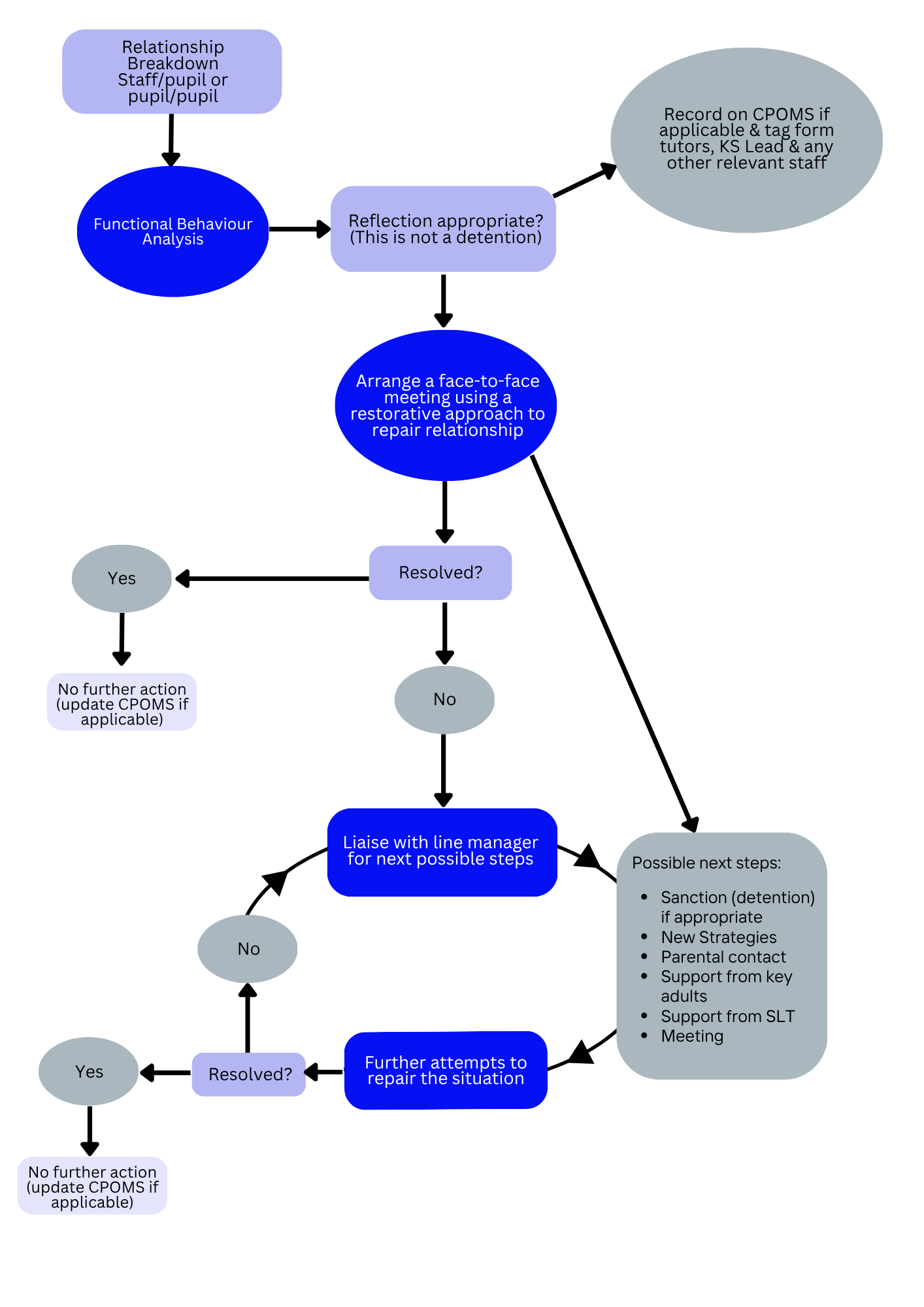
It is expected that staff will attempt to understand the behaviour (functional analysis) of pupils they work with and work towards improvements in the future. This may require support from Tutors, Key Stage Leads and Line Managers. Please see appendix 1 for details.
Restorative Practices
We believe a Restorative Approach is a fundamental component in helping our pupils resolve conflict, build social and communication skills and develop core values such as empathy, responsibility and truth telling. It is an alternative strategy to sanctions that are often recognised as ineffective for dysregulated pupils.
Restorative approaches are based on four key features:
- Respect – everyone listens to other opinions and value them
- Responsibility – taking responsibility for your own actions
- Repair - develop skills to identify solutions that repair harm
- Reintegration – working through a structured supported process that aims to reintegrate pupils back into the classroom.
All staff are trained to use restorative approaches.
Sanctions
The aim of the school’s system is to help pupils understand their behaviours and the consequences of them.
Staff have a shared responsibility for behaviour support and equal authority to prevent and deal with dysregulated pupils.
Sanctions should, wherever possible, be complemented by interventions and strategies to help prevent the emergence or escalation of dysregulated behaviour. Sanctions will be reasonable and proportionate to the circumstances of individual cases. Staff should encourage the justification of natural consequences of behaviour before issuing sanctions that may be less impactful and meaningful to the individual.
Account will be taken of an individual pupil’s age, special educational needs, any disability or any religious requirements affecting them. Consequences beyond the classroom include parental contact in person or by phone conversation. This may lead to a meeting being held with the child and staff member to support the relationship repair. Occasionally we isolate pupils in the Phoenix building, using the ground floor wellbeing room. Before this decision is made, the child, their family and key staff are informed. Typically, the time is used for catching up missed work and restorative practices. The child is always supervised with at least one to one adult support with a key adult who has a positive relationship with the child.
The school can issue suspensions and permanent exclusions but chooses to, only when other strategies have been exhausted. These can only be issued by the Headteacher or the most senior leader on site.
Anti-Bullying
Laleham Gap School take any form of bullying very seriously; we seek to ensure that bullying in any form does not happen. We are committed to providing a caring, safe and friendly environment for everyone.
Bullying incidents are infrequent, due to the very positive ethos, restorative approaches and a high level of care and support. We encourage our pupils to develop respect for each other and care for each other both in school and during out of school visits.
We take part as a whole school in the national anti-bullying week. The week involves assemblies, scenario role plays, Personal Development and Learning for Life input and online bullying focus.
More information regarding Anti-Bullying can be found in our Anti-Bullying Policy.
Targets and Record Keeping
Behaviour of pupils is closely monitored daily by all staff working with that pupil. Details of any specific incidents of dysregulated behaviour are shared with key staff. In addition, a record is made of any instance of dysregulated behaviour using CPOMS. Anything that represents a matter for concern is recorded via the school’s child protection system, from where it is distributed to all key staff on a need-to-know basis.
All physical interventions are recorded in accordance with the school’s positive handling policy. Child protection records and records of physical intervention are monitored by the school’s Lead DSL, SLT and the school governors.
Records of isolation, suspensions and exclusions are monitored by the Headteacher, who reports them to the FGB.
Referrals to outside agencies are monitored and reviewed by the Leadership Team.
For pupils with a history of dysregulated behaviour an Individual Support Plan may be compiled. These are overseen by the Lead DSL. Class teachers and Tutors and are always involved in their construction and review.
Positive Handling
Restrictive interventions, including use of reasonable force, in schools Guidance for schools in England April 2026, states:
Consideration for pupils with special educational needs and/or disabilities (SEND)
Some children and young people with SEND may react to distressing or confusing situations by displaying behaviours which may be harmful to themselves and others. Triggers may include pain, sensory overload, unfamiliar situations or environments or feelings of fear and anxiety. In particular, pupils who are non-verbal or find verbal communication challenging may express their needs, discomfort or confusion through actions. This can lead to pupils with SEND being disproportionately subject to the use of restrictive interventions.
Pupils who repeatedly exhibit dysregulated behaviours are discussed at meetings which involve all adults working closely with the pupil in question. The priority is to find the root of the behaviour to address it fully in the long term. Specific individualised behaviour support plans are devised in consultation with parents/carers and, where appropriate, the pupil, for inclusion in the pupil’s EHCP. All pupils that have had incidents resulting in a physical intervention will have an Individual Support Plan put in place. This is in line with the Restrain Reduction Network.
The school assesses risk to staff, in relation to pupil behaviour.
Staff will be trained in PROACT-SCIP-UK® (hereafter known as PROACT) by approved Kent PROACT Instructors. This approach is supported by Kent County Council and KsENT and will be used exclusively. Additional physical interventions, outside of the core audit based physical interventions may be used if deemed necessary and have been agreed following an Admin 68 request from the PROACT network, the Loddon and a PROACT principal instructor.
New Staff will receive PROACT training as part of their induction and all members of the school community will attend yearly refresher training.
Staff are not expected to put themselves in danger and, if necessary, it might be expedient to remove other pupils and themselves from risky situations.
Staff may experience physical injury – it is accepted that staff may need time and support to recover. Support may be offered by team members or Leadership.
The Governors, Leadership Team and PROACT team of the school will support the actions of staff in the use of physical intervention if they have been conducted in the context of this policy and the methods drawn from PROACT.
When intervention is necessary the following factors are important:
- Other techniques have been used first. All agreed strategies have been used, and it is agreed that there is no alternative other than to use a physical intervention.
- Physical Intervention is the last resort
- Only use the minimum intervention necessary, the least restrictive physical intervention should be used in line with the PROACT gradient.
- Only intervene for the length of time necessary All physical interventions should be for the least amount of time as possible.
- The incident and physical intervention must be recorded as soon as possible; best practice is to record the same day. Within 24 hours.
- Parents/Carers must be informed on the same day whenever an intervention has been used must be informed BEFORE the pupil returns home with details of any restrictive practices used to ensure any medical monitoring takes places due to risk of delayed asphyxiation.
A report of the incident emailed to parents should include the following details as a minimum:
- time, date, location and approximate duration of the intervention
- brief account of why the intervention was assessed as necessary in that instance
- brief account of what type of force was applied, and the degree of force
- details of any physical injuries sustained, if applicable
The use of any physical intervention is subject to stringent controls and the criterion for the use of such strategies is clearly detailed in our Positive Handling, Support and Intervention Policy.
Seclusion
Seclusion is a non-disciplinary intervention involving keeping a pupil confined to a place away from others and prevented from leaving - should only be used as a safety measure to protect others from harm when a pupil is experiencing high levels of emotional or behavioural dysregulation. In such circumstances, the pupil is not acting with intent.
Seclusion should not be implemented by staff through threat of punishment.
The place to which the pupil is confined should be safe and not feel threatening or intimidating to the pupil. The pupil should be supervised at all times during the period of seclusion. As soon as the immediate risk of harm has reduced, the pupil should be allowed to leave.
An incident involving the use of seclusion must be recorded and reported in the same way as a physical intervention.
Searches
Pupils, possessions and room searches may be required where failure to carry out the search might put at risk the welfare of others. Only a member of the Senior Leadership Team can authorise searching pupils while on school premises. Searches can be authorised if there is any suspicion that a pupil is in possession of a prohibited item, such as:
- Knives or weapons
- Alcohol
- Illegal drugs
- Stolen items
- Vapes or nicotine products including lighters
- Fireworks
- Pornographic images
- Any article that the member of staff reasonably suspects has been, or is likely to be used to commit an offence or to cause personal injury to, or damage to the property of, any person (including the pupil).
The pupil will always be asked for their consent for the search to be undertaken. However, if a pupil does not consent and there are reasonable grounds to suspect the pupil may have a prohibited item, pupil consent is not required. Searches will not be intrusive and the pupil’s privacy and dignity will be considered throughout the search process.
A CPOMS record will be made of any search and any outcome recorded. See Searching and Confiscation Policy for more details.
Serious Incidents
Can be dealt with by staff present but would always need to be reported to Leaders verbally and supported by a CPOMS record. Serious incidents include –
- Physical aggression to staff and pupils
- Physical aggression to property
- Health and safety issues including self-harm and self-injury
- Stealing
- Pupils leaving the premises
- Drugs
- Alcohol
- Vapes or nicotine products including lighters
- Bringing/using weapons in school
- Bullying including online aggression
Strictly Prohibited
- ‘Corporal punishment including slapping, throwing missiles and rough handling. Hold or restraint is permissible to avert an immediate danger of personal injury to the child or another person.’ In accordance with the School’s Physical Restraint Policy.
- Deprivation of food or drink.
- Force feeding of food or drink.
- Restriction of parental contact.
- Requirement to wear distinctive or inappropriate clothes.
- The use of or withholding of medication.
- The locking of a child in a single room at any time, even when accompanied by an adult.
Pupil phone use
- Primary pupils, year 7, 8 and 9 – Phones and devices are collected upon arrival.
- Year 7, 8 and 9 pupils may choose to keep their phones on them in locked pouches. Year 10 and 11 pupils may use their phones at breaks (not second break) but in their hub areas only. There will be no use of phones and devices during the first part of lunch to allow all students to interact while eating together.
- The second break (10:50 am) for the Secondary Age Phase, will be a phone and device free break to encourage all students to engage with others.
- From June 2026 there will be a phone ban for all pupils under 16 years of age.
- Post 16 will have individual arrangements to meet the needs of individuals and their independence training.
Refer to pupil acceptable use agreement for further details.
Excellent conduct and Work
Excellent conduct and work may be rewarded by:
- Verbal praise
- Showing work to others in the class
- Being chosen to do something
- Being allowed to choose to do something
- Earning an activity/prize for the whole group
- Sending the pupil to the Subject Leader or SLT with good work.
- Telephone call home
- Commendations / Postcards sent home
- Work displayed in a public place
- Good work/behaviour praised in assembly
- House system
- Certificates and trophies
- End of term prizes/activities
- Ultimate reward at the end of the school year
Primary Award System
The scheme is designed to reward and encourage positive relationships and to celebrate achievement.
- All pupils have a class Dojo and parents and carers are invited to join this online reward system. (Home school contact is also used via this system in most classes however some parents prefer to continue to use the original home school contact books)
- For every 10 Dojos a sticker is given.
- Each pupil has a sticker chart. Once a sticker chart is completed it is recorded in class and saved until Friday when they can choose a prize.
- At the end of the week, all sticker prizes are counted up and students choose from the sticker prizes that are displayed.
- There is a banking scheme where a pupil can save to choose a bigger prize.
- House captains are involved with the running and selecting prizes.
- A house point is awarded for every sticker prize, this is recorded in class and celebrated in the reward assembly on Friday.
- Dojos and stickers are awarded for good work or behaviour.
- There is no limit to how many Dojo/stickers a pupil can accrue.
- Postcards are sent home for exceptional work.
EYFS
EYFS Reward system is adapted to the individual class needs. Sticker prizes are kept in class and awarded instantly for pupils to take home.
Secondary Reward Scheme
- Adults must always be mindful of pupils whose work ethic and behaviour is always good and reward them accordingly. Two different types of reward points may be earned by pupils.
- 5 pence – a merit (max. 2 per lesson), pupils can earn points throughout the school day for good work, helping others, perseverance at a task etc. or at the discretion of the adult.
- 20 pence – a commendation, given less often to ensure the worth of earning the reward point. This would be for exceptional work, sustained effort, assistance to others or service to the school.
- These accumulated rewards can be traded for prizes.
- Adults giving a commendation reward need to ensure the reason it has been given is recorded clearly on Arbor.
- Commendation rewards will be acknowledged in assembly if the pupil is comfortable with this and a postcard sent home via the teaching assistant or the teacher who has given the commendation.
- Reward points cannot be taken away once given.
- Each merit and commendation has a financial value. Pupils save towards a reward.
- Pupils who are saving for a reward will have their names recorded and reward points added to when earned.
Post 16 Reward Scheme
Post 16 run a reward scheme that is linked to the Preparing for Adulthood Curriculum. Each student has 5 bespoke targets that they can get 20p a week for, totalling a possible £1 a week. They can also earn 20p for commendations for outstanding contributions. As this accumulates, students are supported to either save or spend this money on the various Post 16 trips we do. This supports the teaching of managing money.
This reward scheme runs alongside our daily check-ins with key-worker and twice-daily full meet-ups, where groups and individuals may be praised. This praise, where appropriate, is passed to parents / carers in an end-of-week email and to the whole school with assembly recognition.
Appendix 1 - Relationships Policy Flow Chart