
Laleham Gap School
Curriculum
Whole School Curriculum Overview
Curriculum Intent
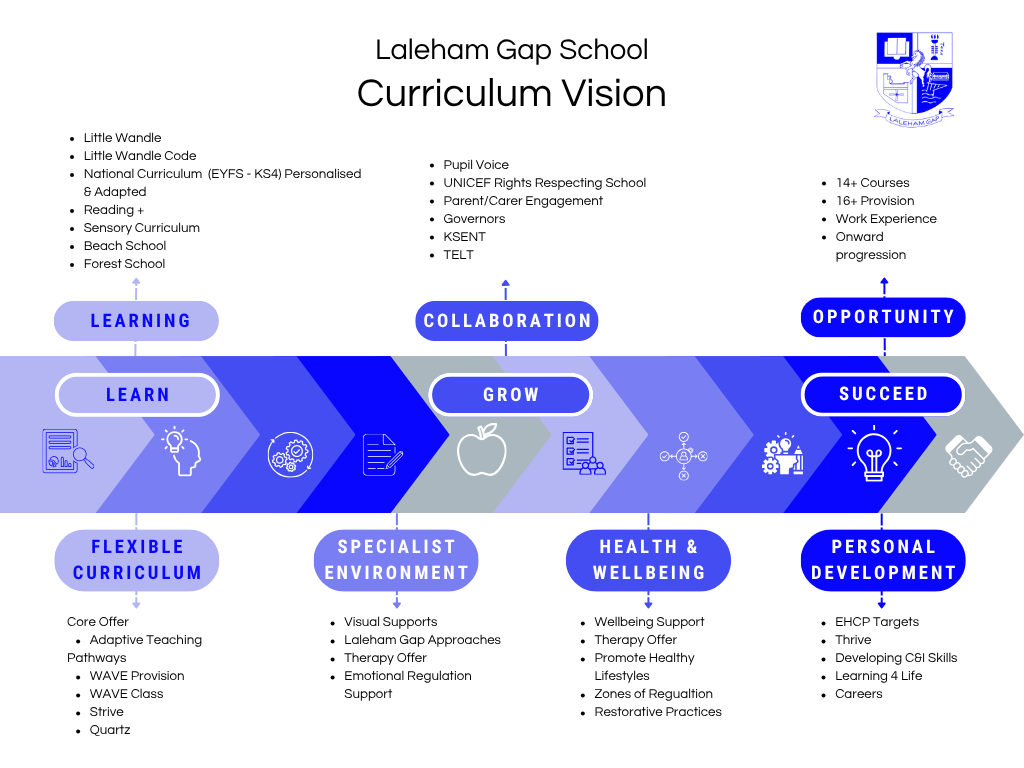
At Laleham Gap School, our intention is that our young people learn, grow and succeed to develop as independent, confident resilient learners with high aspirations in all areas of development, both academically and pastorally. Pupils at all stages are encouraged to achieve their potential. Our learners are stretched and challenged, being encouraged to expand their knowledge and skills through varied curriculum opportunities. Our curriculum is carefully designed to ensure coverage and progression. It provides pupils with memorable learning experiences, both inside and outside the classroom and is enriched at all levels to provide pupils with a range of transferable skills.
Curriculum leaders play an important part in the success of the curriculum by performing a central role in a regular programme of monitoring, evaluation and review. The design of the curriculum ensures that the needs of individuals and small groups of pupils can be met within the environment of high-quality teaching and learning, supported by targeted interventions to meet specific needs. Regular wellbeing meetings evaluate the impact of the interventions on pupil outcomes.
Primary
Most of our Primary pupils are working on Topics in line with Cornerstones which are adapted to meet the needs of the individuals and the current cohort. The topics offer an engaging starting point, as well as a broad and balanced curriculum, to encourage the love of learning with vast cross curricular links, using every opportunity to learn outside the classroom. Examples of this are Forest school, Beach school, using our local area and Inclusive Sport events.
We also use EQUALs Formal Curriculum to bridge the gap for our students who are working consistently and over time below age related expectations towards the National Curriculum. These strands include English, Maths, Independence, Outdoor Schooling, Physical Wellbeing, Play and Leisure and The World Around Me.
Maths, English and Science are usually taught discretely, with the students' individual needs at the forefront. White Rose helps to inform our Maths planning and provides sequential resources across Primary. Little Wandle is used to ensure consistent, high quality teaching of phonics and early reading for every child. This, as well as Cornerstones and our extensive reading activities in a discrete and consistent manner help students continue to grow a love of reading. All classes have a heavy focus on Learning for Life which is a PSHE based curriculum and Personal Development, encompassing personalised activities and interventions based on EHCPs.
TELT Moderation - occurs within our Primary department twice per academic year with our fellow Trust Partners. These result in group agreement for each of the core subjects from EYFS to Yr6. At each moderation attended, all judgments have been agreed by method of peer triangulation.
Secondary
Key Stage 3
We recognise that every child is an individual and the curriculum reflects that. Outside of the core curriculum offer, there are an array of opportunities available to ensure a well-rounded learning experience for all of our pupils; we constantly provide enhancement opportunities to further engage our young people. Pupils move into Key Stage 4 with the skills and confidence to access a wide range of curriculum opportunities.
Key Stage 4
Our aim is that pupils leave us at the end of Key Stage 4 with the skills, confidence and resilience to be able to transition successfully to further education, employment or training. To this end, we aspire to offer a curriculum in Key Stage 4 that is rich in terms of the experiences offered to our unique, individual pupils and provides opportunities for all pupils to be able to follow a program of study that meets their needs, interests and abilities.
Post-16
Our aim is to develop our pupils personally, socially and emotionally to prepare them for transition into four possible pathways:
- A further education college
- School sixth forms
- Preparation for Employment
- Alternative post 16 providers
Our Post 16 Provision aims to prepare a small cohort of existing Laleham Gap pupils who have been identified as being at risk of becoming Not in Employment, Education or Training (NEET) to be ready for one of the pathways identified above. East Kent has a wide range of post 16 education and employment opportunities. Many year 11’s at Laleham Gap School will move into post 16 provision with ease and find immediate success. However, some clearly will need more help and preparation in this transition. Our Post 16 provision aims to prepare students for a successful transition on an individual basis.
Implementation
In the Primary Department, we use the Cornerstones Curriculum to plan and deliver a rich, cross-curricular approach to teaching, with common themes running through each topic for each term. Pupils have the opportunity to access a wide range of texts through which to access their learning. We aim for pupils to have a ‘memorable experience’ within each term that is related to their topic which will engage and enthuse them through providing access to cultural experiences both inside and outside the school. Each topic also includes innovation challenges to provide a broad learning experience and to encourage them to become independent learners. The maths curriculum is taught separately. For our students who are not ready for the National Curriculum, we use the EQUAL’s formal pathway to ensure all of our learner’s needs are met. We regularly track pupil progress using formative assessment methods on Insight and Cornerstones to identify gaps in learning and inform planning. We have dedicated staff to provide interventions in the core curriculum areas for those pupils who require it.
Being 3-form entry, the Secondary Department has Curriculum leads for the core areas of Maths, English and Science who are on the Middle Leadership Team of the school. They lead the planning and delivery of their curriculum areas for their team of subject-specialist teachers. Other curriculum subjects are delivered by subject specialists who teach across the secondary department and maintain responsibility for the teaching and learning of their subjects.
The majority of our curriculum follows an adapted version of the National Curriculum, we also have designated lessons for Personal Development (Primary and Secondary)
During Personal Development lessons, pupils are taught by their class teachers (Primary) or form tutors (Secondary). During this time, they learn skills which are particularly relevant to them, according to their individual Provision Plans which are written in response to needs identified on their Education, Health and Care Plans.
All secondary pupils access ‘Learning for Life’ lessons which support the acquisition of essential social, emotional and communication skills that support them to thrive now and beyond LGS. Starting in Year 7, pupils learn a wide range of skills related to, and including, statutory PSHE content delivered in a bespoke SEN-friendly approach.
Our unique young people have a wide range of needs, interests and abilities. As such, our Key Stage 4 curriculum offer reflects that. We offer a variety of curriculum opportunities for our older learners. They include GCSE, BTEC, Entry Level and Functional Skills qualifications. Some of our pupils who are more academically able have the opportunity to achieve the highest GCSE grades, and do. Our Key Stage 4 curriculum offer is designed so that pupils who wish to study a full suite of GCSE subjects have the chance to do so, giving them the opportunity to attain the entrance grades for sixth form settings in mainstream schools. We also allow pupils the opportunity to work towards qualifications at the local Further Education College, preparing them for the transition into education, employment or training when they leave us. Pupils in Year 11 attend Work Experience placements, which are highly successful, giving them the opportunity to experience the world of work in preparation for later life.
To ensure consistency and accuracy of teacher assessment, teaching staff take part in a range of moderations activities. These include using nationally recognised assessments, taking part in nationwide comparative judgment activities, attending TELT and KsENT moderation events and in school moderation activities.
Our post-16 provision is designed to prepare a small cohort of pupils for transition into the next phase of their education. As every child is different, our post-16 offer is reflective of the needs of our pupils. The curriculum includes a continuation in their English and Maths education as required. However, the main focus is on their independence and the skills required to transition successfully from Laleham Gap School. We are offering a personalised, targeted transition from year 11 to support and help them gain access to these pathways.
The Phoenix building provides an excellent environment for independence and life skills training. Located at Ozengell Place, it provides a safe and stimulating learning environment where the students have continuing access to the full range of facilities and therapies Laleham Gap School offers.
The curriculum is led by the 14+ Lead, who works closely with other Laleham Gap school leaders. This ensures that the team benefits from extensive opportunities for professional development offered by Laleham Gap School and the Collaborative Learning Alliance of Special Schools.
Impact
In the Primary Department, we use Insight to assess pupil progress. A high proportion of our pupils make at least good progress, as can be seen in our progress report. As well as on-going formative assessment practices, we conduct pupil progress reviews across the school to ensure that we are aware of the academic progress of all of our pupils. We conduct learning walks, lesson observations and monitoring activities to ensure a high standard of planning, teaching, and learning.
Progress measures in the Secondary Department are subject-specific, allowing specialist teachers to plan and assess against national standards and prepare pupils for the Key Stage 4 curriculum offer that we provide. As far as academic measures are concerned, pupils at Laleham Gap School perform outstandingly well when compared to pupils attending similar provisions across the county and the country.
We are proud that our pupils leave us and are successful in the education, employment and training that they move on to when they leave us.
We enhance our Core offer with the following range of person-centred pathways designed to meet the needs of our most complex learners. These pathways are integrated with the Core curriculum, allowing learners to move between them to build on their strengths and pursue their interests. We limit the use of pathways to ensure that as many pupils as possible benefit from specialist teaching and to reduce the risk of curriculum narrowing.
Wave Provision (Whole School)
Intent
- Provide a safe introduction and transition to LGS for pupils whose Autism and anxiety significantly affect their ability to access the main school environment
- Maintain connection with school through a flexible, meaningful, and individualised structure that supports gradual, successful reintegration over time
- Nurture a sense of belonging for pupils experiencing Emotionally Based School Non-Attendance (EBSNA), ensuring they feel valued, understood, and supported.
Implementation
The Wave provision is a multi-functional, needs-led space offering an achievable blend of academic, wellbeing, and therapeutic activities. Its core purpose is to empower young people to engage, develop their potential, and work toward reintegration that feels safe, manageable, and sustainable.
- Pupils may attend individually or as part of a small cohort (2–3 pupils), depending on assessed need and suitability at the time
- The provision operates through a timetabled and dynamic model, with staff continuously assessing and reviewing pupils’ needs to deliver appropriate and effective support
- Each pupil receives a personalised timetable, reviewed termly with input from the young person and their family
- Communication across the school reinforces the overarching aim: supporting pupils with EBSNA through thoughtful and structured reintegration
The Wave room is designed to be warm, welcoming, and nurturing, mirroring aspects of the main site classrooms (tables, desks, computer screens) while also offering a calm, comfortable seating area for regulation and wellbeing.
Alongside academic and emotional support, pupils access personal development opportunities that align with targets identified in provision plans and ongoing dialogue with families.
Once a pupil is settled in the space, academic and emotional (Thrive) baseline assessments may be carried out to:
- Inform teaching staff of current levels and needs
- Support planning for an accessible, dignified, and appropriate reintegration pathway—whether into the Wave class next door, the Strive class, or the core school offer
We work closely with class teachers and tutors to:
- Co-design clear, realistic integration plans
- Manage communication around pupil readiness, needs, and academic positioning to ensure reintegration is well-paced and successful
Impact
The Wave provision aims to achieve the following long-term outcomes:
- Children learn, grow, and succeed in ways that are accessible, meaningful, and appropriately challenging within Laleham Gap
- Increased resilience, confidence, and self-esteem, empowering pupils to engage more fully with learning and school life
- Improved attendance and engagement, particularly for pupils who are non-attending due to emotionally based factors
- Greater whole-school awareness and understanding of EBSNA, leading to more effective, compassionate approaches across the school
- Strengthened trust and rapport with parents and carers, through consistent communication and collaborative planning
Wave Class (Secondary)
Intent
The Wave Class builds directly on the foundations established in the Wave Provision. After pupils have achieved stability, emotional regulation, and initial engagement in the smaller, highly individualised provision, the Wave Class aims to:
- Support pupils to transition from individualised, therapeutic engagement toward small-group learning, developing the skills needed for participation in a classroom environment
- Increase learning readiness, including acceptance for routine, directed tasks, and peer presence
- Develop personalised learning and wellbeing plans that help pupils engage more deeply and consistently with their academic progress
- Prepare pupils for reintegration into the Strive Class or the core school offer, ensuring the transition feels achievable, structured, and emotionally safe
Implementation
The Wave Class provides a structured, nurturing environment that bridges the gap between the Wave Provision and the expectations of Strive or the main school.
Progression from the Wave Provision
Pupils entering the Wave Class will typically have:
- Engaged positively with the Wave Provision on a personalised timetable
- Begun to re-establish routines and trust in school
- Reconnected with learning through bespoke academic and wellbeing tasks
The Wave Class builds on these strengths and gradually raises expectations in a supportive, predictable manner.
The Wave Class offers:
- A consistent, class-based setting
- Clear routines and structure similar to the main school
- Increased opportunities for peer interaction, cooperative learning, and social development
The Wave Class focusses on developing:
- Emotional resilience
- Independence skills, such as task initiation, organisation, and transitioning between activities
- Gradually increasing task duration and expectations this prepares pupils for the higher levels of independence and engagement required in Strive or the school’s core offer
- Regular communication with families provides updates and gathers feedback
- Class teachers from Strive or mainstream are gradually introduced to the pupil through visits, shared sessions, and joint planning, ensuring reintegration feels safe and predictable
Impact
- The Wave Class aims to deliver sustained, measurable improvements for pupils transitioning from the Wave Provision.
- Increased confidence and resilience demonstrated through greater participation and engagement in group-based learning
- Improved emotional regulation, enabling pupils to remain in the classroom and manage challenges more independently
- Stronger academic progress, supported by personalised plans and improved readiness to learn.
- Successful transition to Strive or the core school offer, with pupils feeling prepared, supported, and motivated
- Greater trust and confidence in the school, built through consistent communication and visible progress
- A clearer understanding of the pupil’s strengths, needs, and pathways, leading to improved collaboration with parents
- Increased attendance and engagement, particularly for pupils with EBSNA
- A more consistent, whole-school approach to understanding and addressing EBSNA, informed by the progression model from Wave Provision → Wave Class → Strive/Core
- A strengthened culture of early intervention, reducing long-term disengagement, and promoting meaningful reintegration
Strive class (Secondary)
Intent
- To design tailored provision plans that increase pupils’ engagement, participation and investment in their learning within a small-group setting, with opportunities for support from subject specialists
- To develop and refine strategies that enable pupils to successfully integrate into other classes across the school
- To provide a safe, nurturing environment where pupils can build their readiness to learn in specialist subject lessons
- To help pupils become motivated, confident learners who are enabled and prepared to access the school’s core curriculum offer
- To ensure all pupils are able to learn, grow and succeed in ways that are meaningful, accessible and appropriate to their individual needs
- To empower pupils by building their resilience, confidence and self-esteem
Implementation
- Develop personalised provision and support plans, informed by pupil voice, assessment and collaboration with staff and subject specialists
- Use targeted strategies and approaches that promote emotional regulation, readiness to learn and gradual exposure to the whole school environment
- Create a consistent, predictable, safe classroom culture that fosters trust, engagement and positive relationships
- Work closely with families to build rapport, maintain open communication and ensure a joined-up approach to supporting each pupil
- Provide professional development opportunities for staff to increase awareness, understanding and effective practice relating to Emotionally Based School Non-Attendance (EBSNA)
Impact
- Increased attendance and engagement for pupils who previously struggled to attend due to emotionally-based needs
- Improved learner confidence, resilience and emotional readiness, enabling successful transition into specialist subject
- Stronger partnerships with parents, leading to enhanced trust, communication and collaborative problem-solving
- Pupils feel safe, motivated and prepared to access the school’s full curriculum offer, making meaningful progress academically, socially and emotionally
Quartz Class (Primary)
A sensory-rich, relationship-focused learning journey where every child is understood, supported, and able to thrive.
Intent – Our Approach
Quartz Class offers a sensory-led, relationship-focused, personalised curriculum for pupils who benefit from individualised learning experience. Every child’s learning is shaped by their provision plan outcomes, ensuring teaching is meaningful, relevant, and directly connected to what they need to make progress.
We follow a multi-sensory curriculum that supports engagement, communication, regulation, and independence. A higher adult-to-pupil ratio to our core offer Primary class allows staff to provide calm, attuned, responsive support throughout the day. Approaches such as Intensive Interaction help develop early communication and connection, while specialist input from SALT, OT, and Educational Psychology is woven into everyday learning.
Although highly personalised, our curriculum remains aligned with the National Curriculum, Engagement Steps, and Primary Steps to ensure progress is monitored and celebrated.
Implementation – How We Teach
Learning in Quartz Class is delivered through sensory-rich, immersive experiences that follow a predictable structure each day. This helps pupils feel safe, calm, and ready to learn. Daily routines include:
- Sensory regulation routines
- Communication-focused sessions
- Exploration and discovery time
- Fine and gross motor development
- Calming and settling opportunities
Activities are adapted to each child’s sensory profile, communication needs, and provision plan outcomes. Lessons include tactile exploration, movement-based learning, visual supports, sound cues, and activities that build body awareness.
Specialist therapeutic strategies and Intensive Interaction are used to support communication, shared attention, and relational connection. Tasks are broken down into small, achievable steps so that every child can access learning meaningfully while still working toward National Curriculum expectations.
Impact – The Difference It Makes
Children in Quartz Class make progress in ways that are meaningful to them. We aim to see improvements in:
- Shared attention and interaction
- Emotional regulation and readiness to learn
- Independence in sensory exploration and daily routines
- Early communication skills
- Progress toward EHCP and provision plan outcomes
- Confidence, wellbeing, and feeling safe in school
Progress is tracked through Engagement Steps, Primary Steps, provision plan reviews and observations. Most importantly, pupils experience success, connection, and joy in learning, with a curriculum that celebrates their strengths and supports their needs.
Personal Development
At Laleham Gap School, we recognise that encouraging and supporting a young person's personal development is a crucial factor in their ability to enjoy learning and to achieve. As such, we aim to provide an environment and opportunities that enable children to explore and develop spiritually, morally, socially and culturally.
Personal Development lessons help children to go beyond the acquisition of knowledge. They are led by the class teacher/tutor and include Careers Education and the opportunity to learn and rehearse meaningful Life Skills. Some sessions are supported by specialists such as RNLI, Drama Companies, Emergency Services Education Officers, Forest/Beach School Leaders, NHS specialists, Career Advisors etc.
Personal and interpersonal skills and abilities underpin success in all aspects of life. It is important that children’s self-esteem and self-confidence are explicitly fostered, along with the ability to understand and manage their own emotions and to interact effectively with others.
All pupils are actively encouraged to:
- Develop positive relationships with staff and pupils in their tutor/class groups
- Consider, and own, their own interests and priorities
- Support their peers with their targets and interests
- Work towards individual targets through learning experiences – including Learning Outside the Classroom
- Nurture a Growth Mindset
- Work towards trying and mastering Personal and Life Skills
- Develop their self-awareness and self-care
If you have any questions regarding our curriculum please contact us.